Germany's Yuyuan Garden Anchors 40 Years of Shanghai-Hamburg Ties
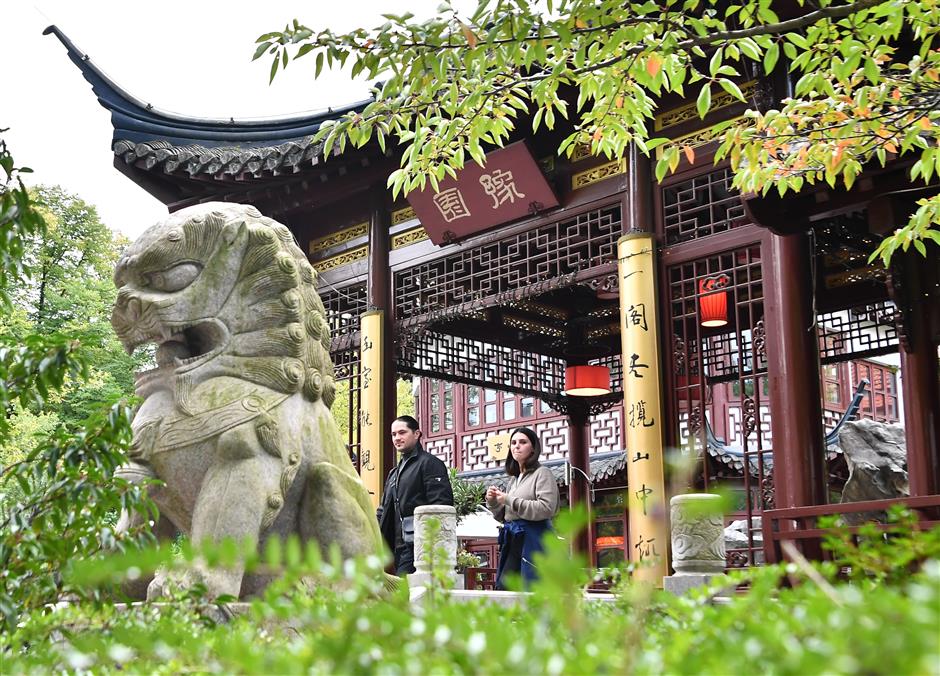
A white moon gate and a zigzag stone bridge sit quietly on a street in Hamburg, offering visitors an escape to China.
This is the Hamburg Yuyuan Garden, which is under the spotlight as Shanghai and Hamburg celebrate 40 years of sister-city ties this year.
The venue covers a 3,400-square-meter plot of land, equivalent to about half of a standard football pitch.
Shanghai and Hamburg established their official sister-city relationship in 1986. The garden welcomed its first visitors in September 2008.
"Absolutely love Yuyuan Garden. It feels like a little escape to China right in the city," said Roya K, an international visitor who reviewed the Hamburg garden online.
"It is a calm, relaxing spot with great service, perfect for a quiet lunch or just soaking in the atmosphere."
The garden fits into a decades-long partnership between the two major port cities. The Hamburg government provided a free plot of land behind the local ethnology museum in 2006, while the Shanghai government led the development to create a permanent intercultural meeting place.
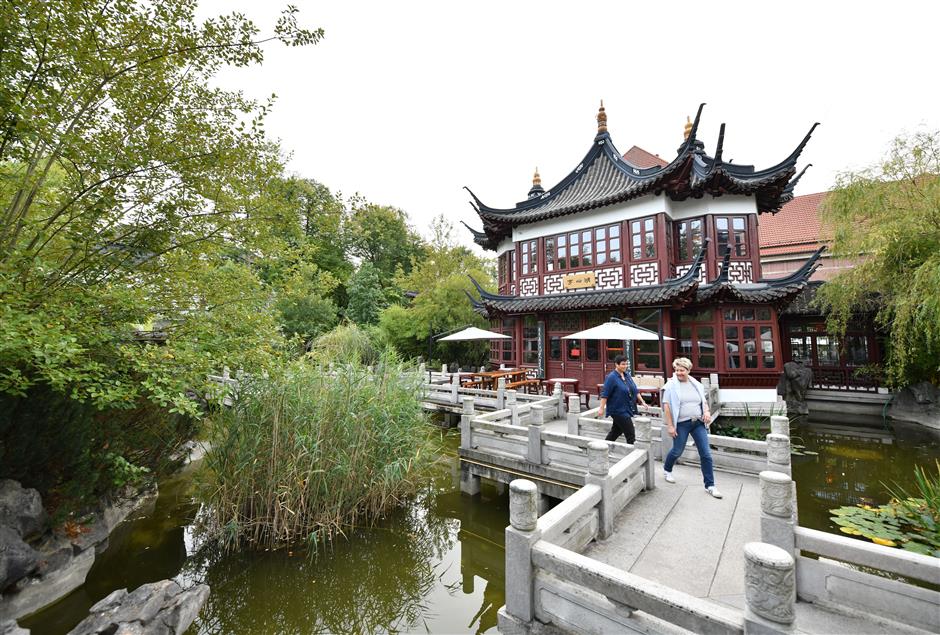
Local residents use the space to experience Chinese daily life. Another visitor, Philip, ordered a hot and spicy beef platter at the garden restaurant.
"A fantastic place to have proper authentic Chinese cuisine," Philip said. "Staff was mindfully double-checking if we could cope with the food, and we loved it. Service was super quick and attentive."
Other diners choose the location for large holiday events. Hamburg resident Jessica hosted a group dinner at the garden restaurant recently.
"Best restaurant ever," Jessica said. "Super accommodating even though we added a few people at the last minute. The garden makes our Chinese New Year celebration a great success."
Managers of the property said that the garden's downtown location aims to bring real Chinese lifestyle aesthetics to European citizens in a tangible way.
"The Hamburg Yuyuan Garden is not a simple copy of Shanghai, but an Oriental garden that has grown anew in the German environment," said Hu Junjie, vice president and spokesperson of Yuyuan Inc.
The design team included the Suzhou Garden Architecture Institute and the China Zhenjiang International Economic and Technical Cooperation Corporation.
The builders used the original Yuyuan Garden in Shanghai as a strict template. They constructed a Mid-Lake Pavilion, Zigzag Bridge, and the Lubolang Restaurant.
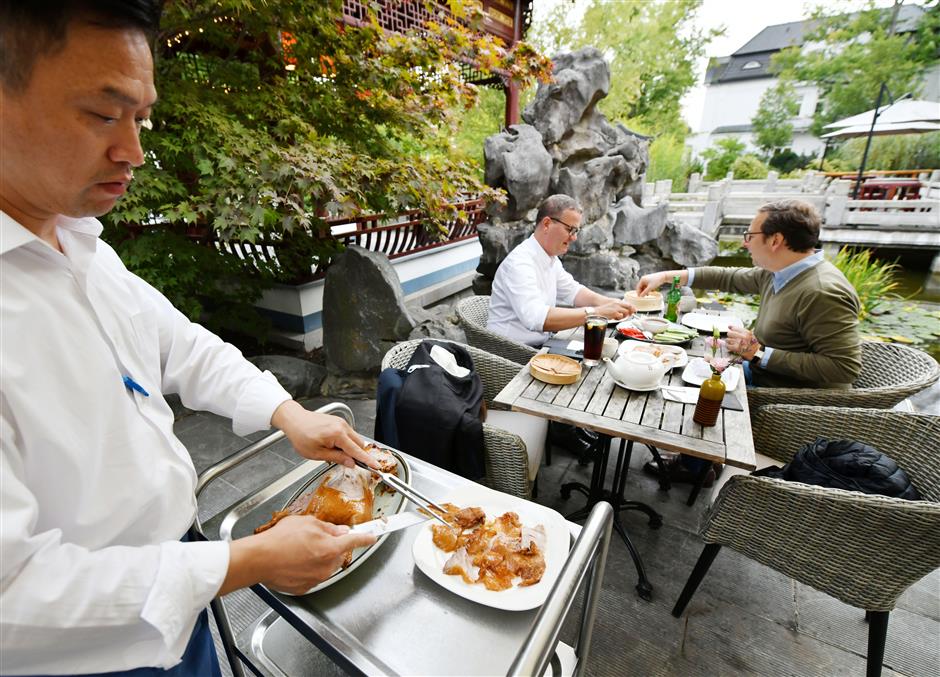
The architects have adjusted the layout to align with local European preferences. For example, traditional Chinese gardens typically use high walls to enclose the scenery, whereas European parks favor an open layout.
The designers have integrated modern Western landscape concepts into the plan by removing the traditional outer walls, thereby revealing the interior scenery to the public.
A large artificial lake has been placed on the southeast side facing the street, providing a public viewing area for city residents.
To minimize noise disturbance to neighboring homes, the restaurant dining rooms and kitchens have been relocated to the northwest side of the property.
The west side of the complex features an archway and an underground garage lane, along with a small courtyard, a long roofed corridor, and a tracery wall.
The structures create a traditional Chinese backdrop while gently defining the boundary with the adjacent museum.
The environmental design employs traditional Suzhou gardening methods, with a layout that creates natural twists and turns along the walking paths, allowing the scenery to change with each step. Small, scattered courtyards connect with one another, producing rich spatial effects.
The construction process required Chinese and German engineers to reconcile differing building standards. Traditional Chinese wooden buildings rely on mortise and tenon joints, a method that conflicts with modern German building codes.
To comply with local laws, the engineering teams developed a hybrid solution. The underground garage was constructed using reinforced concrete, while the ground-level structures were built with traditional Chinese wooden components. Specially designed nodes connect the wooden structures to the concrete foundation.
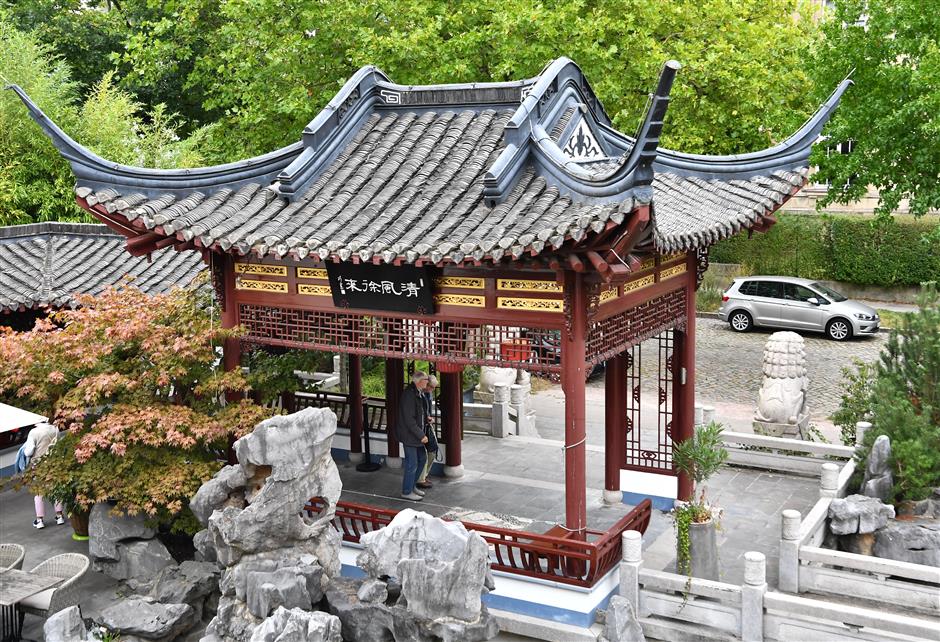
Workers also adapted the buildings to withstand the cold and damp coastal winters in northern Germany. They installed German thermal insulation materials inside the wooden walls. They also fitted custom wooden doors and windows to increase airtightness.
However, the ecological environment of Hamburg has forced unexpected changes to the landscape design.
Builders dug a shallow artificial pond to maintain the visual proportions of the Zigzag Bridge, but the local fishing association prohibited raising live fish in the shallow water.
They said the abundant local seagulls would easily eat the exposed fish, so the garden currently operates the pond without live fish.
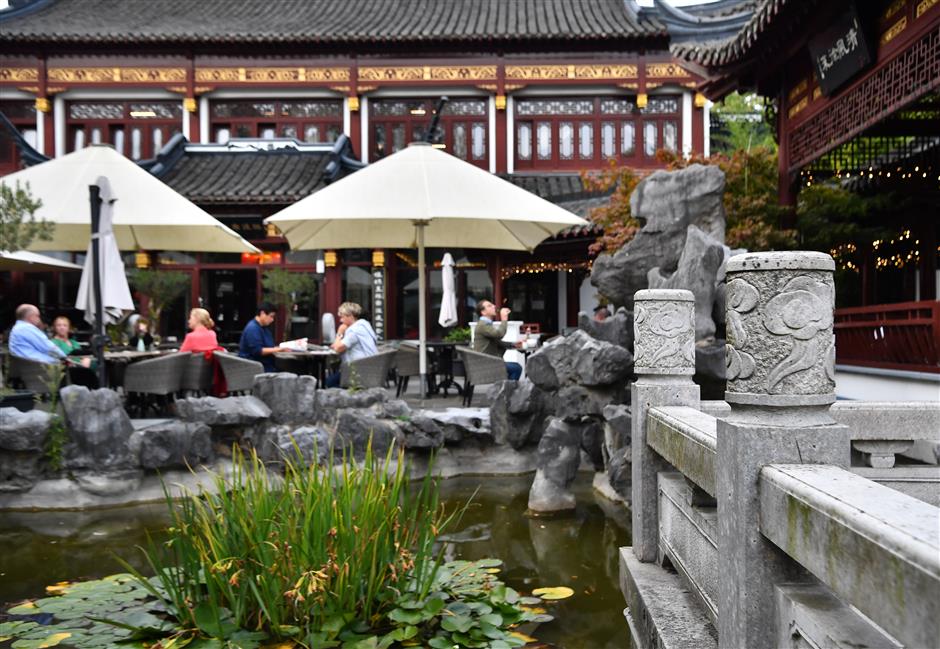
Today, the complex functions as a commercial and educational venue. The center includes a multi-functional cultural house. Organizers hold lectures, art exhibitions, and Chinese folk art performances in this space.
When night falls, traditional music drifts from the Mid-Lake Pavilion. Visitors drink tea in the courtyard. The atmosphere brings the poetic beauty of southern China directly to tourists in Hamburg.
Hamburg University uses the garden for East Asian studies classes. Nearby secondary schools organize field trips for students to visit the site. German couples frequently book the venue for traditional Chinese-style weddings.
"The tea at the Mid-Lake Pavilion, the scenery of the Zigzag Bridge, and the dishes at the Lubolang Restaurant are not cold exhibits, but the vivid daily life of Shanghai," Hu said.
Early this year, the China Media Group hosted its global Spring Festival broadcast at the garden. Organizers lit the entire complex in red lighting to celebrate the Chinese New Year. The illuminated garden served as a visual symbol of the anniversary between the two cities.
The two cities have exchanged architectural landmarks over the years. Shanghai retained the Hamburg House after the World Expo 2010 Shanghai.
The Hamburg House passes on German industrial aesthetics and energy conservation, while the Yuyuan Garden passes on Chinese artistic expression and lifestyle aesthetics.
"This natural goodwill, built on aesthetics and lifestyle, is often the most authentic and lasting connection between people," Hu said.
Editor: Liu Qi