China, Asian Stocks Whipsawed by Tech-Fueled Global Volatility
Chinese and other Asian markets roiled by volatility in global stocks plunged on Friday after a big selloff on Wall Street a day earlier. However, New York markets rebounded on Friday, perhaps lending some recovery hopes for Asian markets when they reopen on Monday.
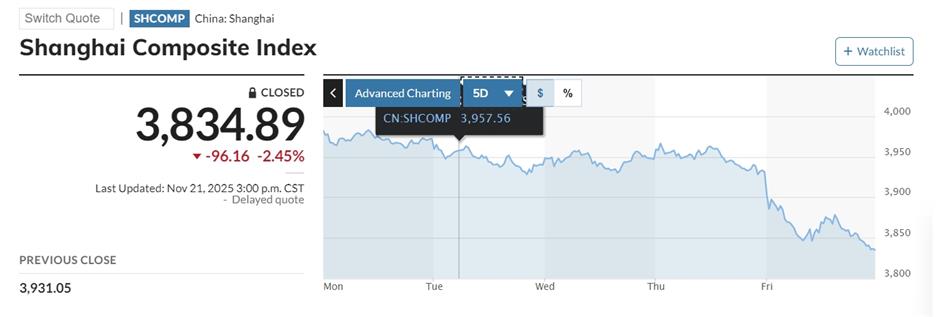
The Shanghai Composite Index lost 3.9 percent this week after plunging 2.45 percent on Friday to end at 3,834 points. The performance was a bit more resilient than smaller exchanges in Shenzhen. The Shenzhen Component Index concluded the week with a slump of 5.1 percent after falling 3.4 percent on Friday, while the tech startup ChiNext lost 4 percent.
Global market volatility has been fed by concerns about overvaluation of technology stocks, particularly those associated with artificial intelligence (AI). Across Chinese markets, 354 shares rose on Friday and 5,072 fell, including lithium battery maker Canmax, new materials producer Guangdong Fangyuan and electric motor maker Jiangte Motor.
"The Chinese stock market suffered continued losses for the week, led by lithium-related shares and storage chips," said Yan Guicheng, an analyst with China Securities. "Although tech companies were not among the worst performers, they also joined the group of losers and slid by a big margin."
Earnings reports from Chinese companies did little to lift sentiment this week. Baidu, China's largest Internet search engine provider and emerging leader in robotaxis, reported its AI-related business delivered strong growth in the third quarter with revenue more than doubling, though the company reported a loss of 11.2 billion yuan (US$1.58 billion) due to increased technology investment and a drop in ad revenue.
Hangzhou-based NetEase, a global leader in Internet and mobile video games, posted third-quarter revenue of 28.4 billion yuan, up 8.2 percent from a year earlier. Net income rose by nearly a third to 8.6 billion yuan.
"Although facing temporary adjustment, AI is a long-term business sector and there is no change in the trend of global tech giants accelerating investment in AI," Yan said.
On Thursday, chip giant Nvidia released third-quarter earnings that beat expectations and Chief Executive Jensen Huang rejected talk of an AI bubble. A rally triggered by the results lasted barely 24 hours. Sundar Pichai, chief of Google parent Alphabet, told the BBC this week that if the bubble in AI bursts, no company in the industry will escape unscathed.
For the week, Hong Kong's Hang Seng Index lost 5 percent in its worst five days of trading since April. Japan's Nikkei fell 3.5 percent, and South Korea's Kospi shed nearly 4 percent.
In New York overnight, the tech-heavy Nasdaq pared back intraday losses to close up 0.9 percent but ended 2.7 percent lower for the week. The S&P 500 and Dow finished the week down about 2 percent. The Stoxx600 in Europe dropped 0.3 percent on Friday. Bitcoin, a barometer of risk sentiment, was down 2.4 percent in late New York trading, tumbling below US$85,000 and continuing its decline to April levels.
Editor: Lu Feiran