Suffering Insomnia? Consult a Chatbot: AI As a Front Door to Healthcare
When retired teacher Yang Guofang couldn't sleep one night last month, she turned to artificial intelligence for help. Within seconds, a health-assistant chatbot asked about her stress levels and other recent health symptoms, then suggested ways to manage anxiety and when to seek medical care.
Similar exchanges now take place more than 10 million times a day on Ant Group's AI health app Afu, which was launched late last year and now has more than 30 million monthly active users.
The surge reflects how China's boom in consumer-related AI has spilled into healthcare, with technology companies racing to turn AI assistants into the next digital gateway after payments and e-commerce.
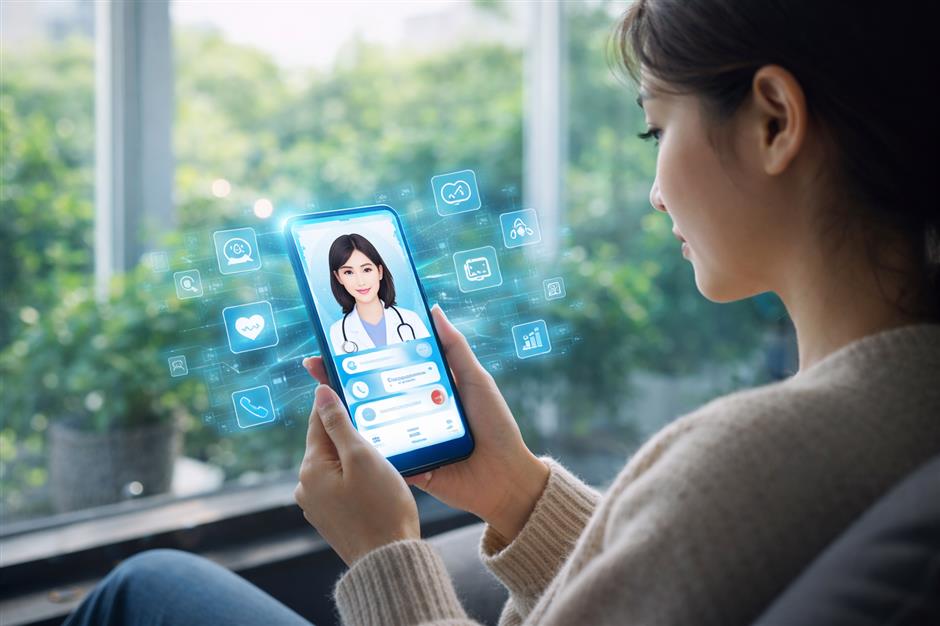
"The rapid adoption of AI health assistants reflects a widening gap between medical demand and numbers of available doctors," said Hungarian genomics professor Bertalan Meskó, director of The Medical Futurist Institute.
"Healthcare is facing a basic math problem," he said, citing World Health Organization estimates that the world currently lacks about 5 million healthcare workers, a shortage projected to reach 10 million by 2030. "Demand for care is outpacing our ability to supply it."
Large language models may help fill part of that gap by answering basic health questions and guiding patients when access to physicians is limited, he added.
China's healthcare system offers a clear example of that imbalance. Large hospitals remain crowded while primary care clinics are unevenly distributed, particularly in smaller cities.
"Many users turn to Afu not for formal diagnoses but for everyday health questions," said Ant Group.
The app now has more than 100 million registered users, with more than a half coming from smaller cities.
"This, to some extent, shows that in areas where high-quality medical resources are relatively limited, people have a stronger demand for health services, and that is where we see the value of AI," the company said.
Afu is connected to more than 5,000 hospitals and about 300,000 physicians, allowing users to book appointments, consult doctors online and purchase medication through the platform, according to Ant Group.
The service also integrates insurance reimbursement and pharmacy delivery, reflecting how technology companies are attempting to build full healthcare ecosystems around AI assistants.
Ant is not alone in this sector.
China's AI healthcare market is quickly becoming crowded, with major technology companies rolling out their own digital health assistants.
Baidu has introduced its Wenxin Health Assistant, powered by its Ernie large language model, positioning it as a 24-hour "family doctor." The service combines AI-generated recommendations with follow-up verification from human physicians. It even joins group chats to answer medical questions when relevant topics arise.
ByteDance launched its Xiaohe AI Doctor in mid-2025, offering features such as symptom checking, medication guidance and medical report interpretation. The app emphasizes ease of use, allowing users to upload lab results or scan drug packaging to receive instant explanations.
IFlytek's Xiaoyi Health Assistant, built on its Spark medical model, targets multiple stages of care, from pre-diagnosis to post-treatment, supported by a large database of medical knowledge.
JD Health has also rolled out AI-driven services integrated into its broader healthcare ecosystem, linking online consultations with drug delivery and at-home testing, backed by its in-house medical model.
The trend extends beyond China. OpenAI in January launched ChatGPT Health, a version of its chatbot designed to integrate with electronic health records and consumer health data, though the service is currently available only to a limited group of users in the US.
All these consultations are free, which highlights a central dilemma of the industry: If AI becomes the front door to healthcare, who ultimately pays for it?
One potential payer is the government.
China's healthcare authorities have begun to incorporate artificial intelligence into the pricing system. In late 2025, the National Healthcare Security Administration included "AI-assisted diagnosis" in its official catalogue of billable medical services, allowing hospitals to seek reimbursement for eligible AI-supported procedures.
"Afu will continue to prioritize broad access to healthcare services," Han Xinyi, chief executive of Ant Group, told a healthcare conference in January. "Basic health Q&A services will remain free, and any future business model will be designed with affordability in mind."
Rather than replacing doctors, most of these healthcare platforms position AI as a first layer of triage – answering routine health questions and directing users toward medical services when necessary.
That role also underpins their business model, with companies betting revenue will come later through hospitals, insurance systems and medical spending routed through these platforms.
Ant Group said its health services were initially developed within Alipay, its mobile payments platform, where users could access hospital registration and digital medical insurance payments. Those capabilities have since been integrated into Afu, allowing users to pay for treatment through public insurance or claim reimbursement from commercial insurers.
The model points to another potential payer, with AI assistants serving as entry points while revenue is generated through insurance, payments and downstream healthcare services.
"We are not focused on commercialization for now," Ant Group said. "Afu is still in its early stages. For now, our priority is to keep improving the product and user experience."
As long as the user base grows and engagement remains strong, the business model will follow. This approach reflects a broader industry strategy: Build scale first; figure out how to monetize later.
The shift is also reshaping how investors view the sector.
Hillhouse Capital said it is focusing only on AI healthcare companies that can integrate into public insurance payment systems or demonstrate clear commercial value.
"In the past, we looked at technical performance. Now we look at hospital procurement contracts and insurance settlement records," said Zhou Kui, a partner at Sequoia Capital.
This model, however, depends heavily on data and raises questions about how it is used.
AI health assistants collect some of the most sensitive forms of personal data, including medical records, medication history and daily health metrics such as sleep and heart rate.
As companies explore closer links between health services, payments and insurance, concerns are growing over whether such data could be used to influence pricing, underwriting or claims decisions.
Ant Group said user data is stored in isolation and will not be shared with third parties without explicit user consent.
"Data security is a core principle, and information is used only when users authorize it for specific services," the company said.
For now, users like Yang are embracing the convenience.
But as AI health assistants move from answering simple questions to shaping real medical and financial decisions, the industry's future may hinge not on how many users it can attract, but on whether it can balance access, trust and accountability.
Editor: Liu Qi
In Case You Missed It...

 Mar 16, 2026