Five-Star Review, Made of Red Velvet: How a Chinese Thank-You is Going Global
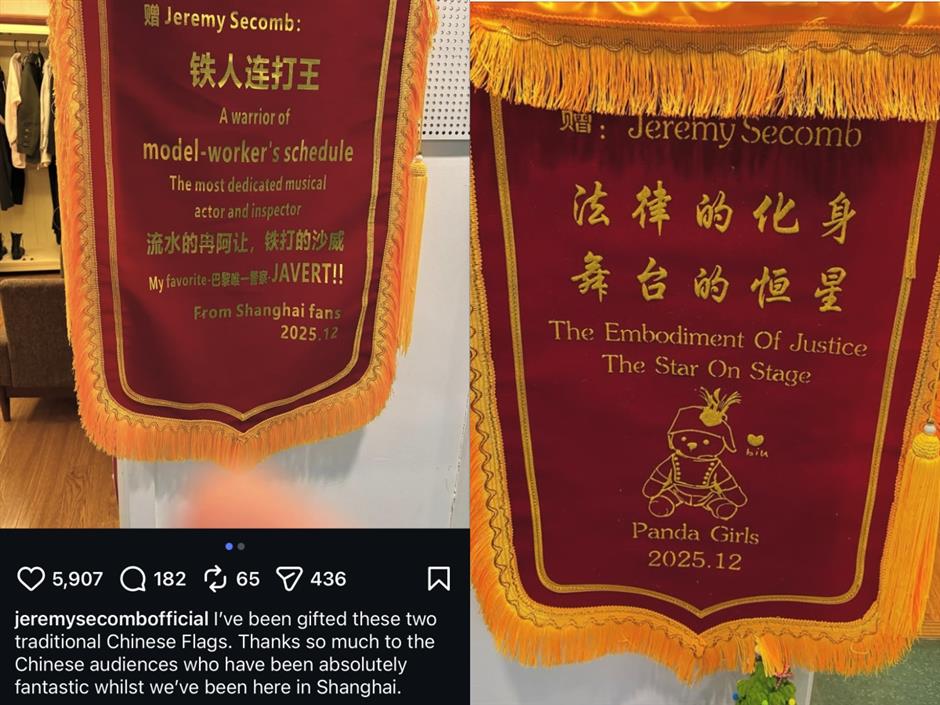
When "Les Misérables" took the stage in Shanghai recently, British actor Jeremy Secomb who portrayed Inspector Javert was presented by audience with two red banners, a typical Chinese way of expressing heartfelt gratitude or respect.
One featured playful bilingual wording:
"A warrior of a model worker's schedule. The most dedicated musical actor and inspector. My favorite – Paris' only policeman – Javert!!"
The other struck a more solemn tone:
"The Embodiment of Justice. The Star on Stage."
The latter, including a cartoon portrait of Secomb and was signed "Panda Girls," joined its counterpart in winning over the actor. Secomb later hung the banners outside his dressing room for the rest of the show's run and shared photos of the pair on Instagram, which quickly racked up thousands of likes.
Secomb is far from the first foreigner to go viral for receiving a Chinese banner.
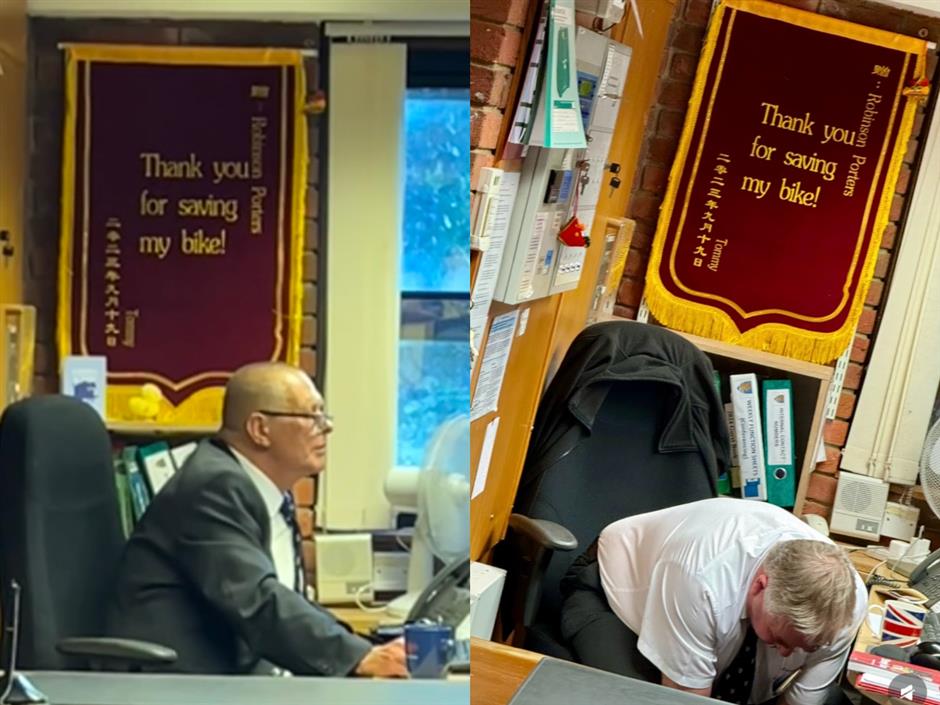
Cambridge, too, had become the focus of online buzz in China, not for its centuries-old colleges or the romantic imagery immortalized by Chinese poet Xu Zhimo (1897-1931), but for a red banner hanging inside the porter's lodge at Robinson College.
In China, such banners, known as jinqi (锦旗), are a common sight in public service settings such as hospitals and police stations. Inside a British university lodge, however, it stands as a delightful rarity.
A bike saved, a banner earned
In an interview shared on Xiaohongshu, or RedNote, a porter at Robinson College recalled that a Chinese student named Tommy gifted the banner back in 2023.
The campus conducts regular checks for unmarked or abandoned bicycles, which are subsequently donated to charity.
"We think his bike didn't have a number," the porter explained, "but we managed to identify it as his. So it survived."
To thank the lodge for retrieving his beloved bike, Tommy presented them with a banner emblazoned with "Thank you for saving my bike!"
The story rocketed to widespread attention after a photo went viral on social media: a porter seated at his desk, with the red banner hung prominently on the wall behind him.
Netizens playfully speculated about the "extraordinary good deed" the porter must have pulled off to merit such a public display of gratitude.
Now, Chinese tourists visiting Cambridge go out of their way to stop by Robinson College, all to catch an in-person glimpse of the banner and snap new photos to share across their social media platforms.
From Cambridge to the world
What started as a small gesture in a university lodge has since resonated across borders, with jinqi popping up in unexpected corners of the globe.
On August 13 last year, New Zealand's Auckland City District Police shared a photo on Facebook that quickly racked up thousands of likes.

In the image, several police officers stand alongside a father and his son, who hold a red Chinese pendant. The caption reads, "We always get a boost from an appreciative email, phone call, or a face-to-face message, but one family has taken 'thank you' to the next level by presenting staff with a giant pendant."
The pendant reads: "Courageous and professional. Lightning-fast actions. Dedicated and warm service. Protecting our communities."
The police explained that while the family was overseas, they received multiple security alerts from their home in Mount Wellington. Officers promptly responded to each call and verified that there were no signs of intrusion or damage. Upon their return, the family brought the pendant to the police station to show their appreciation.
"It's our pleasure and we love the pendant!" the police commented.
Online reactions were quick and positive. Some referred to it as "the highest form of gratitude in Chinese culture," while others called it "a thoughtful way to express appreciation."
Half a world away in Milan, Italy, another jinqi moment unfolded on March 15, 2025. Three Chinese students were riding the metro when a thief snatched one's mobile phone as the train doors slid shut. Transport security staff from Milan's public transport operator (ATM) later recovered the device.
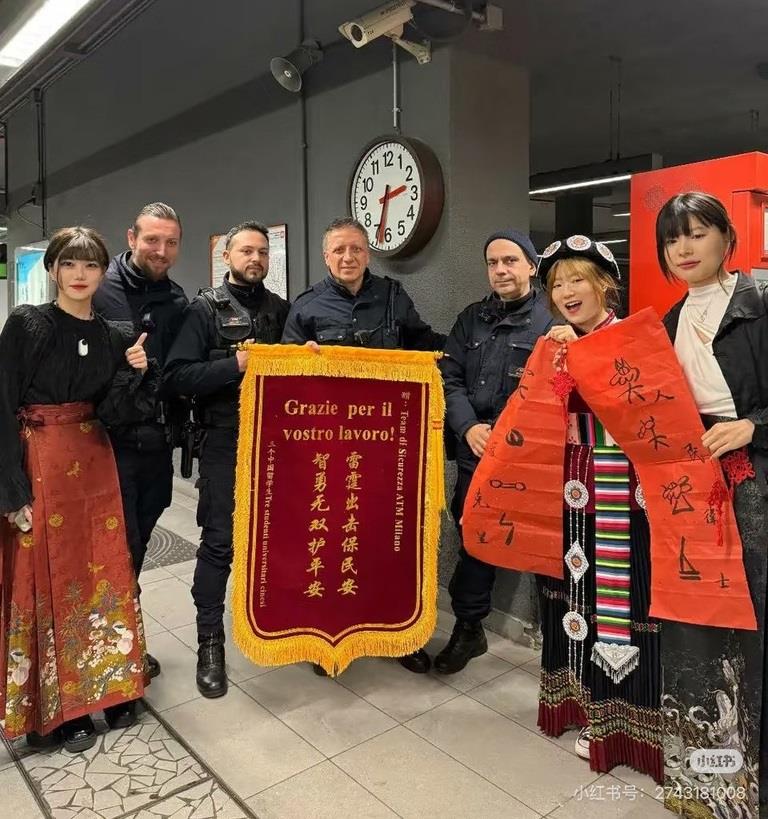
Days later, the students, dressed in traditional Chinese attire, returned to the scene to thank the transport staff and presented them with a custom red banner.
The banner carried a bilingual message in Italian and Chinese:
"Grazie per il vostro lavoro" – "Thank you for your work."
The Italian local outlet Milano Today later reported on the cross-cultural gesture.
According to posts on RedNote, the student first consulted Italian friends to ensure the wording was appropriate, then had the banner custom-made in China and sent overseas.
Making gratitude visible
In China, banners are formal and visible gestures of gratitude, not casual props or offhand thank-yous.
Rooted in ancient military pennants used to commend merit and valor, these banners gradually made their way into civilian life. Today, they are most often gifted to doctors, teachers, police officers and others whose work serves the public good.
Unlike private gifts or handwritten notes, banners are crafted to be displayed. When hung on walls, they transform gratitude into something visible, collective, and enduring.
The banners follow a standard format. Typically made of red velvet, they feature gold lettering applied through heat-transfer or gilding techniques. The text usually includes the recipient's name, a message of thanks, and the giver's name and date.
When banners are brought overseas, they are typically custom-made in China before being carried or sent abroad for a specific recipient.
People are becoming increasingly aware of this practice.
After receiving a banner from her team, Susan, a rowing coach at Tsinghua University, posted a TikTok video introducing the tradition to her followers. She described it simply as: "A five-star review in China."

If appreciation is genuine in China, she explained, it does not stop at a review or a thumbs-up. It becomes something tangible – something you can hang on a wall.
Her comment section were quickly filled with responses.
One viewer noted that many Chinese international students give banners to professors at graduation, often half-jokingly inscribed with messages like "Thank you for not failing me."
Another wrote that receiving a banner mattered more than any other form of thanks because it usually meant someone had helped with something significant.
What makes jinqi such a powerful cross-cultural gesture is its simplicity: unlike gifts that may spark questions about appropriateness or obligation, banners involve no money, no favors, just pure appreciation. In Auckland, Milan and Cambridge, institutions embraced them as heartfelt tokens of thanks, hanging them proudly for all to see.
Back in Cambridge, the banner still hangs in the porter's lodge. As more universities, police stations, and organizations around the world welcome these red velvet banners onto their walls, jinqi remains true to its essence – exactly what it has always been in China: a five-star review, crafted to be seen, cherished, and shared across cultures.