Why Digital Nomads Are Beginning to Look at Shanghai
As remote work loosens the tie between jobs and fixed offices, cities around the world are competing to attract digital nomads – professionals who work online and choose where to live with a laptop rather than a contract.
Shanghai rarely frames itself as part of that race. Yet for Zhou Mo, a community organizer who has spent the past few years moving between China and global digital nomad hubs, the city's appeal has become increasingly evident.
Zhou left Shanghai in 2022, when working remotely made location feel optional. She moved to Dali in southwest China's Yunnan Province and then to Chiang Mai in northern Thailand, places long familiar to digital nomads for low living expenses and a leisure vibe.
Over the next three years, she helped organize China's first digital nomad conferences and built cross-border communities among designers, programmers and content creators who move between cities while working on projects.
"Most people pursue stability," she said. "Only a small group dares to move. And those people are often the most creative."
Returning to Shanghai recently, Zhou has been spending less time in office towers and more time in neighborhoods. She focused more on the transformation of former factories, warehouses, and community facilities into areas where work and daily life intersect.
For her, these everyday places explain why Shanghai is quietly becoming attractive to the highly mobile group.

The term "digital nomad" was coined in the late 1990s, but the lifestyle only became viable at scale in the past decade, as cloud tools, online platforms and remote collaborations matured.
After the COVID pandemic normalized working from anywhere, the number of digital nomads worldwide grew rapidly, prompting many cities to court them openly.
In China, many digital nomads are freelancers or independent creators working across platforms, managing multiple income streams, and moving between cities without formal relocation. Rather than constant travel, many stay put for weeks or months, forming temporary routines.
What they need, Zhou said, is not novelty, but access to space, services, and a sense of normal life.
In Jing'an District, where Zhou lives, former industrial buildings have been converted into mixed-use neighborhood spaces.
Along Suzhou Creek, warehouses that were once used for storage now host exhibitions, reading rooms, and long communal tables where people work quietly during the day. These places are neither offices nor cafés, and they do not require membership.
"You don't feel like you're borrowing a space," Zhou said. "You feel like you're using it."
Shi Yu, the vice director of Jing'an, described the challenge of creating spaces that can serve both community residents and people drawn by new industries.
The key, she said, lies in adaptability – ensuring that urban spaces can respond to changing patterns of work and life rather than being locked into single uses.
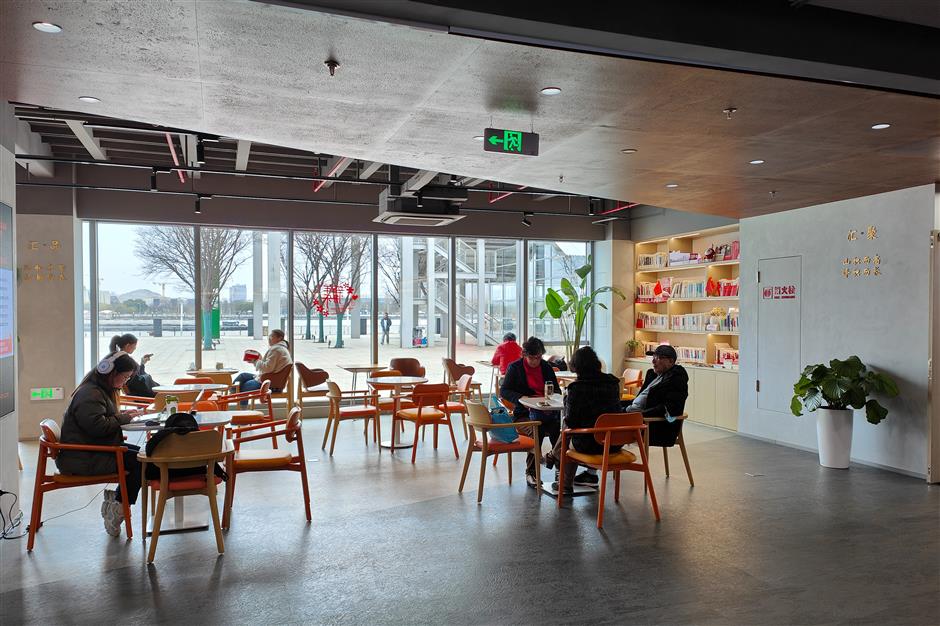
For Ding Xiaoyi, a freelancer who stopped working full-time two years ago, finding places to work without pressure became a habit.
"I've basically built my own map of free workspaces in Shanghai," he said.
One of his regular stops is the Hunan Road Subdistrict Community Service Center in Xuhui District.
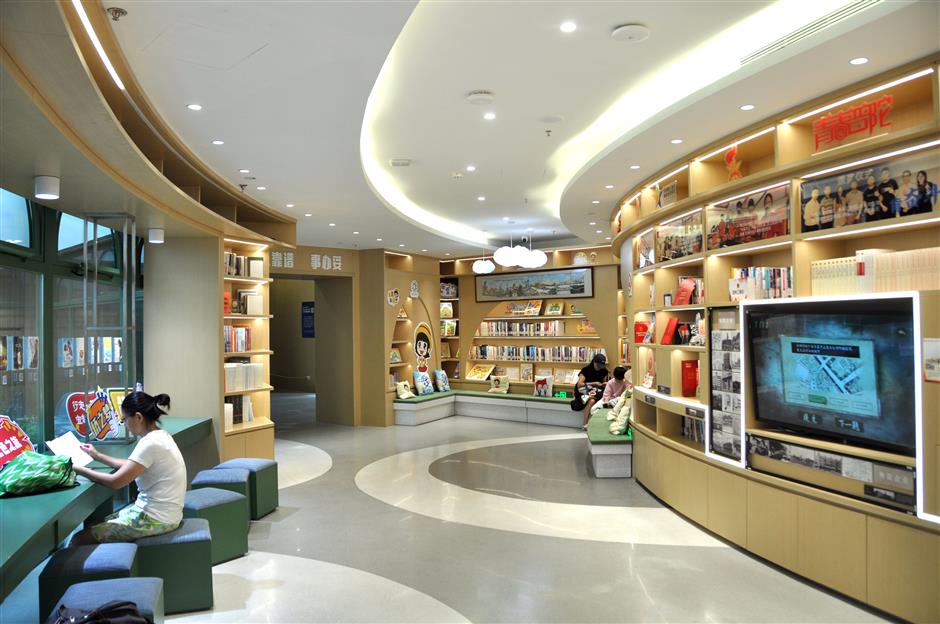
The building is open to the public and arranged across several floors: a community canteen on the ground level, study and work areas upstairs, and a small reading room tucked away above.
"It's the most beautiful community service center I've seen," Ding said. "Air conditioning, Wi-Fi, water, all free, and cheap coffee."
The center at 8 Fuxing Road W. attracts students, freelancers, and nearby office workers alike. Ding often works there for hours, breaking only to eat downstairs or step onto the terrace.
Citywide, more than 12,000 community service centers support the city's goal of a 15-minute life circle for every citizen.
"You can just search for the nearest one near your home, and there's usually a surprise," he said.

Ju Tutu, a 32-year-old blogger who quit her job earlier this year, describes his routine as "wandering office work."
Recently, he was at the Hunan Road Community Service Center from morning till evening. He arrived after lunch, worked upstairs, and stayed until late evening. All the facilities were available.
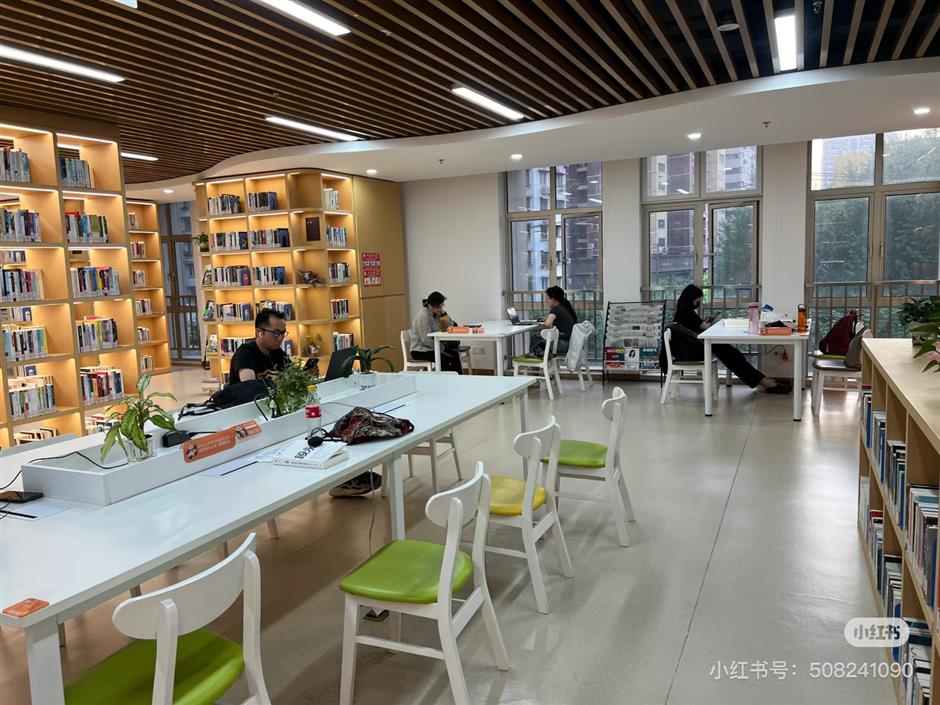
"There are workstations set up specifically for freelancers," he said. "Charging is easy, the lighting is good, and outside the window are plane trees and people passing by."
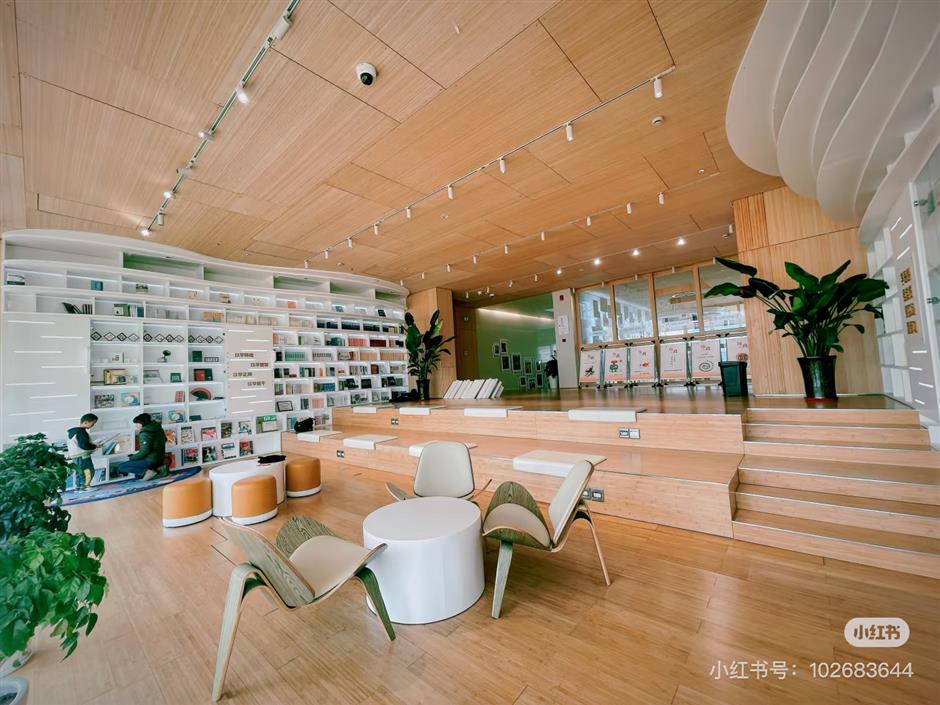
He also frequents the Daning Subdistrict Community Service Center, which he compares to a university library. The third floor opens into a stepped reading hall where almost everyone has a laptop open.
"It's very quiet," Ju said. "People are focused, but there's no 'office feeling.'"
The building has fitness areas, reading rooms and shared activity spaces. Ju says he often stays the whole day, ordering takeout and working late into the evenings.
"If you're feeling anxious, you can just sit here," he said. "Elderly people are reading, young people are working. Everyone has a computer, but no one looks rushed."
At a recent Sea-Hi public forum on urban renewal, Shen Chunlei, Party secretary of Dongming Road Subdistrict in Pudong, spoke about the challenge of welcoming people who "come and go."
"A community should face all groups," Shen said. "You need everyday life scenes where people can feel its warmth."
Dongming Road community, shaped by housing relocation, is not an obvious destination for mobile professionals. Yet Shen said ongoing efforts, including the construction of community gardens and more active street-level spaces, are aimed at gradually improving everyday quality.
Urban scholars see such developments as part of a broader shift. Rather than treating urban renewal as a purely physical transformation, cities are increasingly focused on how spaces are actually used – and by whom.
Tang Yan, a professor at Tsinghua University, described inclusive urban renewal as a move "from space to people" and from design to governance. The measure of success, she said, is whether different groups can genuinely share and benefit from urban spaces.
Zhou, who had shared images of digital nomad communities from other cities, said what impressed her was not the contrast but the direction.
"It's not about copying another place," she said. "It's about whether a space is willing to adjust."
Shanghai has introduced measures to support independent creators and new forms of work, including incentives for online content production.
In Xuhui District, policies encourage OPCs – one-person companies – that make it easier for individuals to formalize independent careers.
None of these policies explicitly targets digital nomads. Yet together with open community spaces and flexible urban design, they form an environment where mobile professionals can work without standing out.
Zhou believes that an understated approach suits the city.
"I started my journey in Shanghai," Zhou said. "And I hope more young people with talent can end their drifting in this city."
In Case You Missed It...
 Sep 22, 2026
![[Chef's Table] 20 Years in Shanghai, Da Man Behind Da Marco](https://obj.shine.cn/files/2026/09/21/5e7efe56-ed6f-4b1f-915d-baddcfd47177_0.jpg)