Shanghai Leads Yangtze River City Collaboration Ranking for 11th Year
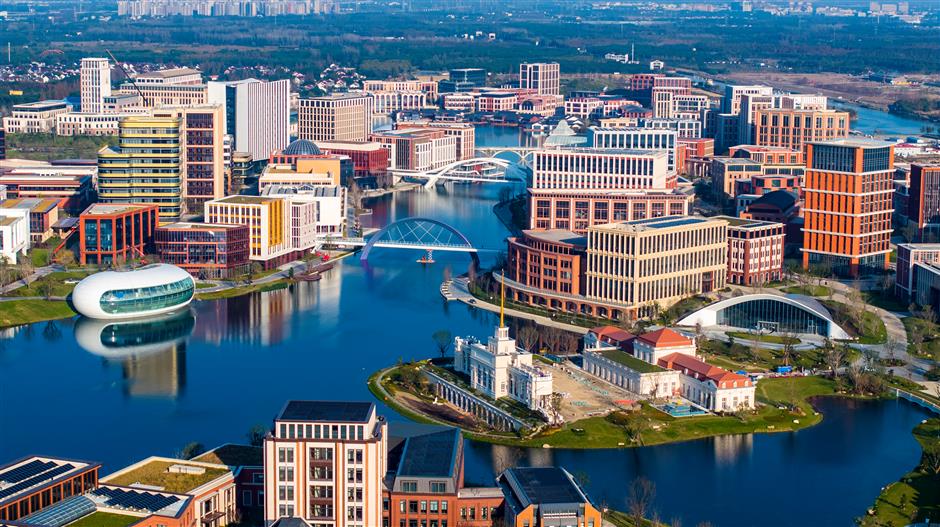
Shanghai has ranked first for the 11th consecutive year in a major index measuring collaborative development among cities along the Yangtze River Economic Belt, according to a report released on Wednesday.
The Yangtze River Economic Belt Urban Collaboration Capacity Index (2025) assessed 110 cities across eastern, central and western China.
It evaluates performance in economic development, technological innovation, exchange and services, and ecological support. Shanghai scored 74.95 points, remaining the highest-ranked city in the region.
The index, which has been published annually since 2015, is led by Zeng Gang, director of the China Modern Urban Research Center at East China Normal University.
According to the report, Shanghai's continued lead reflects its comprehensive strengths and its role as a core city that connects innovation, industry, and services across the river basin.
This year's top 10 cities are Shanghai, Hangzhou, Nanjing, Chengdu, Suzhou, Wuhan, Chongqing, Wuxi, Ningbo, and Hefei.
Several changes occurred within the group. Suzhou and Ningbo, in neighboring Jiangsu and Zhejiang provinces, each rose one place compared with last year.
The report attributes their improvement to stronger performance in converting scientific research into commercial and industrial applications.
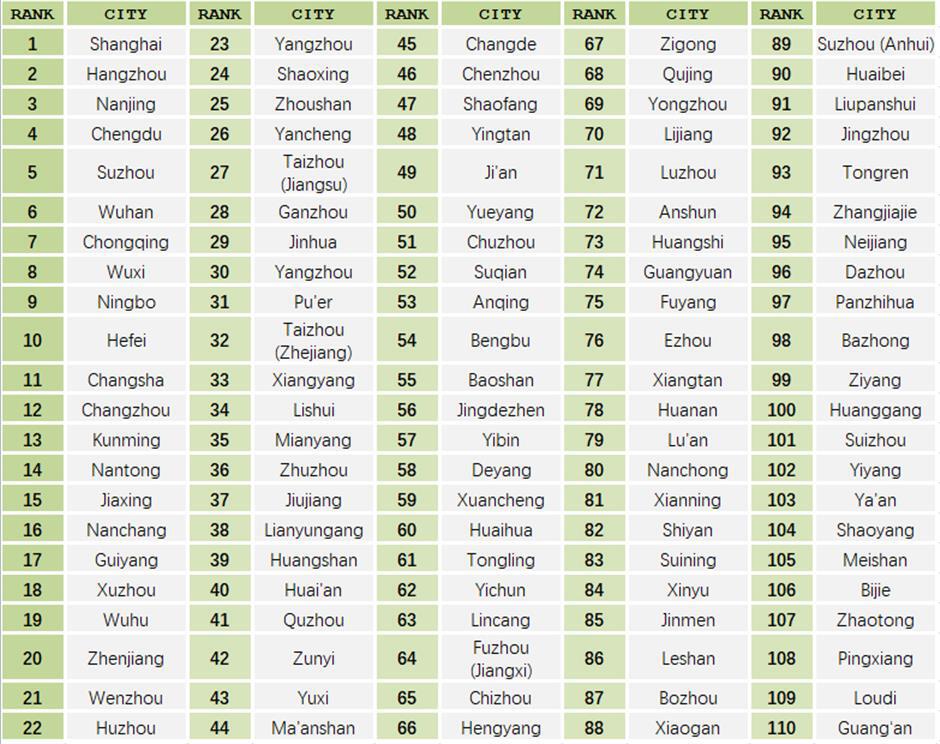
By contrast, Wuhan, capital of central China's Hubei Province, and Hefei, capital of Anhui Province, dropped one position.
While both cities continue to show strong research capacity, the index found their technology commercialization performance lagging behind peers, said Zeng.
Beyond the top tier, several cities posted notable upward movements. Guiyang, the capital of Guizhou Province in southwest China, rose two places, supported by growth in the digital economy.
Yichun, in eastern Jiangxi province, climbed 10 places, benefiting from stronger performance in cultural development and regional cooperation.
Shaoxing, also in Zhejiang, moved up seven places. The report cites its development of emerging industries such as the low-altitude economy, combined with progress in historical and cultural preservation.
Cities including Zhejiang's Huzhou in eastern China and Mianyang in Sichuan Province in southwest China also improved their rankings, largely due to stronger inter-city collaboration.
For the first time, the 2025 index has included historic and cultural district preservation as an indicator, and Shanghai has again claimed the top spot in this category.
The report states that the addition aims to better measure how cities integrate economic growth with cultural continuity as part of high-quality development.
Overall, the index shows steady improvement across the region. The average score rose 8.88 percent from 2024, and 80 cities scored above 12 points, accounting for nearly 73 percent of those assessed, Zeng said.
However, the report also notes persistent imbalances. While coordination in economic development and innovation continued to strengthen, ecological collaboration remained uneven, particularly between downstream coastal areas and inland regions, he added.
Editor: Yang Meiping
In Case You Missed It...
![[Current Trends] What the New York Times Sees in Shanghai – and What It Doesn't](https://obj.shine.cn/files/2026/04/01/a96bd403-c80c-481b-9a39-d9a049b45404_0.jpg)
 Mar 31, 2026
![[Current Trends] What the New York Times Sees in Shanghai – and What It Doesn't](https://obj.shine.cn/files/2026/03/31/6807579f-920e-4cb5-a720-f4490463e7a0_0.png)

![[China Tech] Breakthrough study on robot-assisted esophagus cancer surgery](https://obj.shine.cn/files/2026/04/01/d6ccf1c9-98a4-48c8-8d50-afe37a835352_0.jpg)