'A Sense of Touch' – Materials That Arrive Carrying Previous Lives
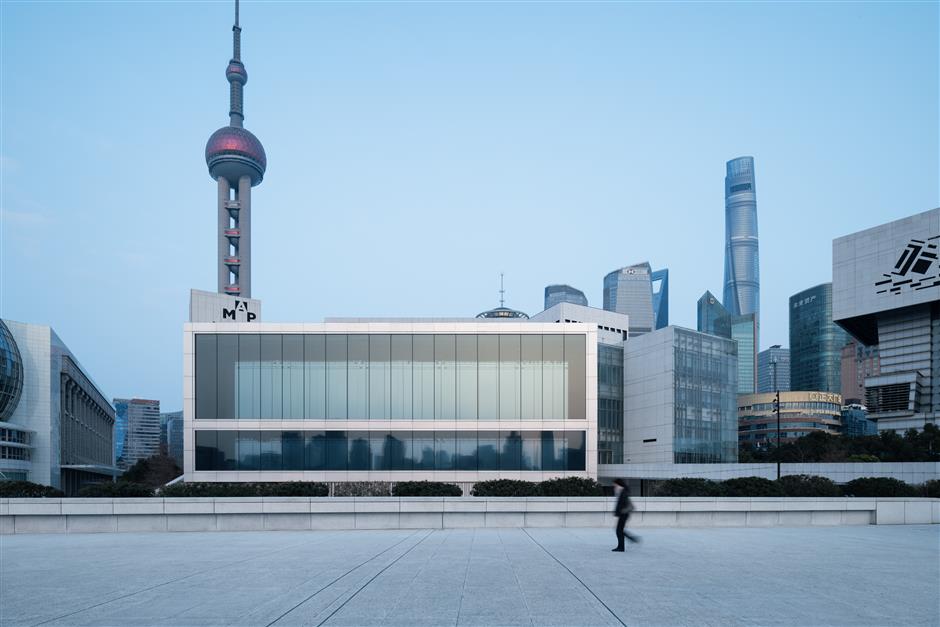
At Shanghai's Museum of Art Pudong, embroidery climbs across sculpture, bamboo hangs in the air like brushstrokes, scraps of fabric become skin, and fragments of old walls reappear in silk thread.
Elsewhere, feathers hover above fired clay; medicine boxes glow against flesh-colored leather; a lost woodblock print is reconstructed through film, stitching and memory. Materials that normally belong to very different worlds – fashion ateliers, village workshops, artists' studios, family archives and discarded objects – are brought into unusually close contact.
That friction is the most interesting part of "A Sense of Touch," a group exhibition bringing artists into collaboration with specialist craftspeople from China and France.
The exhibition forms the centerpiece of la Galerie du 19M SHANGHAI, presented by Chanel, at the Museum of Art Pudong. The wider project brings to Shanghai le19M, the Paris-based center Chanel established in 2021 to house specialist métiers d'art workshops, alongside collaborations with Chinese artists and craft practitioners.
But rather than treating craftsmanship as a display of technical virtuosity, its strongest works ask what happens when a technique developed for one purpose is pushed somewhere else entirely.
Embroidery, for instance, repeatedly becomes something other than decoration.
In Ding Yi's "Appearance of Crosses – Embroidery Painting," silk thread, beads and even flakes of dried paint from his studio enter the grids and crosses that have defined his practice since the late 1980s. The painting process he normally builds through layers of pigment and carving is translated into accumulation: thread, raised surfaces and fragments held inside a textile structure.
For Lei Lei, stitching performs another kind of translation. "Embroidering in Time" begins with a woodblock made by his father in Jiangxi Province in the 1980s and later lost during family moves. Pigs, baskets, hats, wheels and figures from the surviving print return as embroidery, animation and film. The missing object itself was never recovered. What survives is its ability to generate another image.
Memory is less concrete in Tan Jing's installation, which draws on the story of her grandfather, who returned to China from Thailand in 1956. Images move across translucent fabric, appearing and dissolving through layers of embroidery and projection. Nearby, flowers made from organza and silk carry archival letters, photographs and scent.
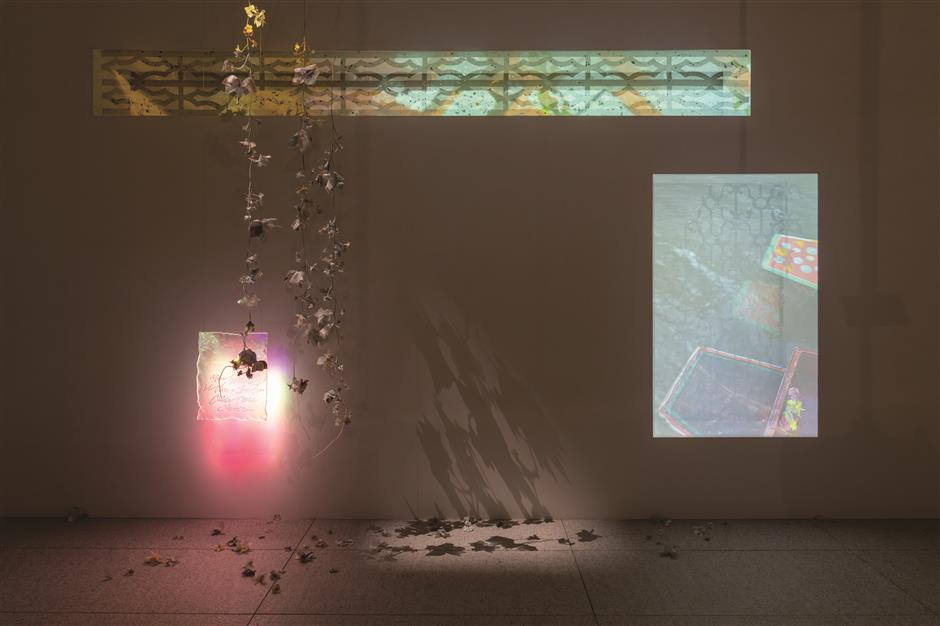
Memory here is not an archive that can simply be opened and read. It behaves more like smell: vivid, intimate and unreliable.
Across the exhibition, materials often arrive carrying previous lives.
Yin Xiuzhen divides the figure of a goddess into 19 hollow sections and wraps their cut edges with leftover samples, scraps and test textiles. Lichen-like embroidery spreads across translucent fabric. The monumental body is held together by remnants, not precious material, but the residue of previous acts of making.
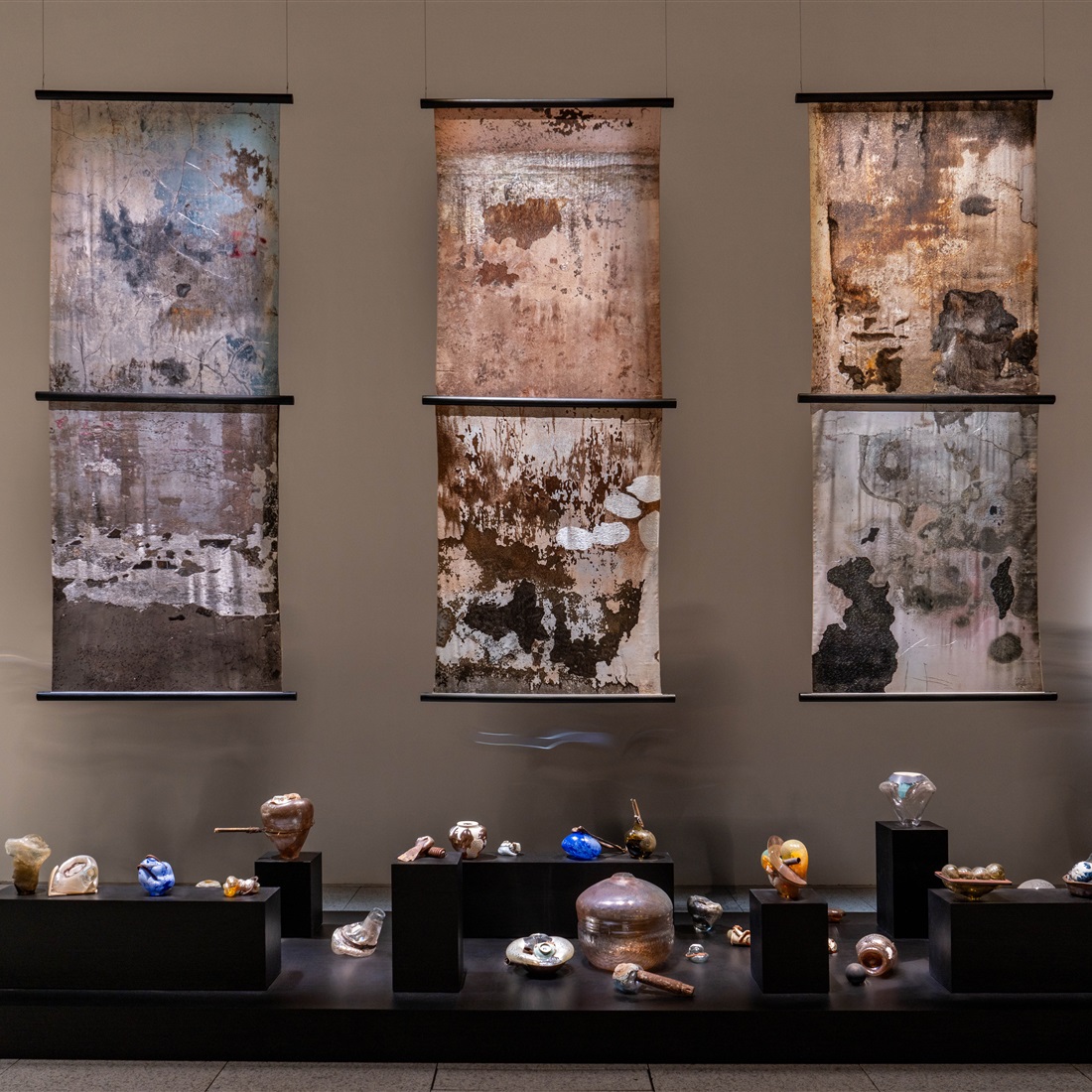
French artist Deborah Fischer similarly begins with things that appear close to disappearance. During a residency in China, she photographed damp, patched and repeatedly repainted walls in the old Shanghai towns of Xinchang and Gaoqiao. Those surfaces were printed onto synthetic fabric before being worked over with Xiang embroidery.
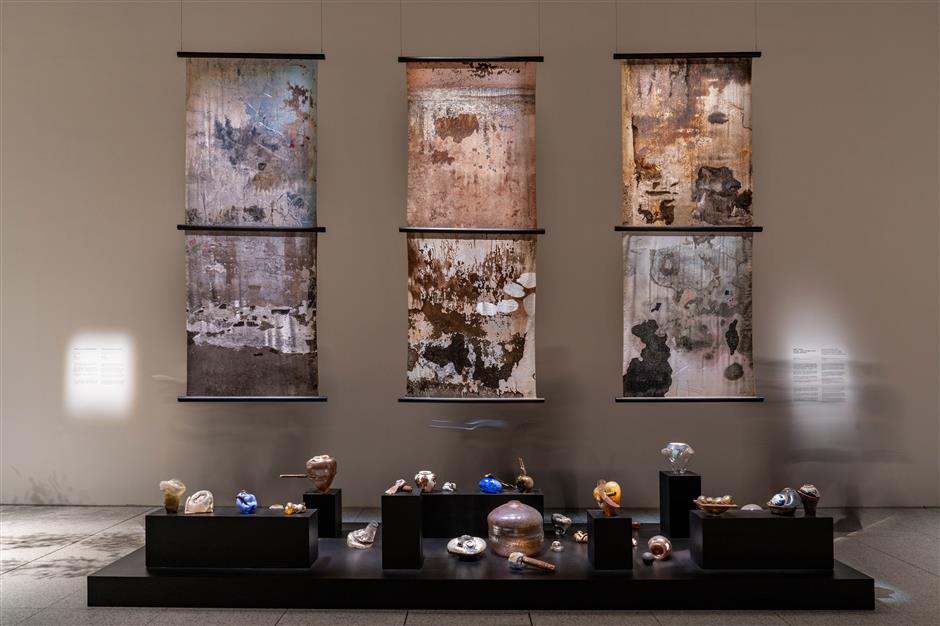
The stitches do not conceal cracks and stains. They follow them.
In Jingdezhen, China's porcelain capital in Jiangxi, meanwhile, discarded ceramic fragments entered another collaboration, this time with glass artist Gong Kehai. Broken objects were pushed into another material state through blown glass, pressing and assemblage.
The gesture is characteristic of much of the exhibition: preservation does not mean returning something to an imagined original condition. It can mean allowing it to become something else.
This becomes particularly interesting when contemporary art encounters Chinese craft traditions that have their own highly specific bodies of knowledge.
Mathilde Denize worked with women artisans connected with the Dousa Textile Cooperative in Guizhou Province, where Dong textile-making depends on knowledge of plants, fermentation, humidity, repeated dyeing and surface treatment. She cut and recombined the textiles with old canvases and botanical hammer prints, producing forms that hover between painting, garment and skin.
Qian Lihuai, who comes from a bamboo-weaving family in Wuzhen, Zhejiang Province, takes another inherited technique out of its conventional function. In "Breathing Between Two Shores," black bamboo weaving works almost like ink. Density, rhythm and empty space suggest roofs, bridges and reflections without describing them literally.
The work retains the intelligence of bamboo weaving while no longer behaving like a traditional woven object. It becomes landscape, drawing and architecture at once.
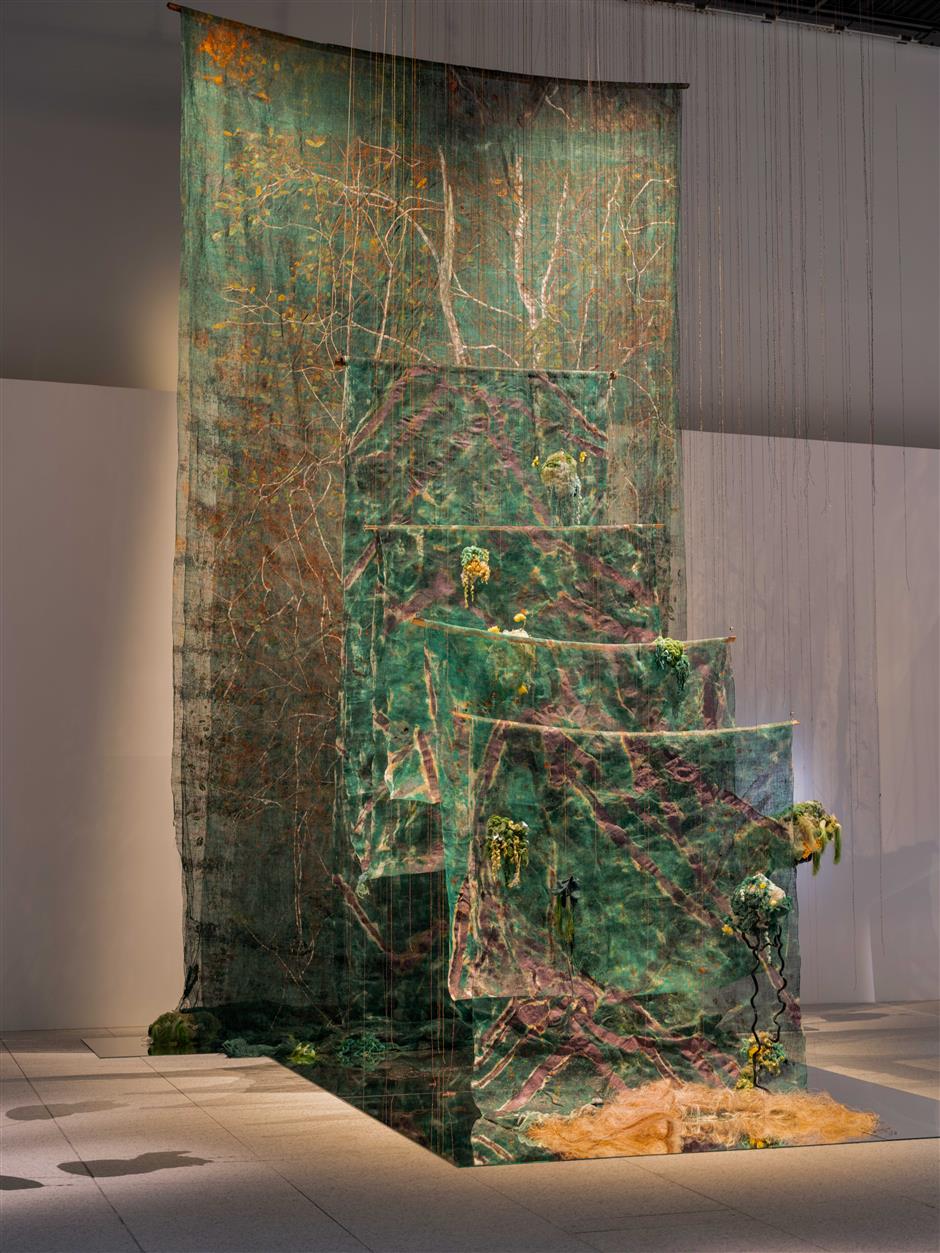
Wu Guanzhen performs a similar shift with lacquer. Drawing on childhood memories of the Wuyi Mountain in Fujian Province, he works with ramie and natural lacquer to create translucent surfaces through which light passes like mist through vegetation. In his collaboration with the Paloma atelier, pleating, distressing, hand-coloring and heat treatment expand that landscape into space, producing vines, moss-like forms and floating vegetation.
Other collaborations work by forcing an established technique into an unfamiliar scale.
Wei Libo's "With the Leaves" grows out of memories of his grandfather, a self-taught craftsman who built his own house and furniture in Lanzhou, Gansu Province. Working with Maison Michel, techniques normally used for millinery were employed to construct a suspended branch at architectural scale. Thirteen separate components were developed and painstakingly joined so that their seams almost disappear.
What usually remains hidden inside an object – moulds, supports, joining systems – becomes part of the work's visible anatomy.
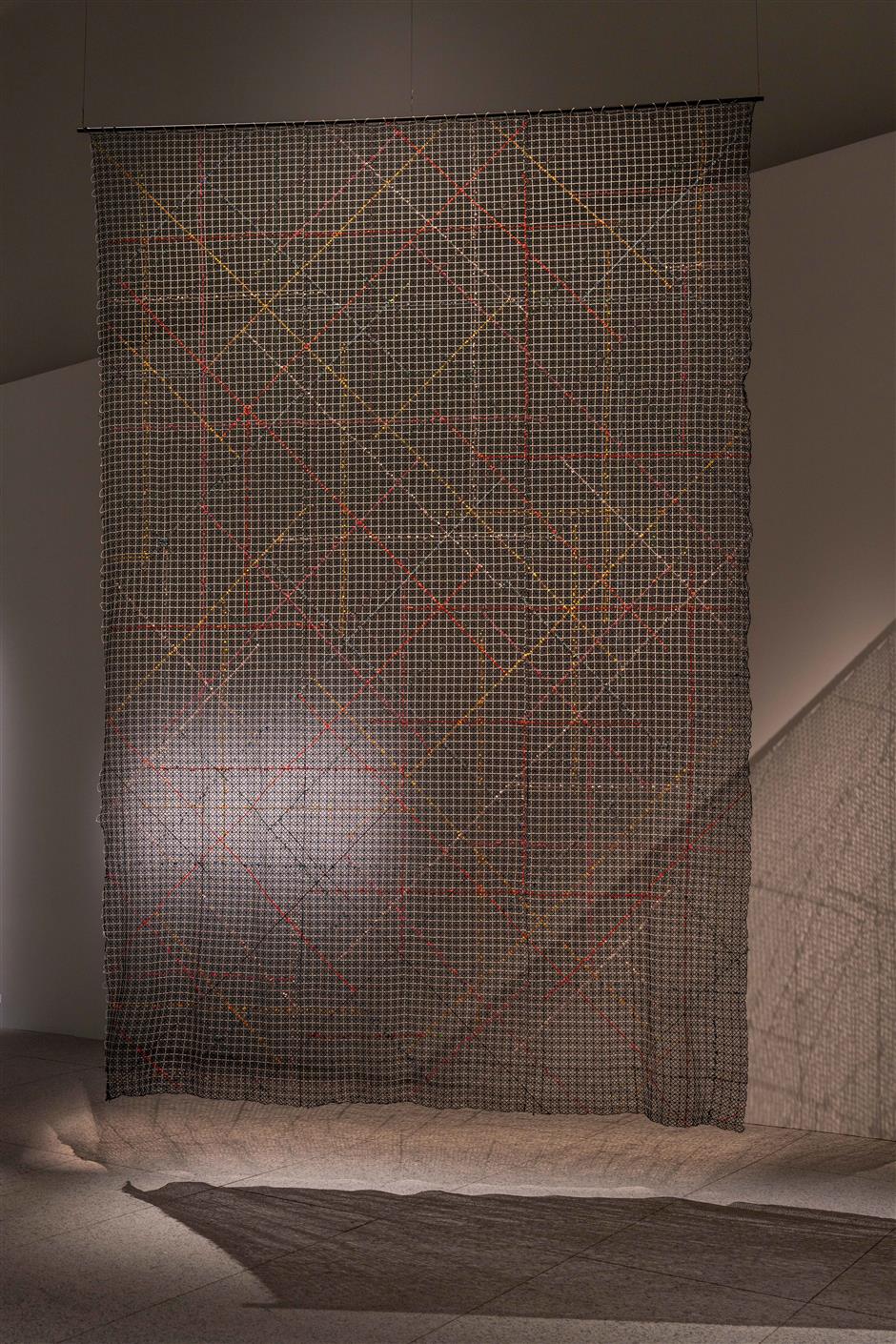
Zhang Zhongyu's "The Body of Wish" begins with another form of controlled making: gourds shaped while still growing by binding and constraining them. In collaboration with metalworkers, the temporary act of tying is translated into woven metal mesh and sculptural bows.
The work turns an old horticultural practice into a question about authorship itself. Where does making begin, after a material is harvested, or while it is still alive?
Across the exhibition, craft is most compelling when it is allowed to leave its assigned place: embroidery becomes structure, bamboo becomes drawing, millinery becomes sculpture.
What is preserved, then, is not a fixed form, but a capacity to change.
Tradition survives here not by standing still, but by being used again differently.
If You Go
Venue: Museum of Art Pudong
Address: 2777 Binjiang Avenue, Pudong New Area浦东新区滨江大道2777号
Date: through November 15
Admission: 100-150 yuan (US$15-22)