In Candida Höfer's World, Empty Spaces Speak Volumes
Candida Höfer's rooms are empty. But they are never lifeless.
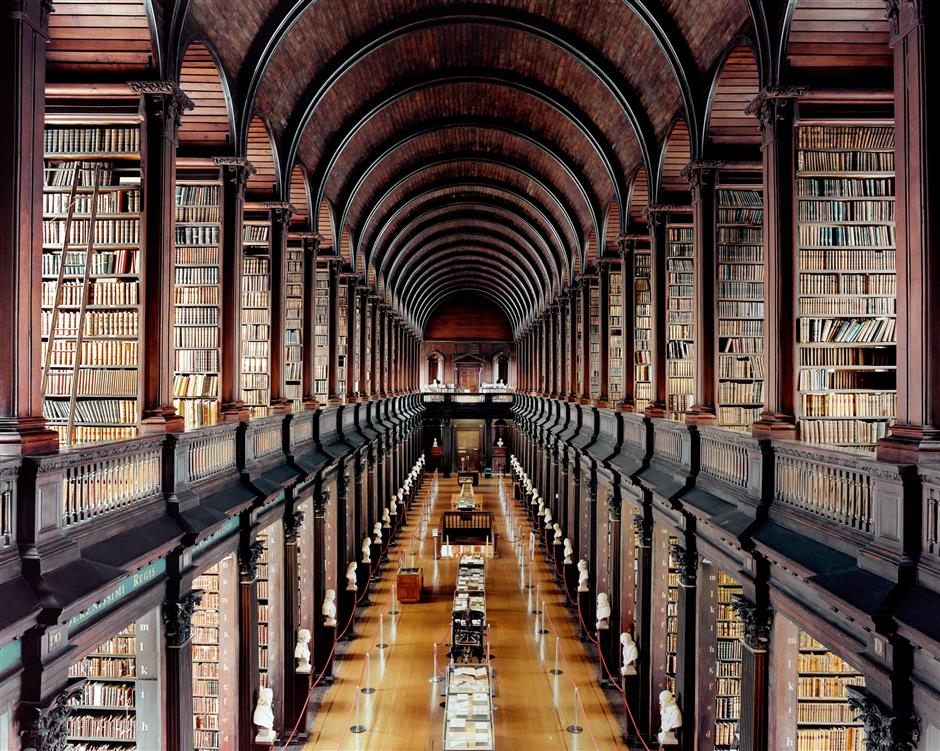
Inside Trinity College Library in Dublin, towering wooden bookshelves stretch beneath a procession of dark arches. Marble busts stand watch along a polished floor. Everything is perfectly arranged, yet not a single reader is in sight.
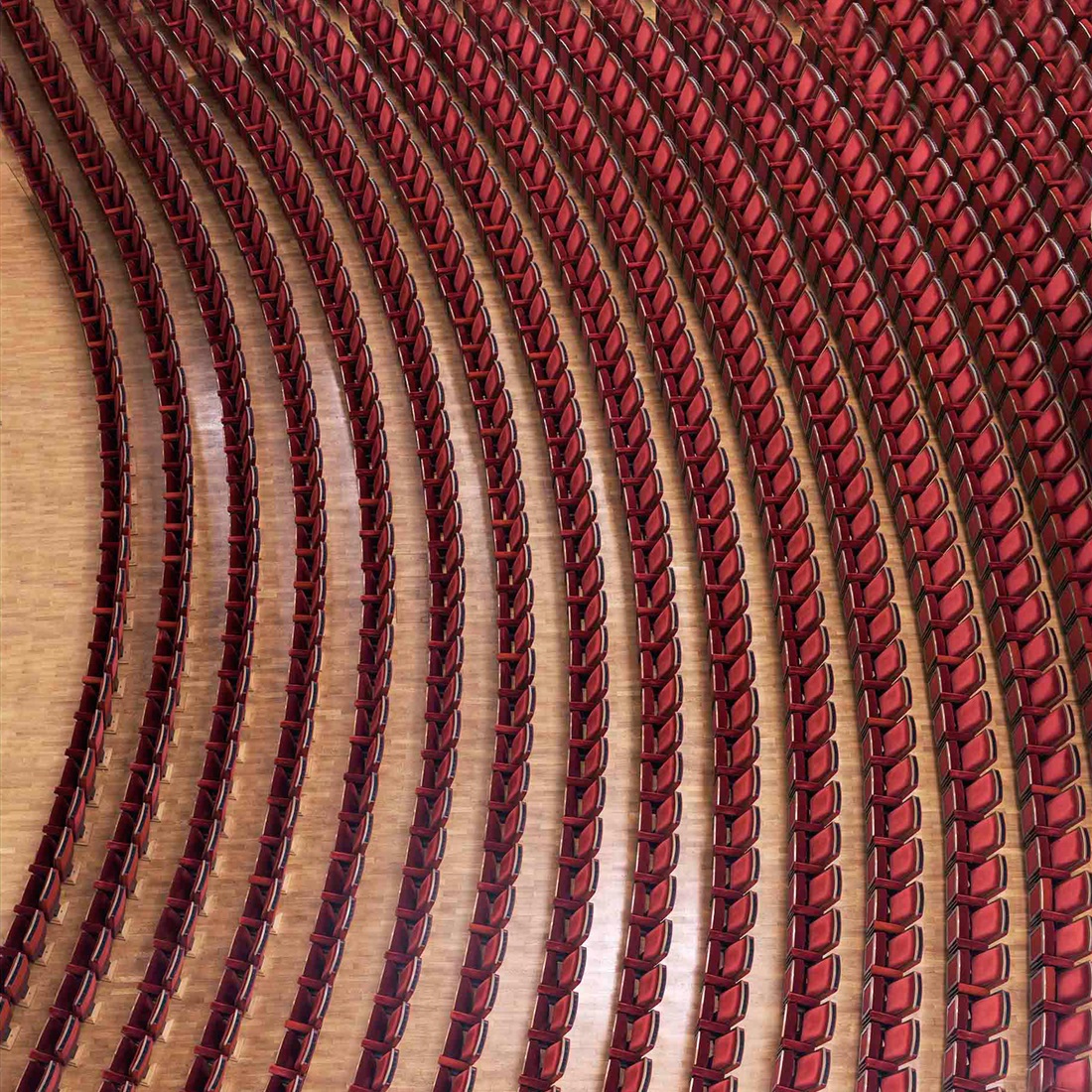
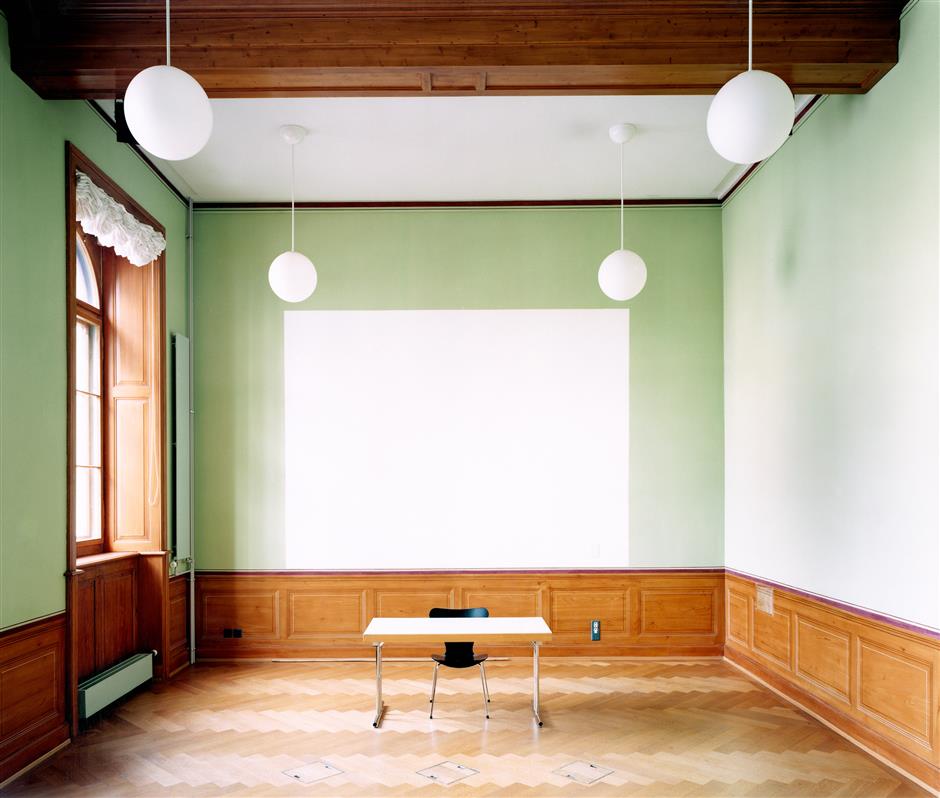
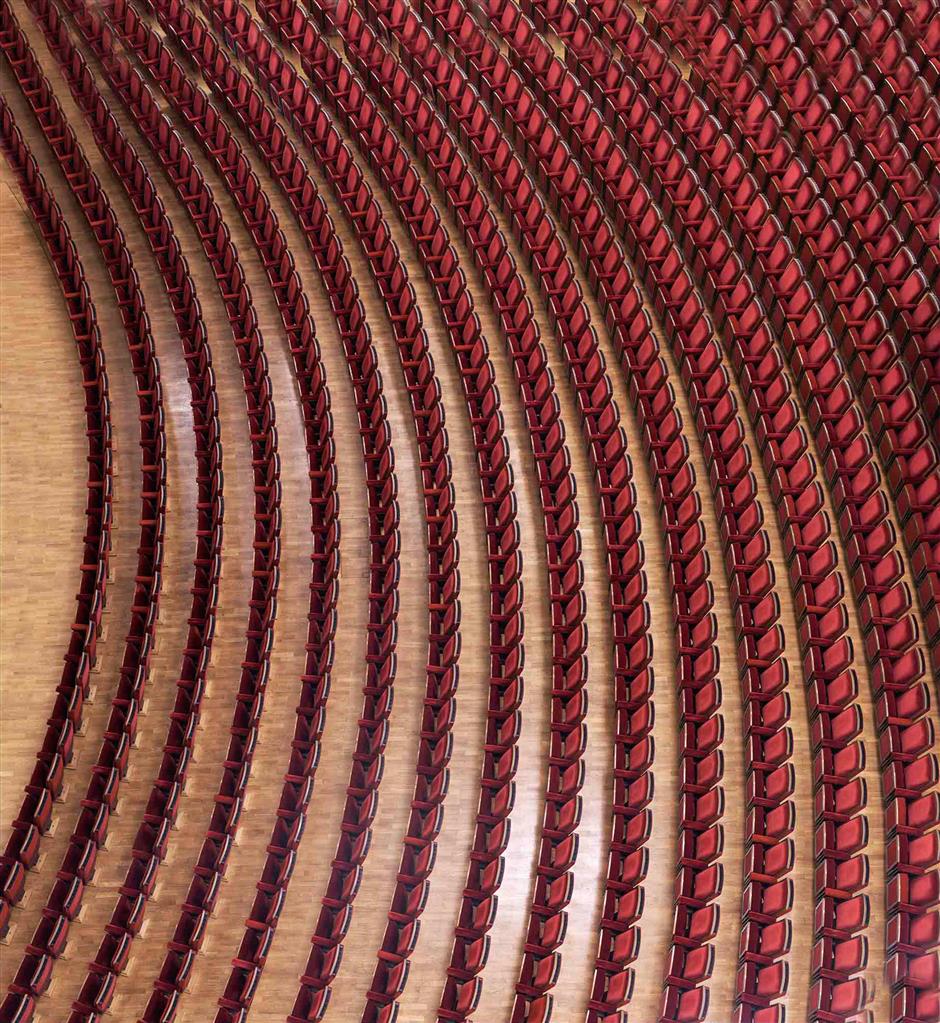
Elsewhere, rows of red theater seats sweep across a photograph in rhythmic curves, their occupants conspicuously absent. In another image, a solitary black chair sits beneath white globe lights in a pale-green room, surrounded by wooden panels and an expanse of bare wall.
Nothing seems to be happening. Yet there is plenty to see.
These quiet, meticulously composed scenes are created by German photographer Candida Höfer. Her exhibition, titled "Rehearsing Assembly," is exhibiting some of her works at Fotografiska Shanghai.
The exhibition features 28 color photos from the 1990s to 2023 of European and Chinese libraries, theaters, museums, and archives. They're linked by architecture and the lives they were built to accommodate.
For Höfer, one of the leading figures of the Düsseldorf School of Photography, the absence of people has become a signature.
In one interview, she explained that photographing empty interiors was a practical decision: she did not want to disturb the people using them.
But she discovered something unexpected.
"With their absence, paradoxically, people become more present in the pictures," she said.
It is a paradox that runs through the Shanghai exhibition.
A theater without an audience still tells us where to sit and where to look. A library with no readers reveals how knowledge is arranged, preserved and accessed. An empty museum invites visitors to contemplate the art it displays and how they should engage with it.
"Some spaces make us slow down. Others make us quiet. Still others invite us to sit and stay," said Shen Chen, curator of the exhibition.
That subtle influence lies at the heart of Rehearsing Assembly. The title plays on two meanings of "assembly:" the arrangement of a building's elements and the gathering of people for a shared purpose.
The architecture is already in place before the crowd arrives. In that sense, the gathering has begun long before anyone takes a seat.
Yet the photographs are far from cold architectural records.
Höfer has a remarkable eye for symmetry, rhythm and light. Her camera often looks straight into a room, drawing viewers along corridors, between columns or through repeating rows of furniture. The effect can be almost hypnotic.
In "Trinity College Library Dublin I" (2004), the soaring wooden arches create a powerful sense of depth, while the rows of books and marble busts bring an almost ceremonial order to the room.
The photograph feels both monumental and intimate. Viewers can take in the grandeur of the library from a distance, then move closer to discover the individual books, sculptures and details that give it character.
The same precision appears in her theater photographs, where bright upholstery, ornate balconies and carefully arranged seating can turn an auditorium into a striking pattern of colors and shapes.
In "Semper Oper Dresden VI" (2023), the curved rows of red seats become an almost abstract composition. Seen without an audience, the theater is transformed into a study of repetition and rhythm.
Höfer's images can be so visually compelling that it is easy to forget the complex work behind them.
Her approach grew out of the Düsseldorf School, where she studied under Bernd and Hilla Becher alongside photographers including Andreas Gursky, Thomas Ruff and Thomas Struth.
Höfer developed a distinctive visual language of her own, turning the interiors of public institutions into what she has called "portraits of space."
Her work is not confined to grand historic buildings.
Among the photographs in Shanghai are images of Beijing's Li Yuan Library, designed by architect Li Xiaodong and nestled in the landscape of Huairou. The building offers a different relationship between architecture and its surroundings, bringing nature into the conversation.
Other works carry visible traces of history.
In "Neues Museum Berlin LXI" (2009), the restored museum interior reveals the marks of wartime destruction alongside later repairs. What might initially appear to be an elegant architectural photograph becomes a record of a building's survival and transformation.
The exhibition itself has been designed to encourage this kind of discovery.
Shen has arranged different spaces in a changing sequence, rather than grouping all the libraries together and all the theaters in one section. The walls alternate between theatrical red and muted green, echoing colors found in Höfer's photographs.
The result is a journey through contrasting buildings, periods and purposes, inviting visitors to notice unexpected connections.
One of the exhibition's largest photographs, "Semper Oper Dresden V" (2023), measures nearly three meters across. It brings the auditorium, orchestra pit and stage into a single view, revealing both the grandeur of the performance space and the arrangements behind a theatrical production.
Her photographs offer an unusual invitation: to spend time looking at places we normally pass through without much thought.
There are no actors on the stage, no readers at the desks, and no visitors wandering the museum halls.
But stand before one of Höfer's photographs long enough, and the empty rooms begin to feel full.
Date: through February 21, 2027
Venue: Fotografiska Shanghai
Address: 127 Guangfu Rd 光复路127号