'Like a Stranger': Li Ran's Psychological Theater and a State of Mind
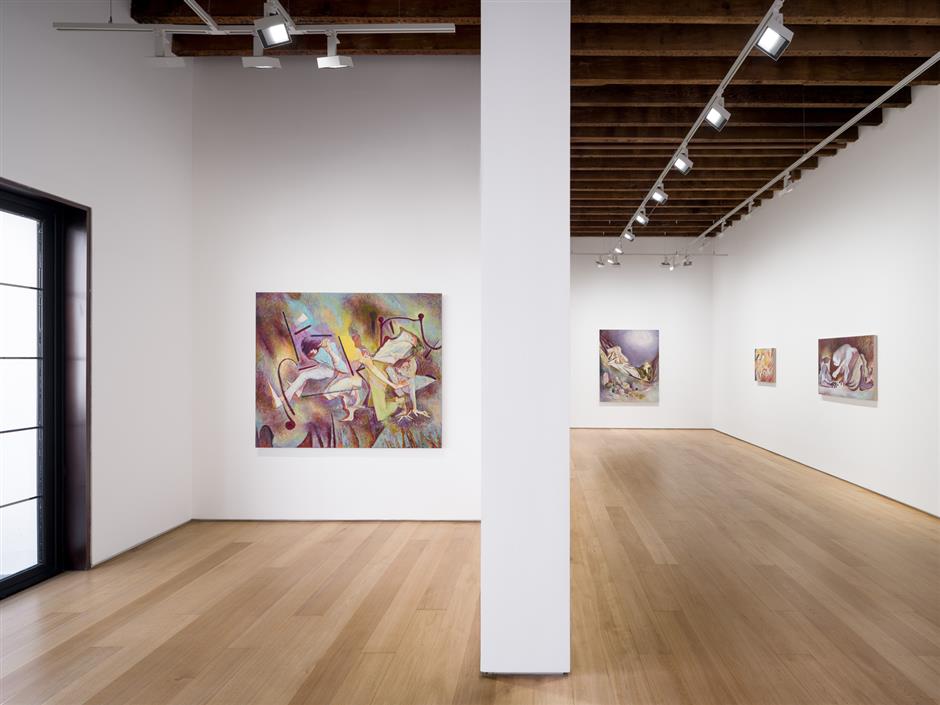
At Lisson Gallery's Shanghai space, Li Ran's new exhibition "Like a Stranger" unfolds like a dimly lit psychological theater. Across the canvases, elongated figures drift, collapse, wait and wander through hazy interiors awash in violet, yellow and bruised pink tones. Some appear trapped in private rituals. Others seem suspended between revelation and exhaustion.
For the Shanghai-based artist, however, the "stranger" in the exhibition title is not simply an unknown figure. It is also a state of mind.
"It's not that we don't recognize them," Li said during a walkthrough of the exhibition. "It's that we are unable to trust."
"Like a Stranger," Li's first solo exhibition with Lisson Gallery in Shanghai, presents a new body of paintings that continue his shift away from the more overtly narrative video and conceptual works he became known for earlier in his career.
The new paintings are looser, more inward and emotionally unstable, pulling from Symbolism, Post-Impressionism, Soviet Romantic painting and Chinese satirical cartoons.
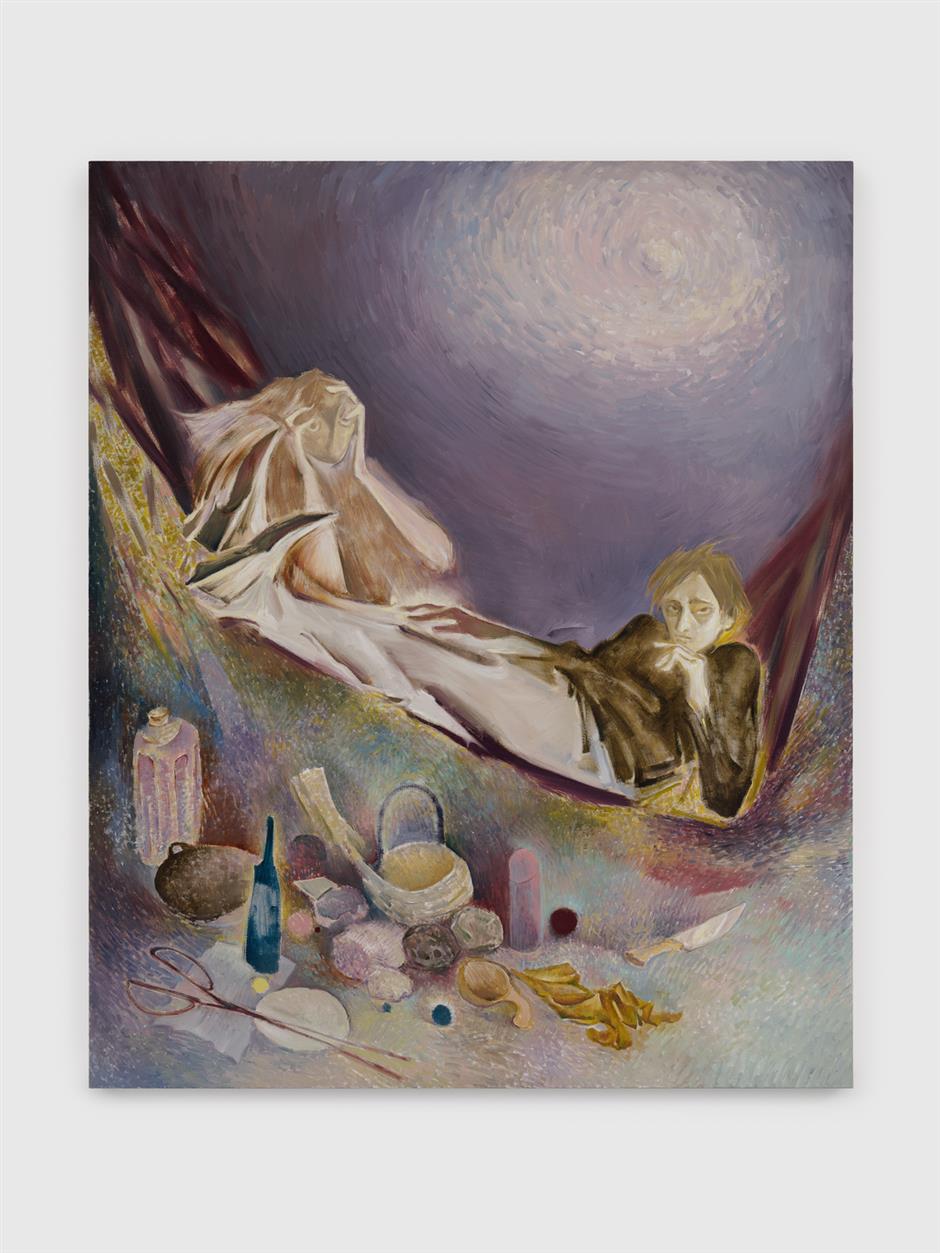
Among the most striking works is "Becoming Wild" (2025), a dreamlike painting inspired by a story Li heard as a child in central Hubei Province. In the 1990s, a man reportedly encountered a "wild man" in the forests of Shennongjia and became obsessed with searching for the creature. He abandoned ordinary life, lived alone in the mountains for years, stopped cutting his hair and beard, and eventually became mistaken for the "wild man" himself.
"That was what interested me," Li said. "He was searching for that person, but in the end he became that person himself."
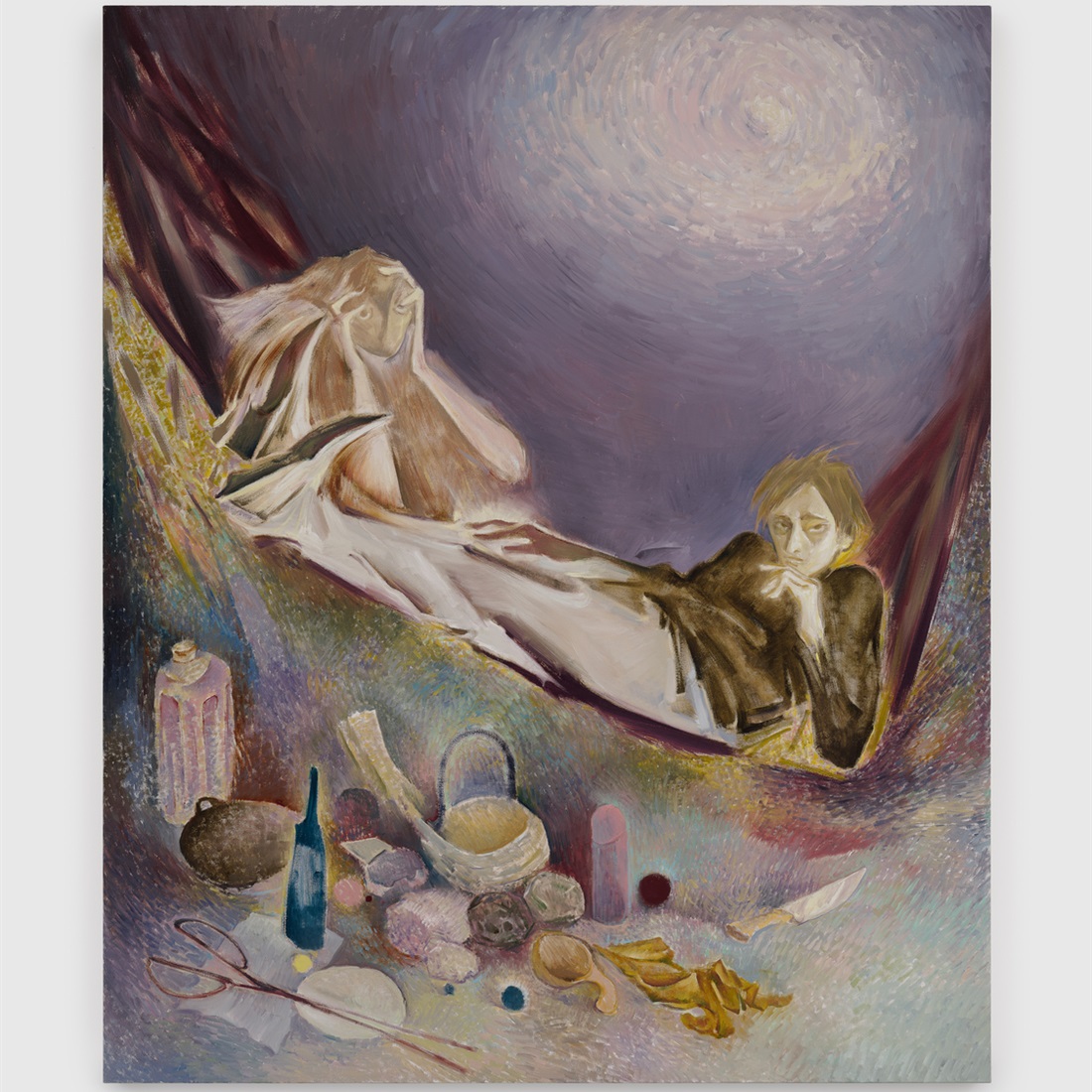
The painting reflects that slippage between observer and observed. A pale-haired figure reclines beneath a glowing circular sky while scattered objects – bottles, baskets, fragments of domestic life – drift across the foreground like abandoned evidence from an unresolved investigation.
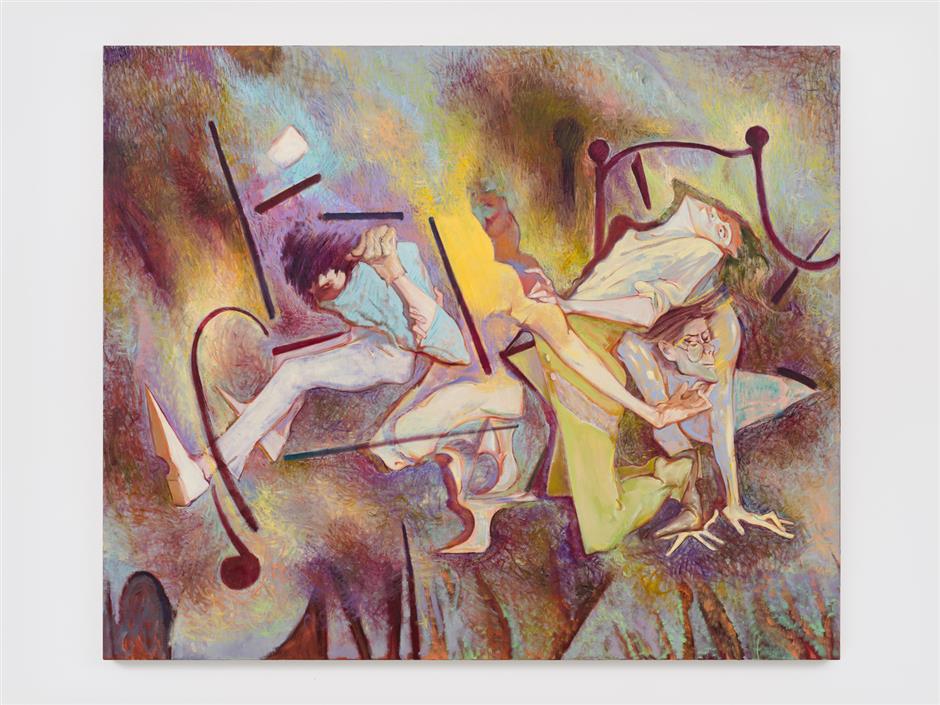
Another major work, "But Your Senses Have Also Fallen" (2025), pushes further into psychological disorientation. Three distorted bodies pull and collapse against one another in a chaotic composition, as if falling out of a bed or struggling to remain upright.
The painting emerged from Li's long-running skepticism toward the idea of "painterliness," a concept frequently discussed in Chinese painting circles but rarely clearly defined.
"Many painters care deeply about painterliness," Li noted. "But when you ask what it actually is, everyone gives a different answer."
Some associate it with expressive brushwork or thick paint. Others with imperfection or spontaneity. For Li, those formal qualities alone no longer feel sufficient. "Could painterliness itself become another kind of illusion?" he asked.
That uncertainty runs throughout the exhibition. Li's paintings resist fixed interpretation, hovering instead between religious allegory, theater staging and personal memory.
In "Fellow Traveler" (2026), two cloaked figures move through a foggy, yellow-lit space, appearing almost like shadows beside one another. The painting refers to the Biblical story of the Road to Emmaus: after Jesus was crucified, two of his followers walked away from Jerusalem in grief and confusion. A stranger joined them on the road and spoke with them, but they did not realize until later that the stranger was the resurrected Jesus.
Li is drawn less to the final moment of recognition than to the uncertain walk before it – when the two men were still trying to understand what had happened and what they could still believe.
"I can't speak about certainty the way Caravaggio or Rembrandt might have done in classical religious painting," Li said. "But I understand what it feels like to walk on a road of confusion."
That may ultimately be the emotional core of "Like a Stranger." Rather than offering resolution, the exhibition lingers inside uncertainty itself – treating estrangement not as alienation, but as a method of staying alert, self-critical and emotionally awake.
If you go:
Date: May 16-July 4
Address: 2/F, 27 Huqiu Rd 虎丘路27号
Admission: Free