The Human Figure Reimagined through Paint
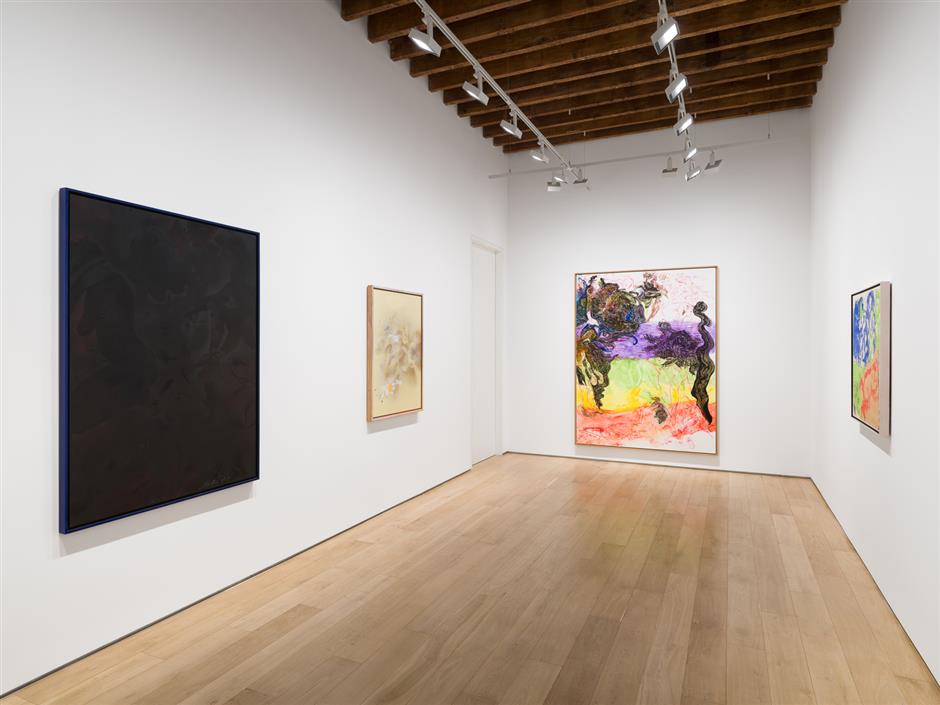
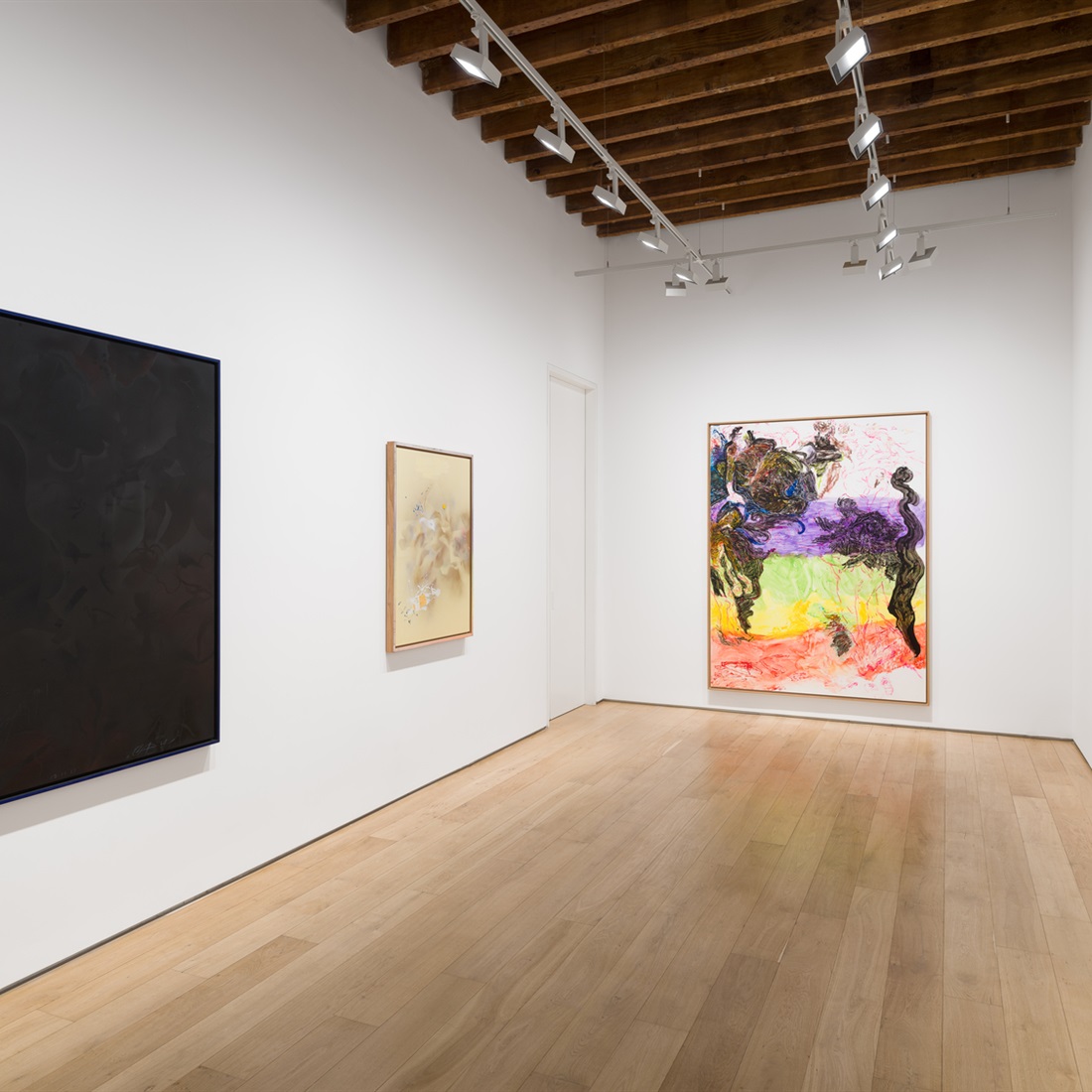
Walking into the Lisson Gallery's Shanghai space, one is immediately struck by a vibrant display of color in motion. Deep cobalt blues swirl across the canvas, while bright greens seep into the surface like flourishing vegetation, and red lines slice through the composition like sudden gestures.
Look longer, and the paintings begin to reveal something else: bodies.
A crouching figure, a pair of arms reaching out, and silhouettes leaning into one another. They emerge slowly from the layered paint before dissolving back into abstraction.
These elusive figures are central to the works of American artist Oliver Lee Jackson, whose first solo exhibition in Asia opened in Shanghai this month. The exhibition brings together works spanning nearly three decades, alongside a previously unseen sculptural screen.
At 90, Jackson remains one of the most distinctive voices in contemporary American painting.
Born in 1935 in St. Louis, Missouri, the artist grew up in a city deeply embedded in the historical tensions of the United States. The cultural and political complexity of that environment forms part of the background to his work, though rarely in explicit narrative form. Instead, Jackson translates experience into a visual language where figuration and abstraction exist simultaneously.
The body is always the starting point. From there, the figure becomes a structure through which paint, gestures, and space unfold.
These "paint people," as the artist calls them, appear as simple line drawings of human bodies or as serpentine shapes formed by chalk, oil paint and spray-painted stencils. Sometimes they gather in groups; sometimes they appear alone – squatting, reclining, drawing, pointing, or embracing.
But the paintings rarely tell a story. Instead, they open a field of perception.
One of the earliest works in the exhibition, "Composite (7.16.97)" from 1997, offers a vivid example of Jackson's approach.
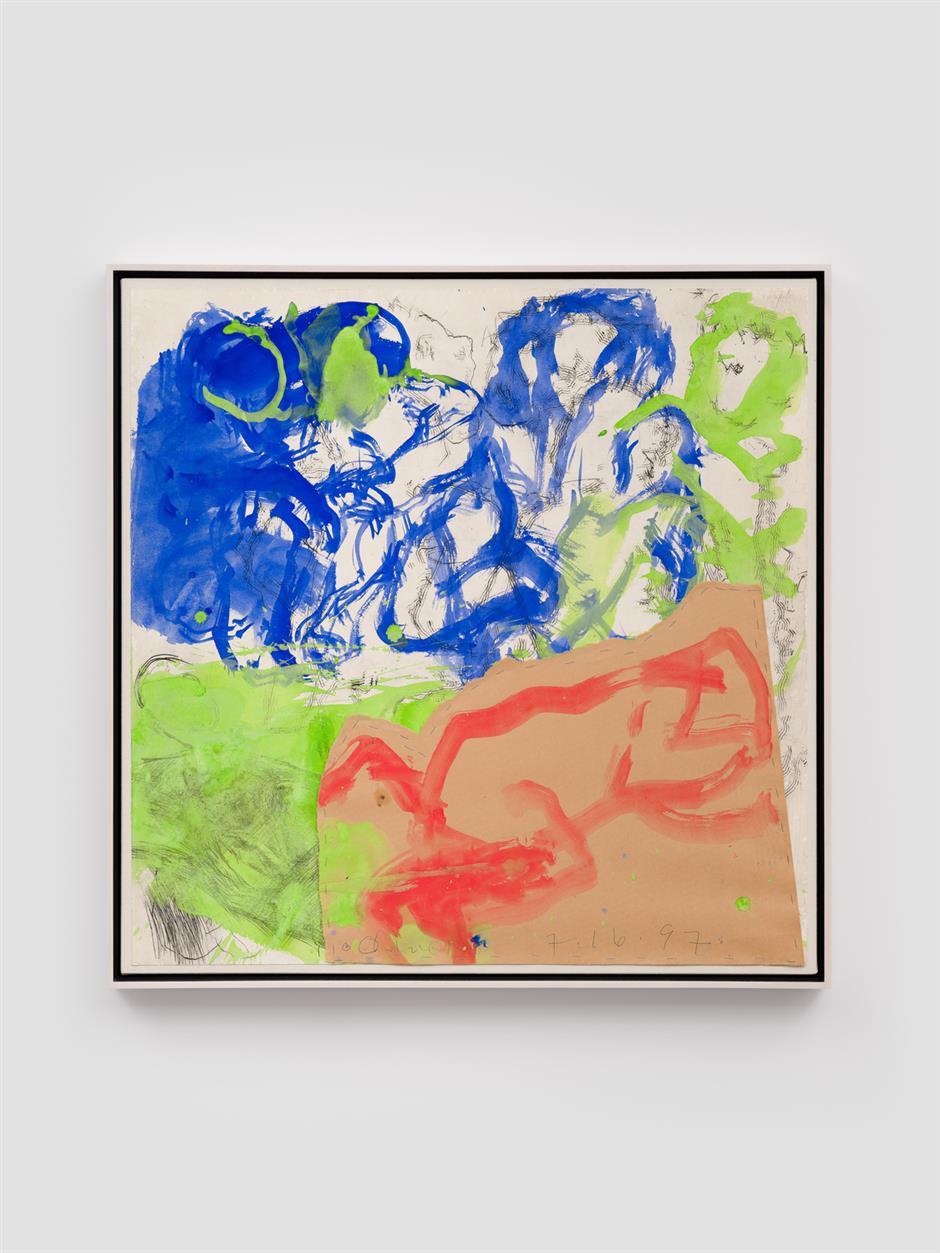
Vast electric blues dominate the composition. Loosely drawn forms or bodies twist and overlap in this turbulent field, echoing across the surface. A bright green patch covers the lower left corner, and a red figure lies on sandy ground in the foreground.
The scene feels both chaotic and alive.
Jackson describes his paintings as "fields of energy." The figures are not fixed forms but catalysts within these energetic environments, appearing and disappearing as the viewer's eye moves through the composition.
The experience of looking becomes almost physical. Lines pull the viewer from one corner of the painting to another, while color and gesture create shifting visual rhythms.
Anchoring the exhibition is a striking three-panel work titled "Screen (7.26.16)," which introduces a sculptural dimension to Jackson's practice.
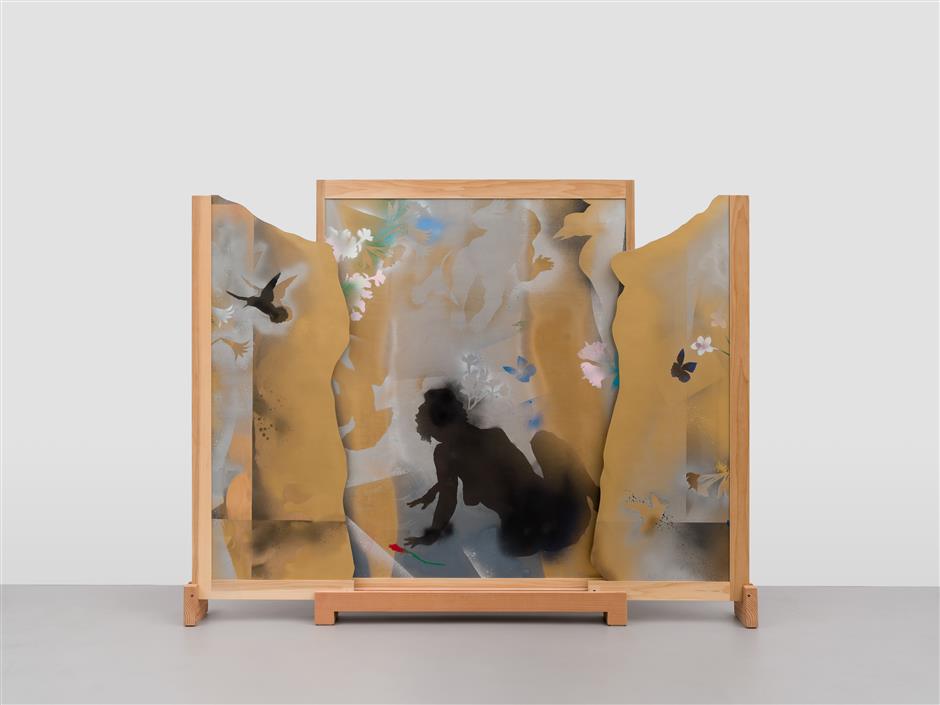
Constructed from wood panels painted on both sides, the work can be folded or expanded like a traditional screen. Each panel acts as a reversible element, allowing the configuration to change depending on how it is arranged.
When the panels are closed, layered silhouettes of human figures overlap across the surface. When opened, the central panel reveals a more abstract landscape-like composition, transforming the work's visual structure.
The piece occupies a curious position between painting and sculpture. Visitors walking around the work encounter constantly shifting imagery – colors, shadows and figures that change as the viewing angle shifts.
If you go:
Date: March 7 - April 25
Address: 2/F, 27 Huqiu Rd 虎丘路27号
Admission: Free