Running the City Without Sound: Deaf Couriers in Shanghai
In Shanghai, a delivery station for deaf riders raises a larger question: what does inclusive work look like in the digital economy?

At 7:09am, food courier Sun Jingjing received her first order of the day: a Starbucks coffee to be delivered to a high-rise residential building 1 kilometer away. For the next two hours, she wove through malls, residential blocks, and office towers, jogging past commuters heading to work – all in silence.
Sun is a deaf courier. At her delivery station, there are 17 full-time deaf riders like her. Many of them previously worked in factories or restaurant kitchens, earning modest incomes and rarely encountering other deaf people. Life often felt lonely.
Now, after work, they gather with fellow deaf riders from the station to share meals. "It makes me very happy," Sun said through sign language.
The 35-year-old arrived in Shanghai last October. Before that, she spent four years working at a Foxconn factory in Zhengzhou, Henan Province, a manufacturing hub for Apple products. The work was physically demanding, involved night shifts, and offered low pay.
Her husband is an art teacher in their hometown of Kaifeng, also in Henan Province. With their daughter admitted to a high school in Dallas, United States, and annual costs of about 400,000 yuan (US$5,680), Sun came to Shanghai alone, encouraged by other deaf friends to try delivery work to earn more.
She now works eight to ten hours a day, earning between 7,000 and 10,000 yuan a month, more than double what she made before.
"I like delivering food. The overall pay is much better than my previous job, and over the past year, I've been able to save a lot," Sun told Shanghai Daily through a sign language interpreter last week.
Wang Liping, 21, also left his factory job in Sichuan Province and moved to Shanghai in September to work as a courier. He said he enjoys the job not only because it pays better, but also because life feels less monotonous and gives him the freedom to explore the city.
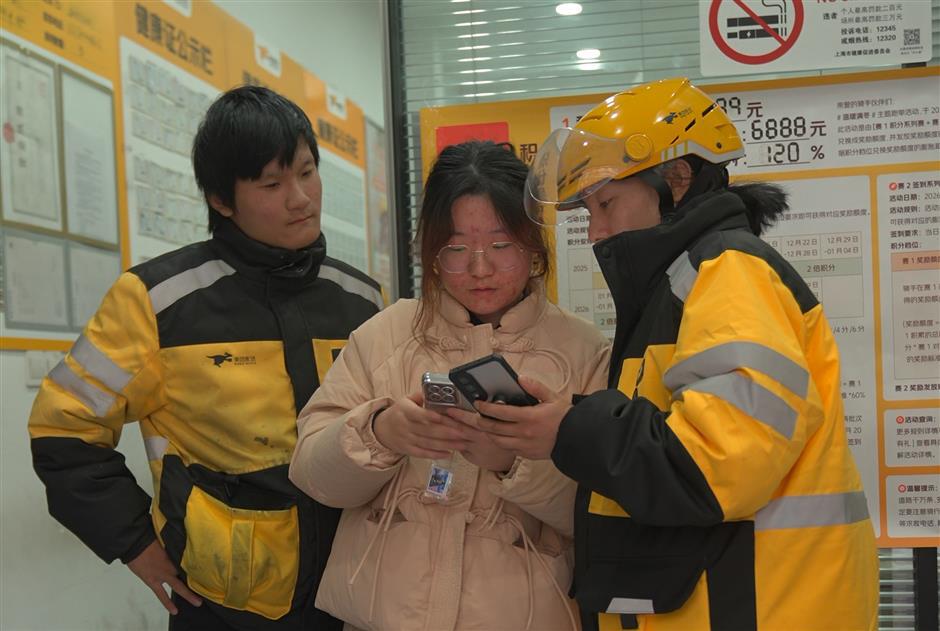
Riders like Sun and Wang are part of a much larger group. Both deliver orders through Meituan, one of China's major food delivery platforms, which employs nearly 15,000 riders with disabilities nationwide, about 80 percent of them hearing-impaired.
Both of them are based at a delivery station on Zhijiang Road M. in Jing'an District, a site Meituan set up last year specifically for riders with disabilities. The station offers social insurance to deaf riders and employs sign language interpreters to help handle special delivery situations.
When navigation goes wrong, customers fail to respond, or deliveries are at risk of timing out, deaf riders turn to the station's sign language interpreter, Gu Xinru, for help. The 23-year-old calls customers to confirm directions, then relays the information to riders via WeChat.
She often ends the call with a familiar line: "A deaf rider is delivering your order. Thank you for your understanding." Occasionally, that sentence earns a small tip. Other times, it helps avert a negative review.
In fact, the performance gap between deaf riders and their able-bodied counterparts is not significant, Gu said.
To make daily deliveries easier, Meituan introduced an AI-powered voice calling feature last December, allowing deaf riders to notify customers with pre-recorded messages at the tap of a button. For these orders, direct phone calls are replaced with in-app messaging and speech-to-text functions, reducing the risk of misunderstandings when customers try to reach riders by phone.
Still, about one-third of issues require human intervention.
Road closures and traffic congestion can be especially stressful for new riders, who worry that delays will hurt their performance scores and bonuses. In such cases, Gu reassures them: if the delay is caused by objective factors, the station can help file an appeal. Riders are encouraged to document the situation with photos and follow proper procedures, rather than react emotionally.
During peak lunch hours, deaf riders may miss pickup calls as they cannot hear. When that happens, Gu contacts the restaurant to check the order and guides the rider through the pickup process.
Even with text-based communication, misunderstandings are common. Deaf riders often use sentence structures that differ from standard spoken language, which can confuse recipients.
On one occasion during a holiday rush, a deaf rider was delivering food to a crowded shopping mall. The customer messaged to ask where he was. The rider replied, "Not arrived. Too crowded. Come down."
The customer read the message as rude and reacted angrily, leaving a negative review and filing a complaint. The rider felt wronged. By "not arrived," he meant he was still en route, not refusing the delivery. By "come down," he was asking the customer to step out to a more visible spot in the crowd so he could identify them.
Gu called the upset customer and apologized, explaining that the rider was deaf and had difficulty expressing himself clearly. After a long pause, the customer replied, "I'm sorry."
Later, the customer sent Gu a long text message apologizing to the rider.
Overall, Gu said that most customers are generally understanding when issues arise during deliveries made by deaf riders.

Disability employment in China's digital economy
Stories like those at Gu's delivery station are part of a much broader picture of disability employment in China.
China is home to more than 85 million people with disabilities, accounting for about 6 percent of the population. According to the Report on the Case for Persons with Disabilities in China (2023), well over 10 million working-age people with disabilities have yet to find employment.
As the digital economy expands, new forms of work, including food delivery and ride-hailing, have become increasingly important sources of employment for people with disabilities.
China Youth Daily reported that the ride-hailing giant Didi has introduced measures to support hearing-impaired drivers, including in-car notices and targeted training on safety and passenger privacy.
Alibaba-backed Taobao Instant Commerce, Meituan's main competitor and formerly known as Ele.me, has launched a program to provide barrier-free communication for deaf couriers, benefiting more than 5,000 hearing-impaired riders so far.
According to Tide News, such digital tools are helping narrow the gap between workers with disabilities and their able-bodied peers.
Yuan Zhe, a teacher at the School of Economics at Zhejiang University, conducted a study of more than 10,000 deaf delivery riders. His research found that accessible communication features on the apps significantly reduced delivery time and improved job performance.
For example, deaf riders previously took an average of 27 seconds longer than other riders at the delivery stage. After the introduction of the AI-powered voice calling system, the gap narrowed to 16.7 seconds.
Yuan's research also found that although disabled riders face multiple challenges on the job, they tend to work harder and show greater job stability, completing about 5 percent more deliveries per week on average than other riders.
Gu told Shanghai Daily that what riders ultimately hope for is recognition and fair treatment.
"What they want most is to be treated the same as others," she said.
In Case You Missed It...
 Dec 26, 2025
![[Experts & Ailment] Combined Western and Chinese Therapy Saves a Shipboard Stroke Victim From Croatia](https://obj.shine.cn/files/2025/12/25/9186f076-ffcb-4dcd-819d-915d6c12abae_0.png)

Popular Reads

Yuan's Rise, Aerospace and Other Industry News Lift China Stocks

Shanghai Busts 'Professional Closure Operators' in Scheme Targeting Prepaid Tuition

Shanghai Court Releases New Judicial Guidelines for Financial Market Development