Beware of 'Carb Face' Narrative Seeking to Monetize Beauty Anxiety
The other day, two elderly women were having a casual talk when I heard the word "carbohydrates."
I slowed down to do a double take, because this term, usually confined to scientists, was uttered casually by a housewife who had just bought some vegetables for her meal.
There are signs that this unusual adoption of a once specialized term in the vernacular is, rather than a mark of enlightenment, merely the success of a marketing ploy preying on popular concern about fitness.
One of the more recent example is the coinage of tanshui lian, literally "carb face."
First registered in Chinese diet/wellness circles about two years ago, it refers to facial puffiness, blamed on excessive intake of carbs, or "carbohydrates," in a thinly veiled demonization of this basic, life-sustaining nutrient.
In a recent commentary carried in The People's Daily, columnist Tang Tianyi observed that this unfounded narrative about "harmful carbs" could go viral, because it fits society's anxiety-driven marketing ploy, which goes like this: First fabricate a concept, stir up societal anxiety, and then profit from sales of related products or services.
In this narrative, the intake of staple carbs is blamed on lack of self-discipline, that can lead to "carb face," marked by facial puffiness, and blunted jawlines, with some quipping that tasty carbs and good looks are inherently incompatible.
The contrariety is "protein face," an appealing, angular and desirable face attributed to the intake of proteins.
This characterization, born of bigotry and marketing incentives, is totally misleading.
In a recent interview with Xinhua news agency, Jin Hui, director of the Department of Clinical Nutrition, Zhongda Hospital Southeast University in Nanjing, Jiangsu Province, dismissed this demonization of carbs as totally untenable in scientific terms.
"For the absolute majority of people, carbohydrates should account for half of their daily food intake. In this respect, quality matters even more than quantity. Significantly, carbohydrates are not confined to noodles and rice only. They also exist in vegetables and fruits. Thus what matters more is the healthy mix of different types of food sources," Jin said.
As a matter of fact, together with fats and proteins, carbs are one of the three essential life-sustaining nutrients, and their intake is essential.
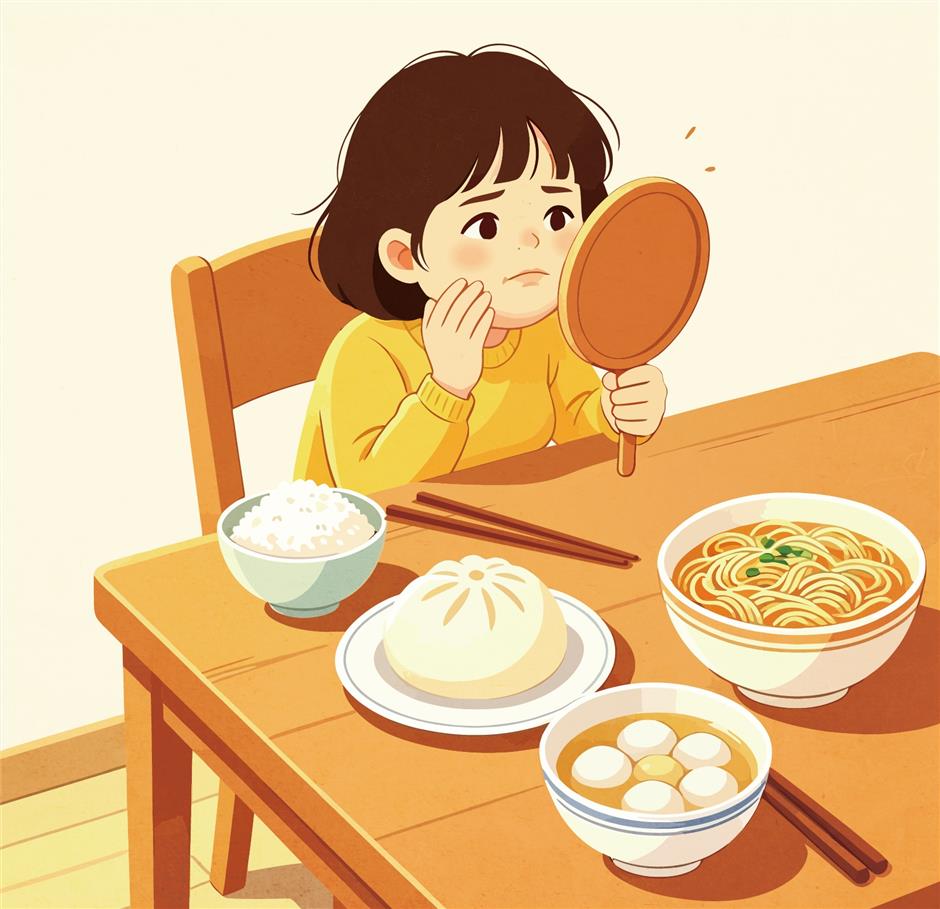
Rigorous long-term carb restriction may cause poor concentration, mood swings, irregular menstruation in women, and impaired liver and kidney metabolism.
Their overhyped effects on sharpened facial contours could be simply explained in terms of reduced calorie and fat intake, and thus are volatile. With facial features ultimately dictated by genes and bone structures, restored diet will quickly lead to glycogen and water intake, and weight rebound, with a vengeance.
Although the narrative is unscientific, it is clever in playing up pervasive social anxiety over personal appearance, even though the underlying salesmanship sticks to the same script: first fabricate a concept, then fuel worries, and then capitalize on the fears by selling certain products or services.
Trending anxiety-triggering memes in China include A4 waist, pointed elf ears, swan neck and right-angle shoulders, to mention just a few.
These tantalizing images can arouse anxiety, which easily translates into online traffic, and money.
When crafty influencers begin to share, seemingly casually, their slimming tips, which range from a branded diet, medicine, to plastic surgery, they are almost invincible before their fandom.
Some people are losing more than their money.
There were reports of people who had undergone elf ear plastic surgery for a slimmer face, only to sustain permanent facial nerve damage.
Others are using blood glucose monitors unnecessarily for weight loss, when repeated checks at short intervals become psychologically compulsory.
As the saying goes, beauty is in the eye of the beholder, and should not be narrowly defined.
Rice, steamed buns, dumplings, and noodles have been sustaining Chinese since time immemorial, the demonization of these basic food is, to say the least, a sign of utter ingratitude.
Editor: Liu Qi
Popular Reads

Volunteers From Home and Abroad Donate Blood to Save Sick Kids in Shanghai

Second-hand Smoke Exposure Rises In The City, Though Overall Smoking Rate Remains Low
Shanghai Launches First International Illustration & Pop Show