A Headline Drug Deal Is Only the Tip of a More Complicated Drive for Profit
An exclusive interview with Felix Fei, co-leader of the health sciences and wellness for EY China
China's biotech companies have learned how to sell drugs to the world. The harder part is proving the deals will create lasting value.
In the first half of 2026, Chinese drugmakers signed 81 overseas licensing deals valued at a potential US$110 billion, or 80 percent of the total value in 2025, according to China's National Medical Products Administration.
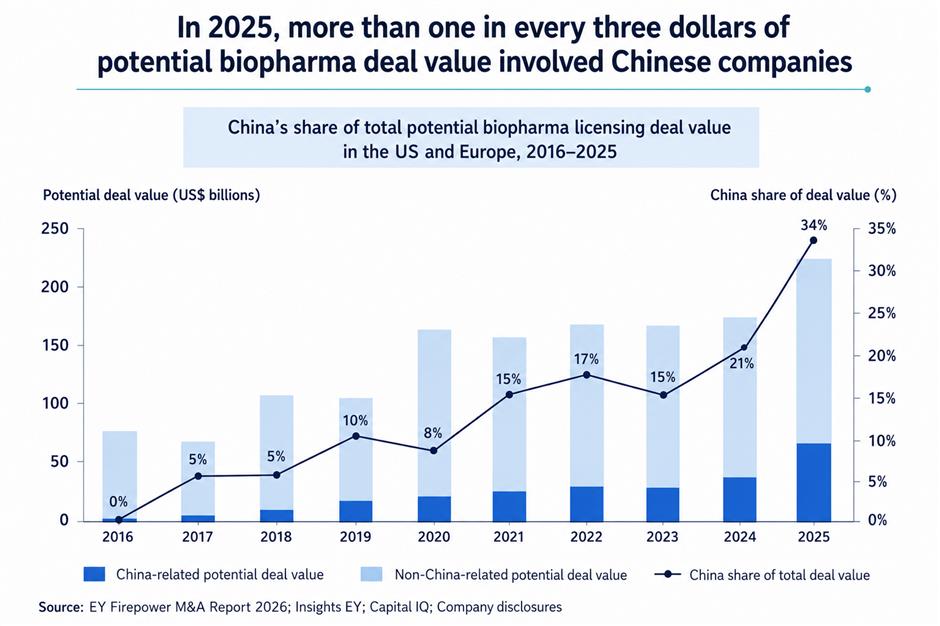
China-related transactions accounted for about 34 percent of the potential value of US and European biopharma partnerships last year, up from roughly 8 percent five years earlier, according to a latest report from consulting firm Ernst & Young, which now calls itself simply EY.
The boom in drug deals has pushed Chinese companies to the forefront of new global industry growth, but the headline figures are typically tied to performance milestones that may take years to attain. At the same time, a Chinese drug may find itself competing for funding, clinical resources and priority inside a buyer's pipeline.
EY found that only 32 percent of 225 life-sciences transactions it examined met their original growth targets. The next phase of China's biotech expansion will therefore be judged less by how many deals are signed than by how many drugs make it through global development and generate revenue.
"The biggest point of failure is still clinical development – clinical, clinical, clinical," said Felix Fei, co-leader of the health sciences and wellness for EY China.
Once a Chinese drug enters a multinational drugmaker's portfolio, Fei said, it is no longer judged in isolation. It must compete with dozens of internal and external programs for budget, trial capacity and management attention. A promising molecule can still be delayed or pushed down the queue if it doesn't fit a buyer's broader pipeline strategy.
That is also why a large licensing headline doesn't automatically translate into a lasting valuation boost. Investors are increasingly looking beyond the maximum deal value to the upfront payment, the conditions attached to future milestone payments and whether a company can produce another drug asset after selling its best one.
"The market is starting to treat business development as a source of recurring value, rather than a one-off story," Fei said. "The real question is whether a company can be paid for its innovation again and again, not whether it can sell one asset at a good price."
Global drugmakers have strong reasons to keep buying.
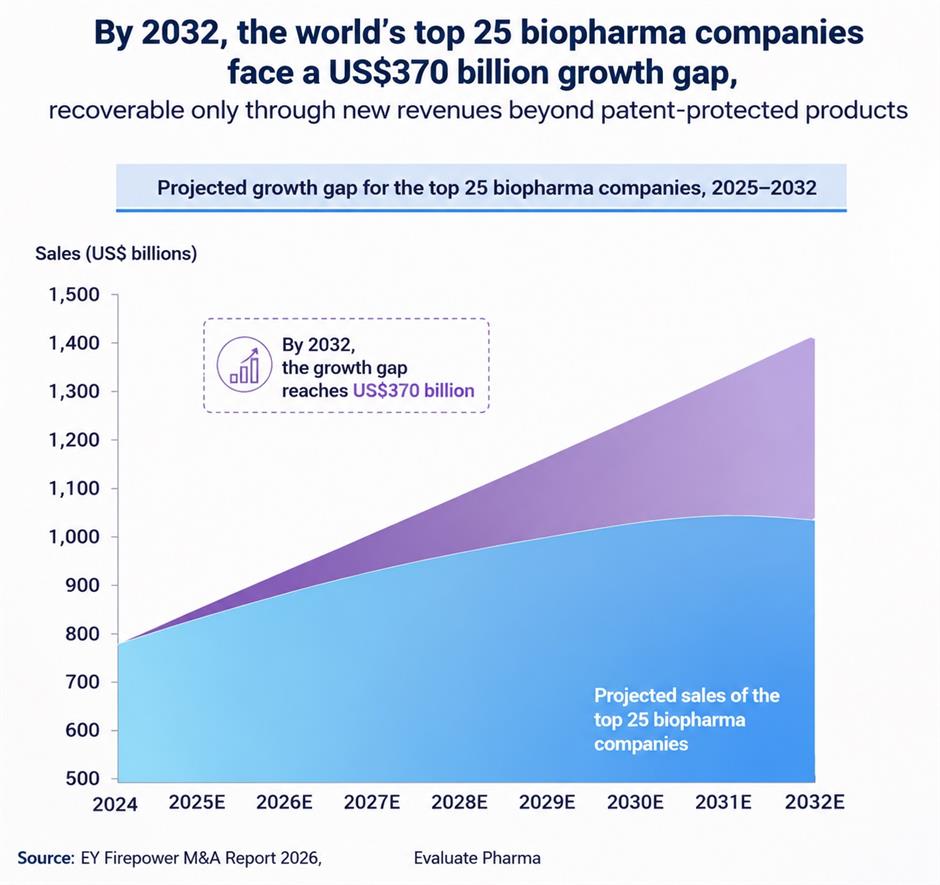
The world's 25 largest biopharma companies could face a US$370 billion growth gap by 2032 as blockbuster products lose market exclusivity through patent expiry. At the same time, the industry has about US$2.1 trillion in dealmaking firepower.
"China offers what many buyers need: a large and fast-moving pool of clinical-stage assets," Fei told China Biz Buzz. "Its advantages lie in lower development costs, faster patient recruitment and strong engineering, chemistry, manufacturing and controls capabilities."
He added, "Chinese companies are producing more assets in areas global drugmakers are already prioritizing, including oncology, autoimmune disease, metabolic disorders and neuroscience."
That does not mean China has overtaken the US at the scientific frontier. Fei said the US still holds an edge in basic research, original target discovery and early scientific validation. China's current strength is turning known or emerging science into trial-ready drugs more quickly and at lower cost.
For global drugmakers facing patent cliffs, that combination is difficult to ignore. But buying rights to a drug is easier than turning it into a global product.
A closer look at deal structures shows why investors are cautious. In 2025, upfront payments comprised only about 7 percent of the potential value of biopharma licensing agreements, according to EY. Further profits rest on development, regulatory and commercial milestones.
"The first number investors should look at is the upfront payment and its share of the total," Fei said. "They should also ask when the money will be paid and what conditions must be met for the milestones to be triggered."
A low upfront payment does not automatically mean the buyer lacks confidence, he added. It can also reflect the stage of a drug's development, the amount of data available and how much risk the buyer is willing to bear at the start.
The same logic applies to the choice of partner. A smaller overseas biotech may sometimes be a better fit than a large pharmaceutical company if a drug fills a clear gap in its pipeline and will receive more management attention.
"Good assets do not always go to the biggest buyer," Fei said. "What matters is whether the program fits the partner's strategy and whether the team has the ability to move it forward."
That fit will become more important as Chinese companies sign more deals. Global drugmakers are not short of options, and a licensed drug can still lose priority if trial costs rise, data disappoint or another program moves ahead of it.
The next question is whether Chinese drugmakers can shape drugs for global development before a deal is signed, rather than trying to retrofit them later.
Fei said companies that design trials around international regulatory requirements from the start are easier for overseas buyers to assess and advance.
"Assets developed first for China and adapted later may face questions over trial design, patient population and whether additional studies will be needed for regulators such as the US Food and Drug Administration," he said.
That can affect both valuation and execution. A buyer may like the science but still discount the value of a new drug if the development package is not ready for a global program. It may also have to repeat work, add trial patients or redesign parts of the clinical plan before moving forward.
The challenge is increasingly organizational as well as scientific. Chinese biotech companies have become faster at generating candidates and early clinical data, but global development requires teams that can manage overseas trials, regulatory strategy, manufacturing standards and negotiations with multinational partners.
"Capital was the first-generation bottleneck. The second generation is people," Fei said.
He said senior business-development executives who can understand the science, negotiate international deal terms and work within US or European regulatory frameworks remain scarce. For some biotech companies, chief executives still lead overseas negotiations themselves.
The shortage of savvy executive teams also may affect what companies retain after signing a deal. A drugmaker that hands over most overseas development may receive cash and reduce risk, but it also gives up experience that could help it manage the next drug discovery. Companies that retain a role in global trials or joint development may generate more long-term value, though they also take on more cost and execution risk.
A broader set of options is now emerging, from single-asset licensing and multi-drug partnerships to co-development, platform deals and self-funded overseas expansion. None is inherently superior, and the choice depends on a drugmaker's capital, pipeline maturity and execution ability.
For most Chinese biotech companies, licensing remains the fastest route to overseas markets. But companies that command higher valuations may be those that can show the deal was not a one-time fluke and they are capable of developing other new drugs or taking on more of the global development themselves.
Editor: Liu Qi
In Case You Missed It...

 Jul 28, 2026