Chinese Heirs-Apparent and Battles for Family Business Control
My friend Andrew graduated two years ago and recently moved to Yiwu, the small commodities export city where his family's firm does overseas retail business.
He runs the family business's Amazon operation. Between shipment schedules and ad spending, he shoots and posts videos to attract clicks and potential clients.
A whole cohort of second-generation entrepreneurs like him are narrating their climb up the business ladder in real time, one video at a time.
It looks natural. It looks easy. Give the kid the overseas channel, a platform parents don't understand anyway, and let them build something adjacent to the core business without touching it. It's a good arrangement – until it isn't.
The day can come when a son or daughter running a new export arm, sub-brand or the e-commerce division wants out of the sandbox and a bigger say in the parent business.
That's the hinge point. This week, one company showed exactly what happens when it swings the wrong way.
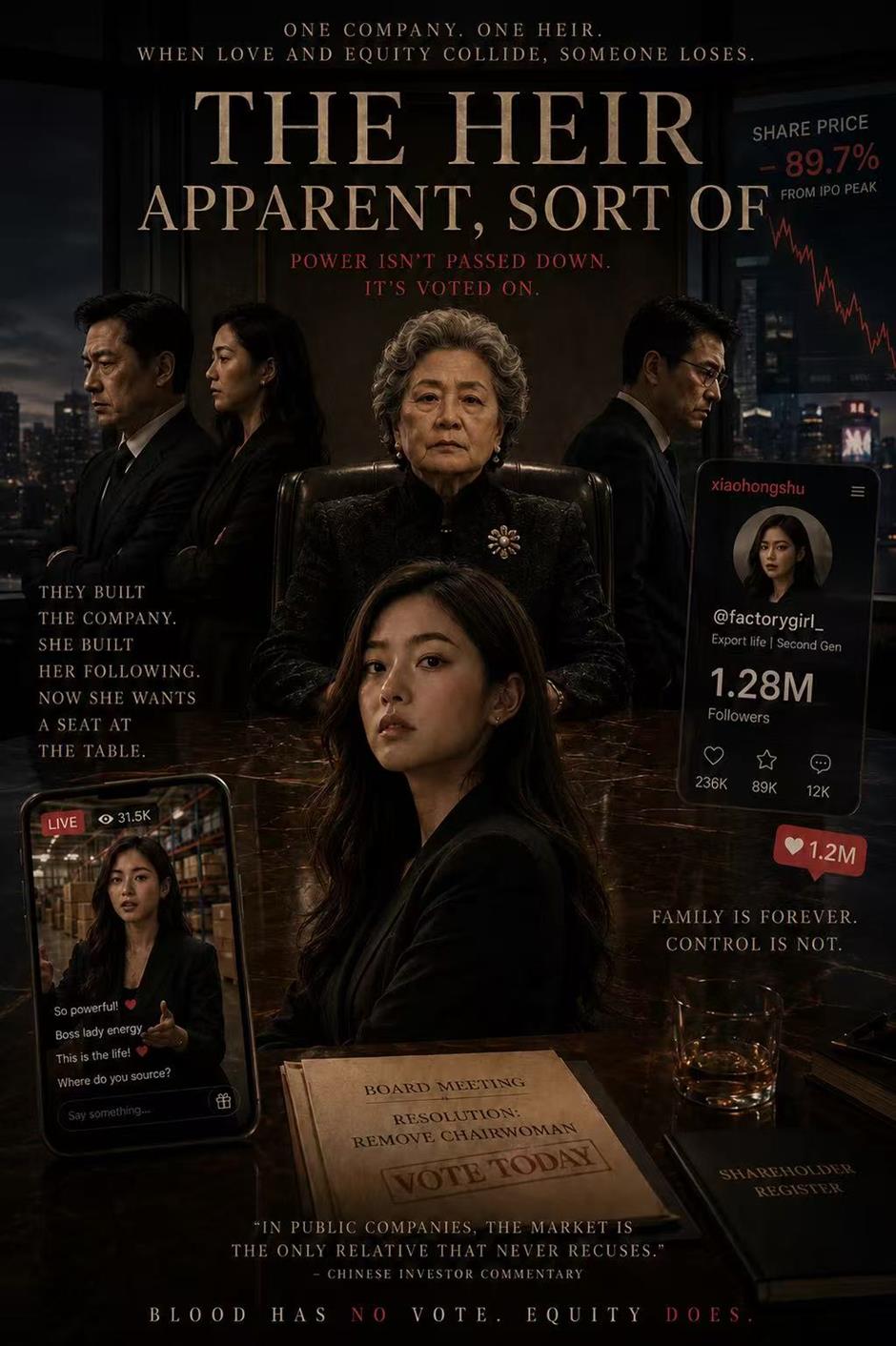
The plot is something HBO's "Succession" writers would recognize immediately: the aging patriarch, a sidelined son-in-law and a power struggle that comes down to the wire.
The scene of the Chinese version is Aojing Medical (奥精医疗), which makes bone repair materials. It's a small-cap Shanghai STAR Market-listed company, not the sort to make big headlines – until now.
The company's co-founder and business soul Cui Fuzhai died in mid-2025. His widow, Huang Wanlan, and their daughter Cui Han inherited his shares, with Cui Han's husband Hu Gang serving as chairman of the company since its listing.
Last year, there was a board shakeup and Hu wasn't renominated; the 83-year-old widow took the chairmanship instead. Seven months later, the daughter and son-in-law fought back, introducing a motion to remove mom from the board entirely. The vote, taken two days ago, failed, with 59.3 percent of shareholders voting to keep the mother as chairman. The outcome was determined by shareholders outside the family, who had already watched as their shares tumble nearly 90 percent from their post-IPO peak.
Aojing isn't an isolated case of family infighting in small companies in the past 18 months. At tyre manufacturer Double Star (双星股份), 84-year-old founder Wang Hai publicly accused his son, daughter-in-law and grandson of "stealing" the company seal and restricting his movement, ultimately losing control of the company in court. Then there was Ningbo Shanshan (杉杉股份), a supplier of lithium-ion battery products, where the death of founder Zheng Yonggang triggered a battle between his second wife and the son from his first marriage. And at Topray Solar (拓⽇新能) – in a reversal of the usual script – the parents sued their daughter to reclaim her shares.
These cases reflect a common narrative – the older generation talking about "the company I founded;" the younger generation talking about "the equity I hold."
Blood ties carry no legal weight when a company goes public and ultimate power rests with the shareholder register.
Back to the Aojing drama. Neither protagonist held a majority of shares, and related-party shareholders had to rescue themselves from the showdown vote. That left the decision to outside stakeholders with little or no knowledge of family tiffs and no particularly loyalty to any faction.
Barely two months before the vote on removing mom from the board, Aojing's annual shareholder meeting in May voted down two management proposals – one related to liability insurance for directors and executives and one on director compensation.
The naysayers' main focus was on the bottom line, not personalities. The company had just turned from a loss, its profit margins were squeezed and a new business line had yet to show itself profitable. Retail shareholders weren't voting for mom; they were voting against being taken for granted by a family that treated the company's board like a kitchen-table argument.
None of this is unique to China. Family business succession is messy everywhere – ask the Murdochs or watch four seasons of "Succession" fight over who gets Waystar Royco. But the Chinese version has a structural twist: there usually isn't a second child.
Logan Roy had four kids to pit against each other. China's heirs, for the most part, come from the one-child family era. One founding generation, one heir. When that bond breaks, there is no backup built into the family structure. Layered atop that factor is a founding generation that started companies during China's reform-and-opening-up era of the 1980s on a sort of founder-as-godfather basis.
Going public on a stock exchange changes the dynamics, ceding a lot of family control to shareholders.
Contrast Aojing's situation with that of Spring Airlines (春秋航空), whose founder Wang Zhenghua granted me a one-hour interview three years after he retired.
Wang started the airline at age 60, stepping down as chairman in 2017 in a process engineered over seven years, and handing the reins of the carrier to his eldest son Wang Yu, who had spent years working outside the family business. His younger son Wang Wei stayed on as a co-shareholder rather than rival claimant to his father's crown.
What stood out in the interview wasn't the handover mechanics but rather how he took his generation of lieutenants on annual trips together to ward off friction points that might calcify into resistance against change among old-guard executives.
Wang said he still shows up at the office but tries not to interfere too much with his son's decisions, hovering over Spring Airlines like a guardian angel.
Giant retailer Anta Sports was founded in 1991 by Ding Hemu and his son Ding Shizhong, now 56 and chairman of the company. Ding Shizhong's brother Ding Shijia and brother-in-law Lai Shixian also sit on the board of directors. The company has developed a succession plan that gives the family's second-generation business experience by operating mid-sized, growth-potential sub-brands.
Ding Shaoxiang, born in 1995, was handed the Descente brand, turning it from revenue of 200 million yuan (US$30 million) into a multi-billion-yuan business. Ding Sirong, born in 1992, took over the Kolon brand, which became Anta's fastest growing segment. The heirs-apparent are doing well, without any apparent family friction.
My friend Andrew in Yiwu is navigating a steep learning curve. He is careful and hasn't hit the point where he wants to muscle into greater company power or where a single heir threatens to break the thread of a family business.
Editor: Liu Qi
In Case You Missed It...
 Jul 26, 2026