US$50 Vanishes in the Global Gap of AI Governance
I was at home in Shanghai one evening when my phone lit up with the name of my younger brother, a university student in Bangladesh. When I picked up the call, I heard panic in his voice.
"Bhaiya," he said, "my Claude account is gone!"
He had opened his laptop that afternoon to work on an assignment due at the end of the week. He uses Claude, the Anthropic chatbot, the way students everywhere now use these tools: to check drafts, tighten arguments and catch the grammar slips that come with writing in a second language.
Anthropic accepts only international credit and debit cards, a quiet barrier in a country where local mobile wallets dominate daily payments. My brother used a Visa card from a Bangladeshi bank, issued in his own name, to pay Anthropic's US$20 fee. That afternoon, instead of the familiar chat window, he found himself locked out. He received an e-mail from Anthropic's safeguards team, with an explanation of sorts. An internal investigation had found "suspicious signals" on his account, it said, indicating a violation of the company's usage policy, and his access had been revoked. It didn't explain further.
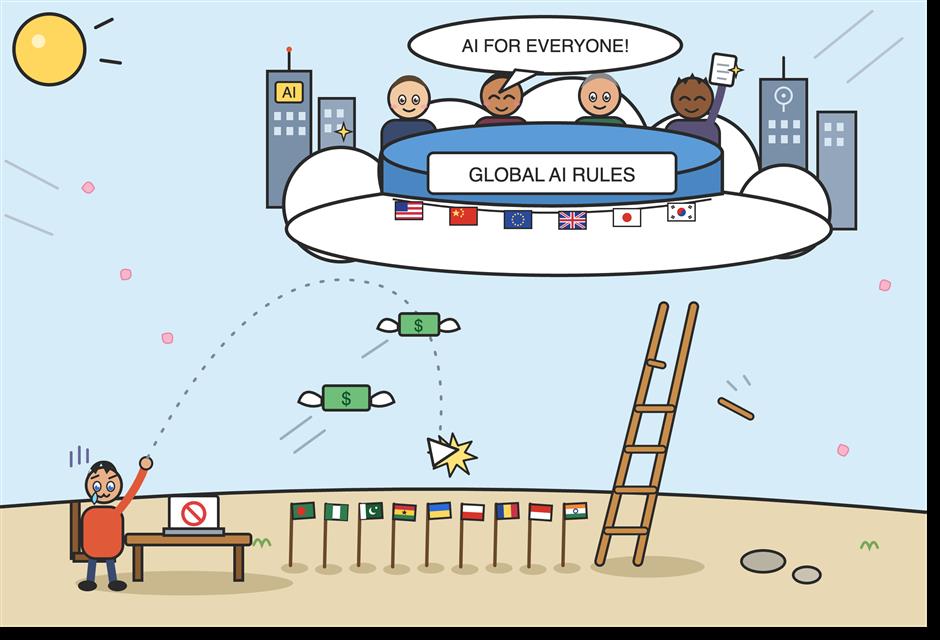
Then came a second message. In the cloying language of automated customer service, it told him his subscription payment had been refunded. He checked his statement the next day and ensuing days, but no refund appeared. The message said nothing about the US$30 dollars of prepaid usage credit he had bought separately, which vanished with the account. For a student in Dhaka, US$50 is lot of money to lose.
He did what the e-mail told him to do. He logged in, filed an appeal, explained his situation, and mentioned the school deadline bearing down on him. More than a month later, he had received no response or even any sign that his appeal had been read.
On the phone that evening, he asked me a question that lingers with me: "You live in China. Which tool should I switch to?" At 20-something, he had already learned a valuable lesson. When an AI company cuts you off from the other side of the world, the only remedy is to find another company.
One family's grievance is not a governance argument. I use Anthropic as an example not because it is a uniquely bad actor. In one respect it is better than most: It publishes enforcement data on its own transparency hub, whereas most technology companies do not.
In a disclosure report for the second half of 2025, Anthropic reported 1.45 banned accounts, with 1,700 of 52,000 appeals overturned. The figures include enforcement related to fraud, spam and abuse. They disclose the scale of enforcement and say nothing about the quality of any single decision: whether the customer learned the reason, whether anyone reviewed the appeal and whether the promised refund arrived.
One detail of his case deserves attention. Anthropic's consumer terms say that a user terminated for violating the terms gets no refund, while a subscription terminated for any other reason earns a pro-rata refund for its remaining period. My brother's ban notice alleged a usage policy violation, which means no refund was owed. Yet the company also told him his payment had been refunded.
The contradictory messages are hard to reconcile, and both sit awkwardly beside his bank statement, where no refund has appeared.
Here is the structure underneath his story. AI services now operate in most countries around the world, but each company answers to courts and regulators in only one or two. Anthropic's terms designate California law and San Francisco courts for disputes and assert that users waive claims under other jurisdictions. Lawyers debate how far such clauses hold up in any given country and if mandatory consumer protection rules can be contracted away.
For an ordinary student, though, the debate is academic. Whatever rights Bangladesh consumer law preserves on paper, enforcing them against a foreign company would cost far more than the claim is worth. Bangladesh does have a consumer protection authority, the Directorate of National Consumer Rights Protection, with a hotline and a complaint process. But a complaint against a foreign provider is hard to investigate and harder to remedy
Why call this an AI governance problem instead of normal Internet commerce? Frozen accounts and unreachable support exist in gaming and streaming too, and the consumer-law gap predates AI. What AI adds is the depth of the dependence. These accounts are becoming personalized working infrastructure. They hold accumulated conversations, custom instructions and workflows that users build their studying and livelihoods around.
Enforcement decisions themselves are increasingly automated and opaque. And a handful of foreign firms are gaining traction in developing markets faster than redress institutions can keep up. Researchers have documented the pattern in studying how Global South stakeholders are sidelined in the institutions that write AI's rules, and Global South governments have begun organizing against it, most recently through a New Delhi forum on international AI accountability.
Yet that conversation centers on sovereignty, data and national capacity. A framework that secures data sovereignty for states while leaving the individual customer without recourse will have solved the dignified half of the problem and skipped the daily half.
The daily half is fixable, and Europe has shown how. The European Union's Digital Services Act requires platforms to give users a statement of reasons when accounts are restricted, to run internal complaint systems and to provide access to out-of-court dispute settlement. Whether standalone AI chatbots fall fully within those platform rules is still contested among lawyers.
The EU service proves that reason-giving, appeals and independent dispute resolution can be imposed on major digital services at scale. Anthropic itself now publishes transparency reports under the EU act, covering enforcement and complaint-handling for the Claude.ai features within the law's scope in Europe. This procedural machinery already runs for covered services there.
A workable global baseline is not hard to sketch. Any restriction on a paying account should come with meaningful stated reasons, allowing narrow exceptions where disclosure would help bad actors evade security systems. A paying user who lodges a non-frivolous challenge to a permanent termination should get a meaningful human review and a decision within a reasonable fixed period, say 14 days – a mark my brother's unanswered appeal has long passed.
Unused paid balances should come back automatically, in a way the customer can verify, unless funds are lawfully withheld for documented fraud, sanctions or payment disputes. And the companies should be required to join an independent cross-border, dispute-resolution scheme, open to users in every market where they sell subscriptions and modeled on the ombudsman systems that already govern international banking and telecommunications. Each of these exists somewhere in law or practice today. What does not yet exist is a commitment to offer them everywhere the companies take money.
The venues for building wider commitment are taking shape. Last week, China launched the World AI Cooperation Organization, signed by 29 countries, and stated that AI governance should be inclusive and that developing countries deserve an equal say in writing the rules. Earlier this month, the UN convened the inaugural Global Dialogue on AI Governance in Geneva, which closed with a pointed message: What matters now is not new declarations but concrete actions.
Universal consumer redress is exactly the kind of step that call describes. It does not require the US and China to resolve their competition over technology chips, models and talent. Great powers have long competed while agreeing on baseline rules for shared systems, from aviation to international payments. American companies, for their part, have every commercial reason to want the durable trust of users in the emerging markets where their next billion customers live.
My brother will be fine. He found another tool, finished his assignment and moved on, the way students do. But I keep returning to that phone call, and how quickly he stopped expecting fairness and started shopping for alternatives. His shrug points to the larger risk. As dependence on a few foreign AI services deepens across the developing world, users are developing a level of skepticism that could undermine a stable foundation for the AI century.
Helping a single student in Bangladesh address an injustice may not be earth-shaking in the global scheme of things, but rules to protect consumers are important first steps in addressing larger problems.
(The author is a master's student at Shanghai Jiao Tong University.)
Editor: Liu Qi
In Case You Missed It...

 Oct 1, 2026
![[Hai Guide] A Full Spectator Guide to 2026 Rolex Shanghai Masters](https://obj.shine.cn/files/2026/09/29/03c5fbca-2b79-478a-ac69-47815adceda1_0.jpg)