Winds of Change Power China's Renewable Energy Turbine Industry
SinoArk
This column intends to take deep dives into how today's industrial change is being woven by China – its factories, markets, and clusters that provide the threads. Each story will follow a cast of people and companies – engineers and founders, suppliers and shop-floor managers – whose daily choices animate China's innovation engine. We tell their stories closely, in human scale, and then pull back to read the larger weave: How domestic design, scale and supply-chain craft ripple outward and reshape industries across continents.
For years, the story of Chinese manufacturing has often followed a predictable but brutal arc: explosive growth, ruthless competition and a "race to the bottom" in price-cutting that left trails of bankruptcies in its wake.
This self-defeating phenomenon, popularly known in China as neijuan, or involution, has plagued industries from steel to solar panels. But in 2025, China's wind power industry, the largest in the world, did something unexpected. It stopped fighting a price war.
Beginning in late 2024, winning bid prices for Chinese wind turbines, excluding towers, began stabilizing above 1,400 yuan (US$200) per kilowatt – a figure widely regarded as the base cost line for most manufacturers.
"This means the wind power industry has stopped the price war and walked out of involution," noted Qin Haiyan, secretary-general of the China Wind Energy Association.
The results were immediate and lucrative. By the third quarter of 2025, revenues for listed wind power companies surged 38 percent from a year earlier to 171 billion yuan, with net profits climbing 13 percent. The entire industry chain underwent a comprehensive recovery as turbine pricing rebounded from a low of 1,359 yuan per kilowatt-hour to 1,533 yuan.
While solar power manufacturers continue to grapple with losses and price wars, the wind sector's successful pivot offers a compelling blueprint for China. It's a story of industrial self-discipline, technological daring and a strategic pivot from selling hardware to selling intelligence. The transformation has profound implications for the global fight against climate change.
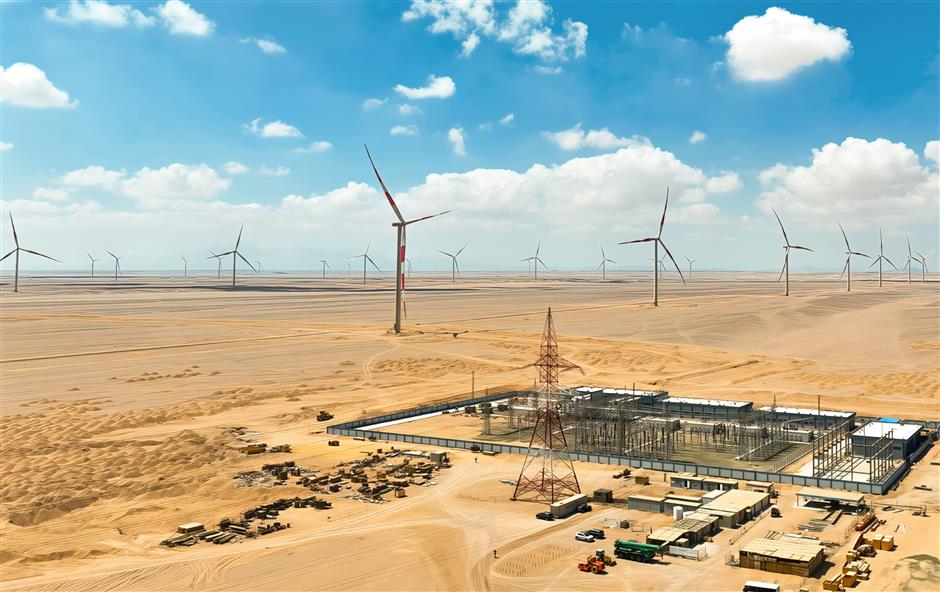
Drawing the line on cost
To understand the significance of 2025, one must look back at the scars of the past. The industry is still haunted by the memory of the 2008-10 cycle, when turbine prices plummeted from 6,000 yuan per kilowatt-hour to under 4,000 yuan. That era saw the rise and fall of Sinovel, a former industry champion that crumbled not just due to quality issues but also because of massive inventory overhang. It was holding 9 billion yuan in inventory by 2013 while revenue collapsed.
The lesson was learned. Today, the landscape is radically different. Through years of consolidation, the number of players has shrunk. By 2024, only 13 manufacturers secured new orders, with the top five commanding a staggering 75 percent of market share. Unlike the bloated inventories of the Sinovel era, new giants like Goldwind operate with lean, flexible production lines, maintaining minimal stockpiles of raw materials and finished units.
In October 2024, 12 wind turbine manufacturers linked arms to form the China Wind Energy Association, representing 99 percent of the mainland market. Its members signed a pledge of self-discipline and fair competition.
The association lacks enforcement power, but its influence proved decisive. The convention established a clear red line: companies bidding below cost would face investigation and reporting to authorities. At a summit in November 2024, 40 industry leaders, including developers and manufacturers, reached a consensus to overhaul the bidding system.
The impact was swift. The State Power Investment Corp, a leading developer, modified its tender rules for a massive 8.4 gigawatt project that same month. Whereas the the lowest bidder formerly set the benchmark, the new system set the standard at 5 percent below the average bid, and penalties were introduced for deviating too far from that average. The "lowest bid wins" system was dead. The average bid price for the project rose to 2,092 yuan per kilowatt-hour – significantly higher than previous lows.
"Price drops were becoming unbearable for everyone, manufacturers and developers alike," said a Beijing-based wind industry investor who was among a group of private investors who visited Goldwind headquarters. "Now, everyone has returned to rationality." By March 2025, major manufacturers reaffirmed their commitment to the new bidding system.
Supply chain upgrading
Stopping the price war was only the first step. To justify higher prices and restore value, the industry had to look upstream and modernize its supply chain. The wind sector shifted its focus from scale expansion to technological supremacy, with research and development investment hitting 32 billion yuan in 2024, a 65 percent increase from 2020.
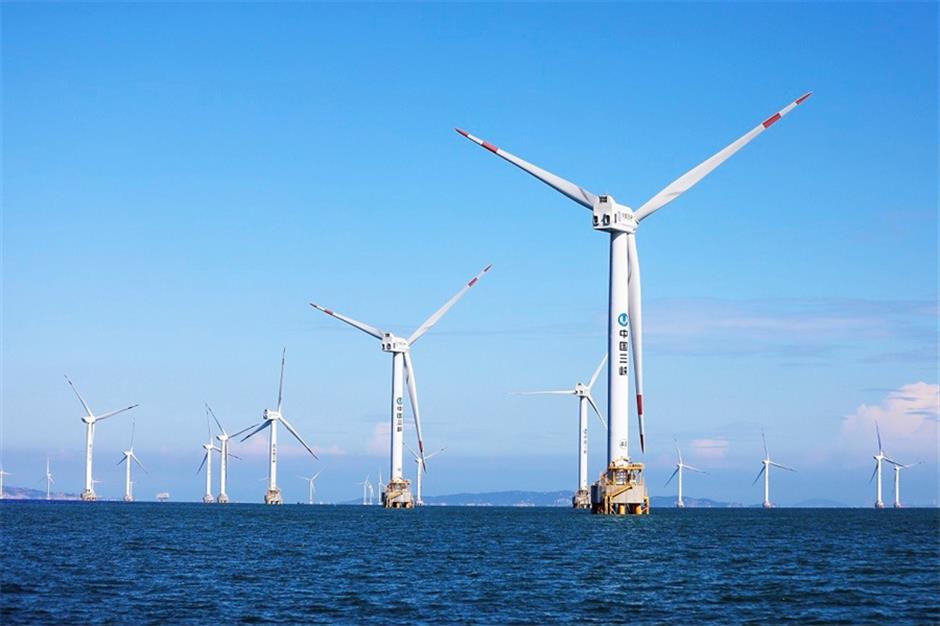
The most visible manifestation of this change was the size of wind turbines. Manufacturers pushed the boundaries of physics to develop 16 megawatt and even 20 megawatt offshore turbines. A single 16 megawatt unit can now generate 60 million kilowatt-hours a year, enough to power 30,000 households. This scaling up has been instrumental in driving the cost of offshore wind below 0.3 yuan per kilowatt-hour.
However, the real revolution occurred inside the nacelle, the housing covering generating components in a wind turbine. For years, critical components like main shaft bearings were the chokepoint of Chinese wind power, monopolized by European giants like Sweden's SKF and Germany's Schaeffler. The push for larger turbines necessitated a domestic breakthrough.
Chinese firms like Wafangdian Bearing and LYC Bearing, working in close collaboration with wind turbine OEMs including Envision Energy, rose to the challenge by developing main shaft and yaw/pitch bearings for 2.5-16 megawatt turbines, with lifespans exceeding 15 years. This innovation shattered the foreign monopoly, driving the localization rate of wind-turbine bearings from 30 percent in 2020 to 65 percent in 2024. The economic impact was profound because domestically made bearings cost 20-30 percent less than imports.
Similar strides were made in subsea cabling. Companies like ZTT Group and Hengtong Group mastered submarine cable technology that cut losses from transmissions by offshore turbines up to 25 percent.
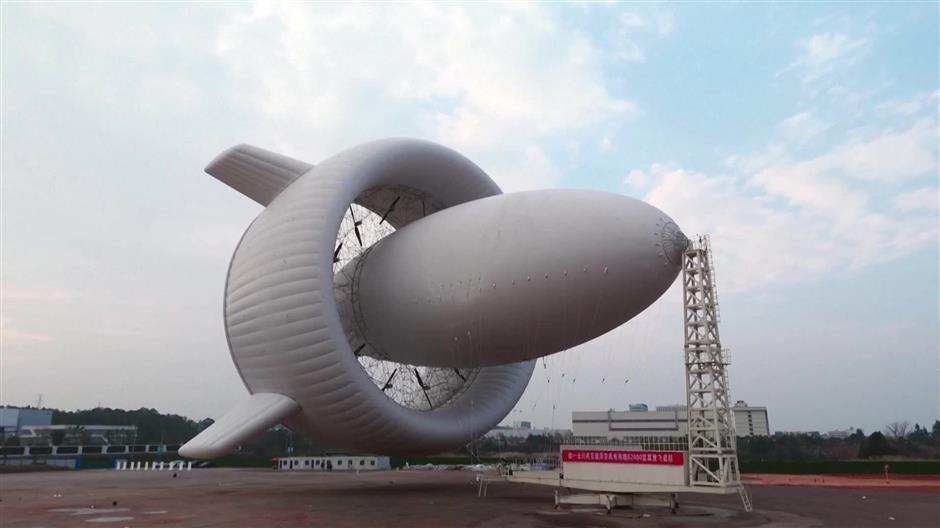
When algorithms meet air currents
Perhaps the most sophisticated evolution in China's wind sector is the industry shift from merely selling hardware to producing renewable energy platforms, powered by artificial intelligence.
The driving force behind this shift is the evolving nature of the energy market. As wind power integrated deeper into the grid, it faced the problem of profitability affected by the inherent unpredictability of the weather.
"In the first half of the year, not a single wind project passed our investment committee because we couldn't calculate the returns," lamented one developer.
Companies once again rose to the challenge, led by Envision Energy. The company has argued that the era of simply pursuing installed capacity is over. The new game is about "when to generate electricity and how much is most profitable."
Envision's solution is the integration of "bits and watts" – a merging of digital intelligence with physical machinery. The company announced the launch of Tianji large-scale weather foundation model and Dubhe energy foundation model, designed to shape the world's largest Physical AI system – the AI energy system.
Dubhe sits at the core of Envision's Physical AI architecture, analyzing vast real-world energy data streams to orchestrate renewable generation, storage, grids, and demand in real time. Tianji provides the predictive intelligence that allows Physical AI to anticipate and respond to weather-driven variability, improving wind speed prediction accuracy significantly, ensuring the energy system operates efficiently and reliably at scale.
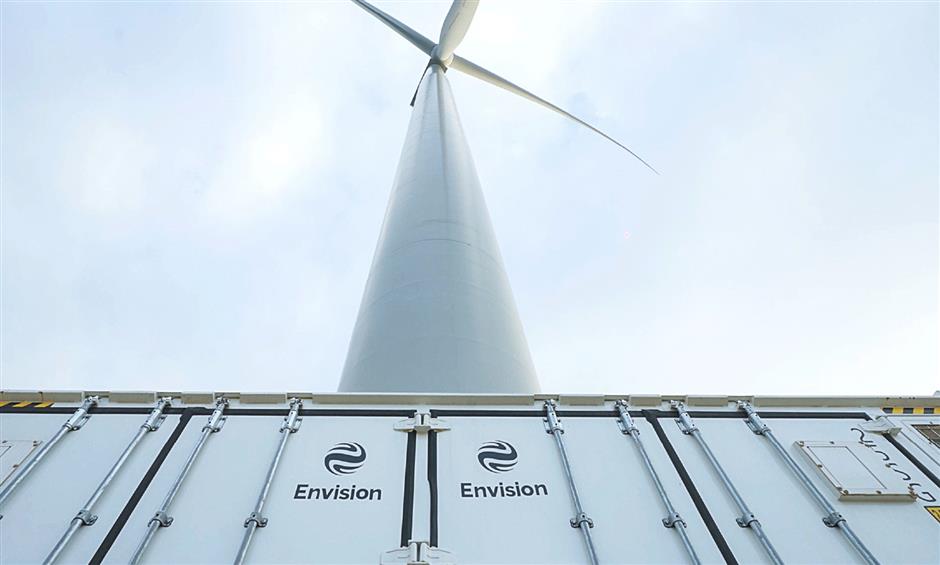
This capability birthed the Envision wind-storage turbine, which fully unlocks the synergies between wind and storage, increasing energy output while lowering LCOE, and enhancing investment returns through power market trading. It actively supports the grid and can even operate in "island mode" during outages, ensuring the ability to autonomously withstand extreme conditions, such as typhoons.
"Language models understand words. Physical AI understands the world. Energy is the foundation of all systems. This isn't just an energy transition. It's a civilizational upgrade, laying the foundation for human prosperity within planetary boundaries," said Zhang Lei, founder and CEO of Envision.
Frontiers offshore and overseas
With the domestic price war quelled and technology upgraded, China's wind giants have turned their gaze toward two frontiers: the deep ocean and the global market.
Off the coast of Fujian Province this month, China successfully installed the world's first 20 megawatt wind turbine. Standing in waters over 40 meters deep and 30 kilometers from shore, the project involved hoisting 147-meter blades to a hub height of 174 meters, creating a rotor sweep equal to 10 football fields.
This engineering marvel cements China's emerging dominance in offshore wind. The country has led the world in new offshore capacity for seven consecutive years. Coastal provinces like Jiangsu and Guangdong have each surpassed 10 gigawatts of installed capacity, effectively placing power generation right next to the economic centers that need it most and alleviating strains on the West-to-East power transmission grid.
At the same time, China's wind power industry is looking for new markets abroad. In the first eight months of 2025 alone, wind turbine exports surged 19 percent to over US$1.06 billion.
Despite protectionist barriers facing Chinese electric vehicles and solar panels, and US President Donald Trump's stated disdain for wind power, Chinese wind turbines are finding no shortage of eager foreign buyers. Analysts at Guosheng Securities estimate that Chinese turbines are priced 19-24 percent lower than Western counterparts in overseas markets and offer 40 percent shorter delivery times.
This competitiveness is not just about cheap labor; it's about an well-oiled industrial ecosystem. Goldwind leveraged the system to build Africa's largest wind project, located in Egypt. Mingyang Smart Energy is not only fulfilling massive orders from Saudi Arabia but is also investing over 14 billion yuan to build a manufacturing base in Scotland. Envision Energy, the global leader in orders for three years running, secured orders totaling over 40 gigawatts in 2025, with a footprint expanding from India to the Philippines.
Companies are exporting technological expertise as well as products, supplying advanced components like 25 megawatt grid-forming converters and capturing niche markets in Europe for subsea cables and bearings. With financial backing from state policy banks offering low-interest loans for overseas expansion, the global footprint of Chinese wind power shows every sign of getting increasing bigger.
(The author specializes in the international expansion of Chinese tech companies in the advanced hardware and energy sectors. He also serves as a geo-economic expert for several think tanks in Beijing.)
In Case You Missed It...

 Apr 17, 2026