Huawei Unveils 'Tau Scaling Law' in Chip Design Breakthrough
Huawei Technologies has proposed an alternative roadmap for semiconductor development, projecting that its new design methodology will enable high-end chips to achieve a transistor density equivalent to advanced 1.4-nanometer (nm) processors by 2031.
The strategy was unveiled today by He Tingbo, president of Huawei's semiconductor business and director of its Scientist Committee, during a keynote speech at the 2026 IEEE International Symposium on Circuits and Systems (ISCAS) in Shanghai.
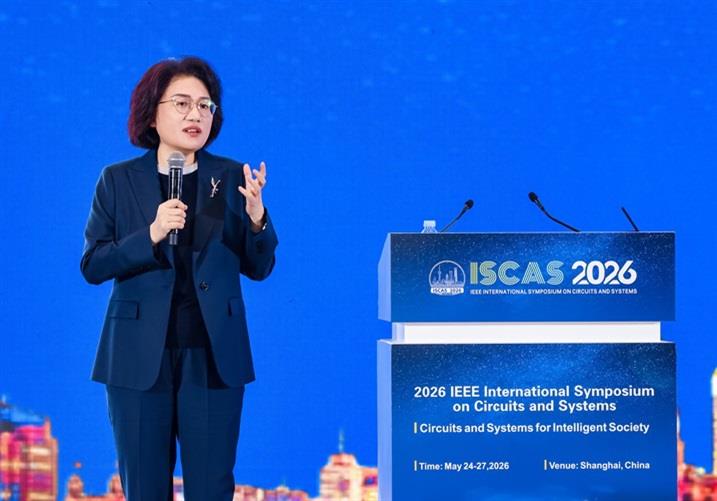
Unlike traditional Moore's Law, which shrinks transistor dimensions, the Tau Scaling Law focuses on "time scaling" – systematically compressing signal propagation delays across devices, circuits, chips and systems.
A core component of this strategy is the "Logic Folding" architecture.
According to a corporate statement published on Huawei's official newsroom, the Shenzhen-headquartered company has spent the past six years developing this framework, having already designed and mass-produced 381 chips utilizing principles aligned with the Tau Scaling Law across consumer and artificial intelligence (AI) markets.
The next phase of deployment is scheduled for the fall of 2026, when Huawei plans to launch its next-generation Kirin smartphone processors, which will be the first commercial chips to officially integrate the LogicFolding architecture.
Looking ahead, Huawei aims for its high-end chips designed under this law to reach a transistor density equivalent to global 1.4-nm processes by 2031. For reference, industry leader Taiwan Semiconductor Manufacturing (TSMC) plans to begin mass production of its conventional 1.4-nm process in 2028.
By targeting performance leaps through architectural innovation rather than finer lithography, the approach aims to circumvent restrictions on advanced EUV (extreme ultra-violet) equipment. Investors view the strategy as a potential path to lessen China's reliance on imported chipmaking tools.
The announcement lifted sentiment in China's tech sector. Shares of Semiconductor Manufacturing International Corporation (SMIC), the largest contract chipmaker in Chinese mainland, rose 18 percent on the Shanghai Stock Exchange on Monday as investors bet that Huawei's design-level breakthroughs could improve performance using existing manufacturing nodes.
Editor: Liu Qi
In Case You Missed It...

 Oct 6, 2026
![[ChinaMaxxing] The Weather We're Having Now Is Called Hanlu](https://obj.shine.cn/files/2026/10/06/b7375dbf-9c63-45c4-9bb8-6e7642996189_0.jpg)
![[Cultural Mosaic] Theater as a Bridge: Cross-Cultural Co-Creation is About Building Equal Dialogue](https://obj.shine.cn/files/2026/09/30/f397224f-18e9-4135-adf9-0eead315b847_0.jpg)