Minhang Business and Investment Spotlight
Yangtze Delta R&D cluster zone opens
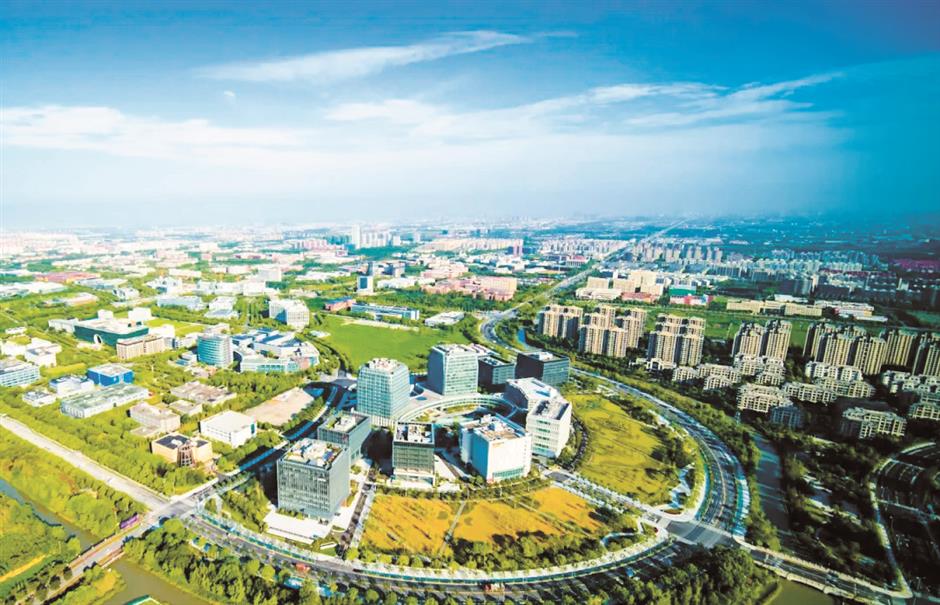
The Yangtze River Delta Manufacturing R&D Cluster Zone was launched last month at the Minhang Investment Promotion Conference.
This cluster zone is an innovative way to integrate scientific and technological innovation with industrial innovation in the Yangtze River Delta.
It uses Hongqiao International Central Business District and Minhang District strengths in scientific and technological innovation, talent concentration and industrial development to develop an R&D-driven economy.
In the Hongqiao Central Business District (Minhang), it aims to create a Yangtze River Delta hub for scientific and technological innovation and a new model of cross-regional industrial collaboration.
Xinzhuang Town, Jiangchuan Road Subdistrict and Nanhongqiao Group presented regional characteristics, industrial resources and business support services.
Aerospace, biopharmaceuticals and advanced energy equipment and green low-carbon technologies have driven district growth.
Minhang is positioning itself for growth in brain-computer interfaces and low-altitude economies. The district's land resources bureau planned its spatial layout from 2026 to 2030 to advance high-quality land development in 10 major industrial zones, including Minhang, Xinzhuang and Zizhu.
Estée Lauder launches China Fulfillment Center
Estée Lauder Companies unveiled its China Fulfillment Center in Xinzhuang Industrial Park in Minhang District in late March. The facility is one of the first in the beauty industry to use a "dual-warehouse linkage" model to integrate customs-supervised and domestic inventory.
This facility, one of the company's most automated omnichannel fulfillment centers, powers its supply chain in China for all sales channels, including e-commerce platforms and offline retail stores, providing integrated logistics services for the company's entire brand portfolio.
Stéphane de La Faverie, President and CEO of Estée Lauder Companies, said they are optimizing their regional footprint to deliver beauty products faster, more reliably and efficiently by improving their digital and intelligent supply chains and investing in infrastructure.
With automated storage, goods-to-person picking and high-speed sorting, it enables round-the-clock "lights-out" operations. It processes over 400,000 orders daily. An AI-powered, end-to-end supply chain management platform optimizes omnichannel fulfillment, nearly doubling one-day delivery coverage by 2021.
"Our new China Fulfillment Center is not just about expanding capacity; it is about building a smarter, more resilient and more synchronized value chain that can support our ongoing growth," said Roberto Canevari, executive vice president, chief value chain officer of Estée Lauder Companies.
The company's Open Innovation Center was also unveiled. It will collaborate with local universities, research institutions and medical organizations to connect regional innovation resources and work with local start-ups and emerging technology companies.
AI software standards established
China's intelligent economy and industrial development were discussed at the Grand neoBay's first Embodied Artificial Intelligence Technology Ecosystem Conference in late March by government officials, industry leaders and researchers. The event established humanoid robotics AI hardware and software standards to improve supply chain coordination and industry unification.
The Global Embodied AI Ecosystem Co-Build Plan aims to remove barriers to collaboration and help the industry standardize.
Shanghai-based high-tech company Mscape partnered with nearly 20 robotics companies, including Unitree, Fourier and iFlytek, for a full-chain ecosystem for technology development, product deployment, scenario testing and commercial operations.
Twin meets talk up sci-tech support
NEOTECH 2026 and the Grand neoBay Innovation and Technology Ecosystem Conference was held last month in Minhang District to promote industry exchange and multi-tiered capital support for science and technology enterprises throughout their life cycle.
Ten outstanding innovative companies and 10 technology innovators were named to the 2025 Grand neoBay High-Quality Science and Technology Innovation Enterprises & Entrepreneurs Influence List.
Nearly 120 representatives from government departments, technology and innovation enterprises, universities and research institutes, financial institutions and professional service platforms attended the immersive and interactive event.
Participants discussed ways to foster new-quality productive forces, high-quality regional technological innovation and development and start-up growth.
Meanwhile, eight sub-funds of the Grand neoBay Science and Technology Innovation Source Fund were launched.
They target biopharmaceuticals, artificial intelligence, advanced manufacturing, future energy and brain science fully aligning with the region's key industrial development priorities.
Editor: Li Qian