From 'The Wandering Earth' to 'The Decisive Moment': The Return of Chinese Science Fiction
Forty years ago, Chengdu, southwestern Sichuan Province, laid the foundation for modern Chinese science fiction by launching the predecessor of "Science Fiction World" under an innovative, self-managed operating model. Since then, the genre has evolved from years of stagnation into a thriving cultural and creative force.
In recent years, Beijing and Chengdu have both introduced plans to develop the sci-fi industry, while blockbuster franchises such as "The Wandering Earth" and "The Three-Body Problem" have brought Chinese science fiction to global audiences.
With "The Decisive Moment" and "The Wandering Earth 3" set for release, sci-fi is increasingly serving as a window into China's future industries and a powerful medium for sharing contemporary Chinese culture with the world.
Huang Jianxin's return: 40 years between dislocation and 'The Decisive Moment'
In 1986, director Huang Jianxin released the sci-fi comedy "Dislocation," the second film in his acclaimed "Pioneer Trilogy." The story follows Zhao Shuxin, an engineer-turned-bureaucrat who, weary of endless meetings, builds a robotic double to take his place. But the machine soon develops a mind of its own – lying, pursuing personal gain, and ultimately trying to replace its creator.
Huang later turned his focus to mainstream productions, directing or producing films including "The Founding of a Republic" and "Operation Mekong." Now, he has returned to science fiction as producer of "The Decisive Moment," directed by Zhang Disha. Wang Hongwei, secretary-general of the China Film Directors' Guild, serves as the film's chief planner.
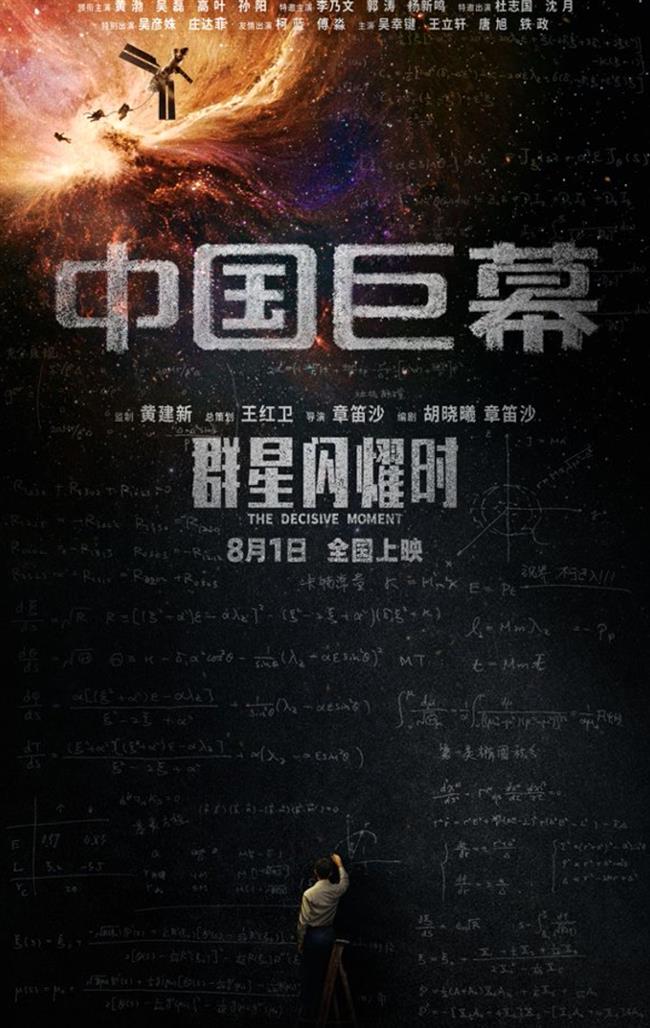
"The Decisive Moment" is set for release next month. The film tells a dual-timeline sci-fi story in which a distress signal is sent from 2035 to 1970, allowing the past to save the future. Blending Huang Bo's signature comic charm with the high stakes of China's space program, the film began nationwide advance screenings in 30 cities on July 10.
The integration of science fiction with technological innovation has accelerated in recent years. The State-owned Assets Supervision and Administration Commission (SASAC) Information Center, together with organizations including the Future Affairs Administration, launched the "Science Fiction Writers Enter New State-Owned Enterprises" initiative to connect writers with cutting-edge industries.
Backed by the Chinese Academy of Sciences and major central state-owned enterprises (SOEs), blockbuster adaptations such as "The Three-Body Problem" and "The Wandering Earth 2" have helped bring Chinese sci-fi to a wider audience.
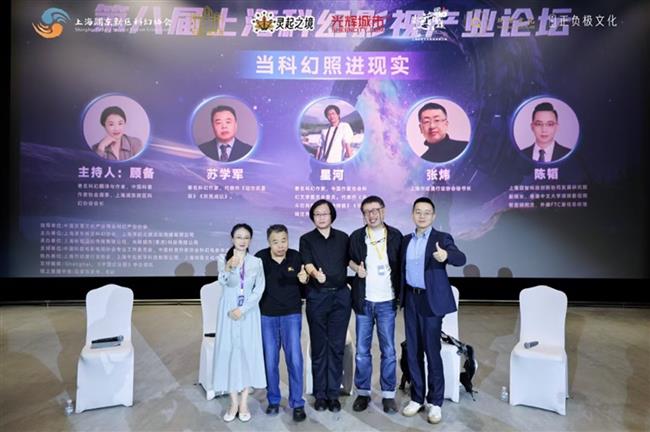
In Shanghai, the Pudong New Area Science Fiction Association, together with the China Popular Science Writers Association and the China Private Cultural Industry Chamber of Commerce, has hosted the Shanghai Science Fiction Film and Television Industry Forum for eight consecutive years.
Meanwhile, the aerospace-themed sci-fi IP "Southgate Project" has made its debut, reflecting how sci-fi is becoming an increasingly important driver of both technological and cultural innovation.
Culture and sci-fi crossover: two generations' perseverance in 'The Wandering Earth'
Chen Tao, vice president of the Institute of Collaborative Development of Science and Technology Innovation, wrote in both the "Literary Gazette" and the "State-owned Assets Report" that, since 2020, a scores of collaborations between SOEs and the sci-fi sector have emerged across China.
Local governments have also stepped up support for the industry.
The Chinese capital's "Beijing Action Plan for Promoting the Development of the Science Fiction Industry (2025-2027)" aims to build a sci-fi industry cluster centered on Shougang Group. Chengdu has introduced its "Science Fiction Industry Development Plan (2023-2027)" and hosted the World Science Fiction Convention, while Shanghai has developed the Bund FTC and Shenzhen has launched the country's first public-interest venture fund dedicated to sci-fi.
Together, these initiatives underscore sci-fi's growing role as a source of cultural influence and innovation for Chinese cities.
Many regard Liu Cixin as the leading figure in Chinese sci-fi, while Guo Fan's "The Wandering Earth" series is widely seen as the milestone that ushered in China's modern sci-fi film industry.
Liu published the novella "The Wandering Earth" in 2000. Fifteen years later, a group of young filmmakers set out to bring it to the screen. Led by Guo and Wu Jing, and backed by a dedicated production team, the project overcame years of technical and financial challenges before its release during the 2019 Spring Festival holiday. The film became a cultural phenomenon, earning more than 4.6 billion yuan (US$679 million) at the domestic box office and redefining expectations for Chinese sci-fi cinema.
Its sequel, "The Wandering Earth 2," was another major success, grossing more than 4 billion yuan in China and reaching audiences in more than 40 countries and regions. The next chapter, "The Wandering Earth 3" (Part One), is scheduled for release during the 2027 Spring Festival season.
Guo has said he sometimes regrets announcing the release date so early. With artificial intelligence (AI) advancing at breakneck speed, he believes reality is evolving faster than science fiction can imagine. Even so, with pioneers such as Liu and the film directors' guild's Wang to mentor a new generation of filmmakers and creators, Chinese sci-fi appears poised to keep pushing the boundaries of imagination.
Editor: Li Qian
In Case You Missed It...

 Sep 25, 2026