The Dog Days and the Art of Lying Low: A Chinese Philosophy for Extreme Heat
As the Northern Hemisphere swelters under a relentless July sun, millions will instinctively seek refuge in the blast of air-conditioning and the chill of ice water. Our modern reflex is to fight the heat, to build climate-controlled fortresses against nature's extremes.
But on July 15, as the traditional Chinese calendar officially ushers in this year's sanfu (三伏) – the most intense 40-day stretch of the Chinese summer – a radically different philosophy takes over. In Chinese culture, the peak of summer is not merely endured; it is navigated through a sophisticated, centuries-old framework that demands a counter-intuitive approach: to survive the heat, one must actively guard against the cold.

The philosophy of strategic retreat
In Western culture, this sweltering period is known as the Dog Days, a term rooted in ancient Roman astronomy when the Dog Star, Sirius, rose with the sun, signaling a season of drought and lethargy. While neighboring countries in East Asia have adopted similar summer concepts due to historical cultural exchange, sanfu remains a uniquely Chinese meteorological and medical marker.
To truly grasp this philosophy, one must look at the Chinese character fu (伏) itself. Traced back to its ancient roots, fu depicts a person lying low, much like a dog resting in the shade, symbolizing the act of hiding or taking shelter.
In the context of sanfu, the character carries a profound double meaning. It is a reminder for humans to "lie low" and avoid the harsh midday sun, but it also reflects the ancient Chinese "five elements theory." With summer dominated by the fierce Fire element, the Metal element of the approaching autumn is forced to hide and bide its time. Thus, fu is not merely about enduring the heat; it is a philosophical posture of strategic retreat. It teaches us that when faced with overwhelming external forces, true strength lies in lying low, preserving inner energy, and waiting for the right moment to emerge.
A 40-day window for healing
This year's sanfu period is particularly notable.
Following the ancient Chinese lunisolar calculation of "counting the geng (庚) days after the Summer Solstice," this year's cycle spans a grueling 40 days, fueled by an extended 20-day zhongfu (中伏 middle fu) phase. Furthermore, 2026 is a Fire Horse year in the Chinese zodiac, promising an intensely hot and humid summer.
Yet, in traditional Chinese medicine (TCM), a longer sanfu is not a curse; it represents a period of abundant yang energy, offering an unparalleled opportunity to heal the body's deepest imbalances.
The most striking aspect of the Chinese sanfu is its core tenet regarding modern conveniences. According to TCM physiology, the body's yang energy reaches its zenith during this period. Blood vessels dilate, and pores open wide to release heat, leaving the body highly vulnerable to invading cold. A sudden blast of artificial air-conditioning or the consumption of ice-cold beverages is viewed as an insidious threat. This artificial chill can penetrate the open pores, driving hanxie (寒邪), or cold evil, deep into the internal organs and disrupting the digestive system. Thus, the true art of Chinese summer survival lies in maintaining thermal balance, keeping the neck and upper back warm, and favoring room-temperature water over ice.
This 40-day cycle is not a monolith; it is carefully divided into three distinct phases, each serving a specific physiological purpose.
Chufu (初伏 early fu) marks the beginning of the extreme heat, signaling the body to open its pores and priming it for therapeutic intervention. Zhongfu, which spans a grueling 20 days this year, represents the absolute zenith of yang energy and humidity. In TCM, this is the most critical window for expelling deeply rooted cold, as the body's defenses are at their most receptive. Finally, mofu (末伏 late fu) arrives after the onset of autumn.
As the fierce heat begins to wane and the body's yang energy starts to gather inward, this final phase acts as a crucial consolidation period, sealing in the therapeutic benefits and preparing the body's defenses for the approaching winter. This rhythmic progression reflects a profound respect for the gradual shifts of nature.
Culinary paradoxes and herbal patches
This Chinese philosophy of paradoxical balance extends directly to the dining table. While Westerners might instinctively reach for a frozen treat, traditional Chinese wisdom advocates yi re zhi re (以热治热), or fighting heat with heat. During sanfu, it is customary to consume warming foods like mutton or chicken. These meats stimulate circulation and help expel the accumulated cold and dampness from the body, replenishing proteins lost through profuse sweating. Concurrently, bitter, water-rich vegetables like bitter melon and winter melon are eaten to clear internal toxins. This culinary application of yin-yang maintains the body's delicate internal ecosystem amidst external extremes.
Perhaps the most profound expression of this Chinese wisdom is the concept of dong bing xia zhi (冬病夏治), or treating winter diseases in summer. Based on the ancient Chinese medical classic "Huangdi Neijing" (黄帝内经 "The Yellow Emperor's Inner Canon"), this practice leverages the peak summer yang energy to fortify the body's defenses.
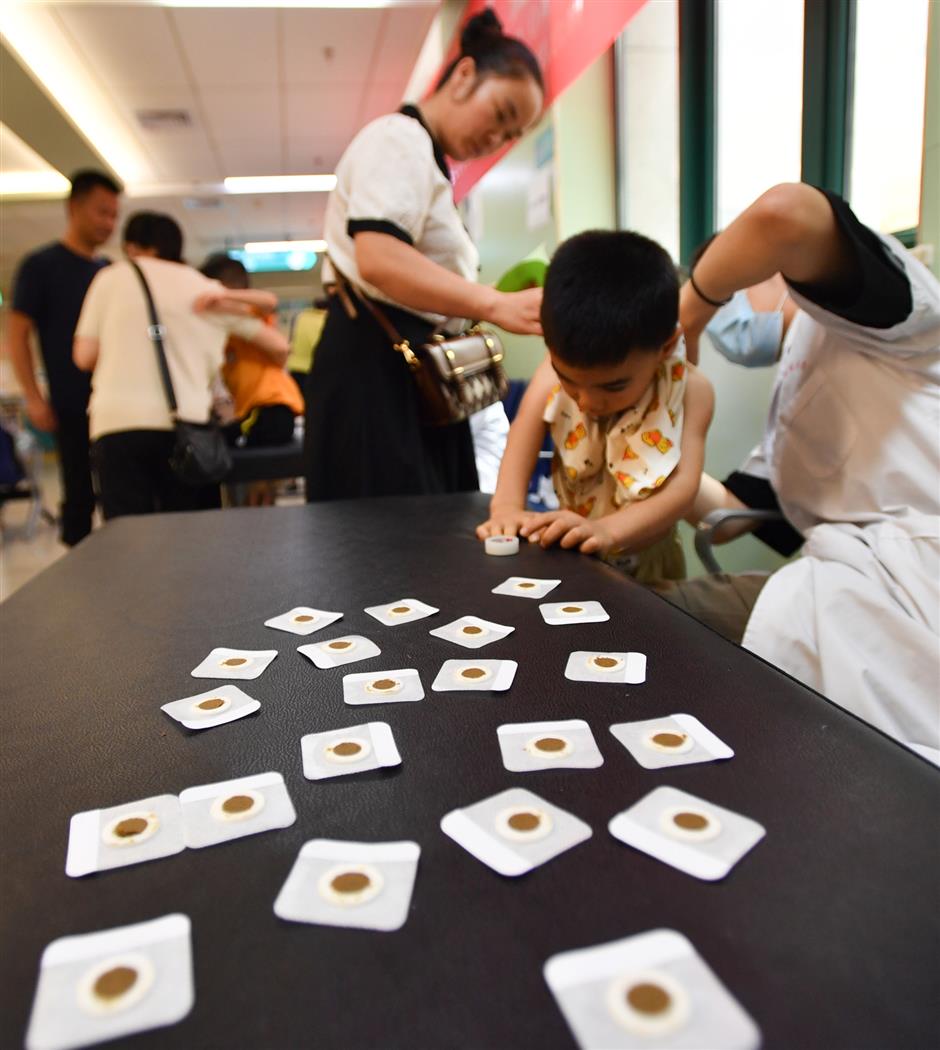
A prime example is the traditional Chinese herbal patch therapy, known as sanfu tie (三伏贴), or literally, dog days patch. Practitioners apply patches infused with warming herbs like white mustard seed (白芥子 baijiezi) and asarum (细辛 xixin) to specific acupoints. With the body's pores fully dilated during sanfu, the medicinal properties easily penetrate the skin and flow through the meridians to expel deeply rooted cold and dampness. This therapy aims to eradicate chronic ailments – such as asthma, allergic rhinitis, or arthritis – that typically flare up in the freezing winter. It is a masterclass in long-term thinking: using the fire of July to build resilience for the ice of January.
Synchronizing with the land
Beyond personal health, sanfu dictates the rhythm of the land in Chinese agricultural history. Proverbs like "plant carrots in early fu, and cabbages in middle fu" underscore a profound synchronization between human activity and natural cycles. The sweltering heat is not an obstacle to farming, but an indispensable catalyst for the coming harvest.
Ultimately, the arrival of sanfu on July 15 serves as a powerful metaphor for navigating modern life's pressures. In an era defined by climate anxiety and relentless productivity, the Eastern approach to the sanfu period offers a radical alternative. It teaches us that when faced with overwhelming heat, we should neither panic nor fight. Instead, we must adapt, protect our inner core, and harness the intensity of the moment to cultivate lasting strength.
(The author, who earned a PhD in linguistics at the University of Illinois Urbana-Champaign, is a professor of English and college dean at Sanda University, Shanghai.)
Editor: Liu Qi
In Case You Missed It...
![[Quick News] Typhoon Bavi Gathers Strength, Bringing More Wind and Rain to City](https://obj.shine.cn/files/2026/07/11/d929698f-539b-4889-ba59-c9f6ed1208e9_0.png)
 Jul 11, 2026
![[Quick News] Heat and Wind Alerts Replace Typhoon Bavi](https://obj.shine.cn/files/2026/07/13/e4ed9e9b-915d-4778-8b18-e0d54e699de7_0.jpg)
![[Quick News] Typhoon Bavi Makes Landfall Twice, Weakens as It Moves Inland](https://obj.shine.cn/files/2026/07/12/45097d9a-145e-4244-b7dc-75c5025b1ecb_0.jpg)
![[Quick News] Shanghai Shuts Parks, Ferries and Attractions as Typhoon Bavi Closes in](https://obj.shine.cn/files/2026/07/11/5c43c44e-fdb3-4be0-9c05-147e9d58afc0_0.jpg)
