AI Dynamic Shifts as China's Token Surge Transfers 'Digital Electricity'
SinoArk
This column intends to take deep dives into how today's industrial change is being woven by China – its factories, markets, and clusters that provide the threads. Each story will follow a cast of people and companies – engineers and founders, suppliers and shop-floor managers – whose daily choices animate China's innovation engine. We tell their stories closely, in human scale, and then pull back to read the larger weave: How domestic design, scale and supply-chain craft ripple outward and reshape industries across continents.

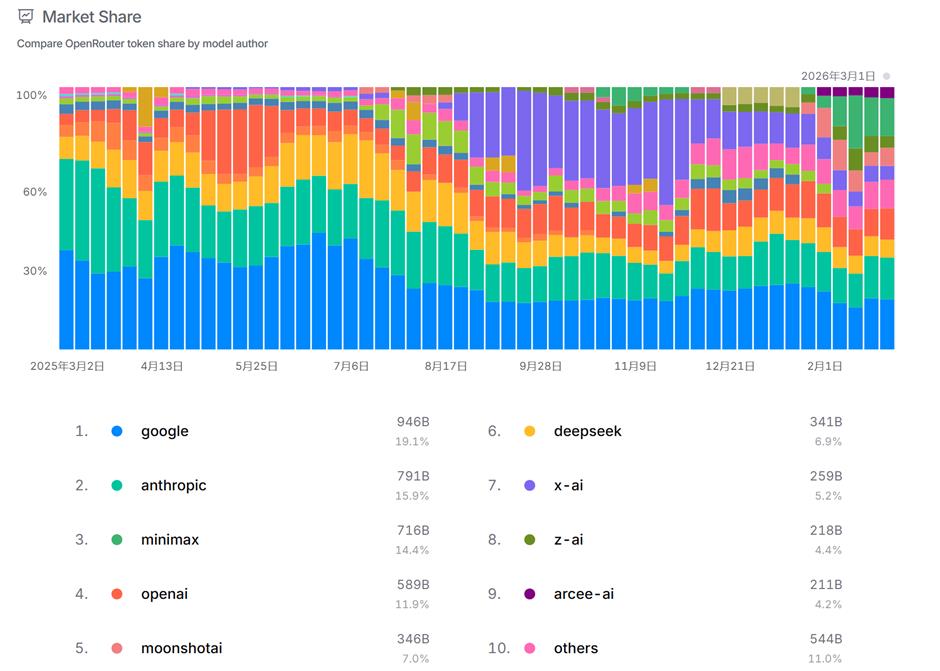
The global artificial intelligence landscape might have reached a historic inflection point in February. Data from OpenRouter, the world's largest aggregator for large language model programming interface, revealed a startling shift. For the first time, Chinese models accounted for 61 percent of the total token consumption among the platform's top 10 models.
During the week of February 9-15 that preceded the nine-day Chinese New Year holiday, mainland models recorded 4.1 trillion tokens in call volume, surpassing the 2.9 trillion tokens generated by US models during the same period. Within just three weeks, the call volume for these Chinese models surged by 127 percent.
This "statistical anomaly" represents a fundamental change in how AI is consumed and integrated into the global economy. To understand this shift, one must first understand what a "token" is. In the world of AI, a token is the fundamental unit of data processing – roughly equivalent to 0.75 English words or 1.5 Chinese characters.
Crucially, token consumption is not just a "word count" of a conversation; it represents every logic deduction, every self-correction and every tool call the AI performs. High token volume is difficult to "fake" because it requires real users executing complex, multi-step tasks that trigger massive computational cycles.
The data from last month shows that four of the top five most-called models globally were all Chinese: MiniMax's M2.5, Moonshot AI's Kimi K2.5, Zhipu AI's GLM-5 and DeepSeek's V3.2. Together, these four models comprised 86 percent of total call volume among the top five aggregated by OpenRouter. MiniMax M2.5, in particular, had its weekly call volume explode to 3.1 trillion tokens shortly after release, exceeding the combined total of the other three leading Chinese models.

However, these figures should be viewed with cautious optimism. Much of this initial surge was driven by the Chinese domestic market. During the 2026 Chinese Lunar New Year period, major Chinese AI firms like ByteDance, Alibaba and Tencent launched aggressive marketing campaigns for their app, offering free trials and gifts totaling millions in value.
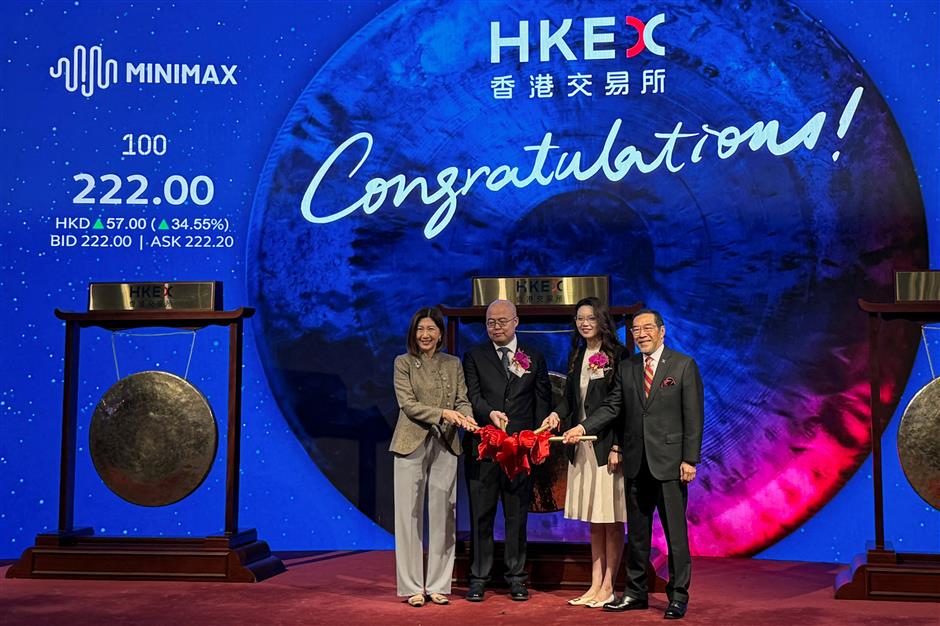
Most companies have seen their valuations soar. Moonshot AI is now valued over US$10 billion, and these firms are using promotions to bolster data performance after the initial public offerings or new rounds of fundraising.
Despite these short-term drivers, the long-term significance of token consumption cannot be overstated. For AI models, token usage is the lifeblood of optimization. Just as internet companies rely on user data to refine their products, AI models require continuous engagement in diverse, real-world scenarios to improve machine-training, terminal adaptation and iterative features.
According to Andrew Ma, a member of the technical staff at xAI, "every token consumed is essentially a 'training' moment, making the model more precise, efficient and better aligned with real-world needs".
This is supported by the "State of AI" report by OpenRouter, which shows that programming tasks grew from 11 percent of token usage in early 2025 to over 50 percent by 2026, becoming the single largest category of usage. This shift toward complex, high-frequency engineering tasks is rapidly maturing the operational excellence of the global AI supply chain.
The true potential for these models lies in their international expansion. Two recent milestones underscore this trend: the successful acquisition of the AI startup Manus by Meta, which signaled global recognition of Chinese AI engineering, and the explosion of OpenClaw, an open-source agent framework that reached over 210,000 stars on GitHub within weeks.
OpenClaw represents a paradigm shift from chatbot AI to AI agents. An agent can autonomously control an operating system, execute terminal commands and manage complex workflows. While traditional AI conversations might consume a few thousand tokens, an agent like OpenClaw running multiple background sub-tasks can trigger an exponential surge in token usage.
This is where the Chinese AI supply chain has found its "hook." In a world where US giants like Anthropic charge US$5 per million input tokens and US$25 per million output tokens for their flagship model Claude Opus 4.6, Chinese models like MiniMax M2.5 offer comparable performance for a fraction of the price – 30 US cents per million input tokens and US$1.10 per million output tokens. We are talking about a price differential of up to 22 times.
As OpenRouter Chief Operating Officer Chris Clark noted, the high market share of Chinese open-weight models is largely driven by their integration into the automated agent workflows of US developers.
A European development studio recently reported that it runs 80 percent of its routine reasoning on Kimi K2.5 and reserves expensive models like Claude only for the most difficult 20 percent of their architecture. This strategy is a massive boon for developers in emerging countries and for mid-to-low income groups who want to participate in the new AI economy but can't afford premium subscription fees. By drastically lowering the barrier to entry, the Chinese AI stack is helping to democratize high-level intelligence tools globally.
To capitalize on this, Chinese firms have launched localized versions of these agent tools. Moonshot AI introduced Kimi Claw, allowing users to deploy a persistent agent in a browser tab with one click, connected to over 5,000 community plug-ins.
This ease of deployment, combined with extreme affordability, allowed Moonshot to generate more revenue in the 20 days following the launch of Kimi K2.5 than it did for the entire year of 2025. NetEase Youdao and Alibaba have followed suit with their own agent frameworks – Lobster AI and CoPaw – creating a vibrant ecosystem of "ready-to-work" AI assistants.
Why are Chinese tokens so much cheaper? The answer lies in a uniquely integrated full-stack supply chain that combines hardware manufacturing with massive energy advantages.
China possesses a comprehensive manufacturing base for AI hardware. Every component – from printed circuit boards and undersea cables to storage devices and advanced cooling systems – can be produced within a mature ecosystem that minimizes costs through sheer scale. These products are already sold worldwide, supporting data centers on every continent. This hardware maturity ensures that capital expenditure for building AI infrastructure in China is significantly lower than in the West.
Even more critical is the cost of power. Large-scale AI reasoning is, fundamentally, a transformation of electricity into intelligence. A single high-end graphics processing unit consumes more than 700 watts of electricity per hour when fully loaded. For a massive data center, the annual power bill can reach hundreds of millions of dollars. China's industrial electricity prices are roughly 40 percent cheaper than those in the US.
This shift has the potential to forge a new global trade paradigm: the export of "digital electricity." According to Feng Xin, a Shenzhen-based renewable energy asset investor, this process functions as a seamless value transfer.
As Feng explains it, "When a developer in San Francisco or Singapore initiates a call to a Chinese application programming interface, the request travels via undersea cables to a domestic data center. There, the hardware consumes power from the Chinese grid to perform the necessary reasoning, after which the result is transmitted back to the user. While the physical electricity never leaves the national grid, its economic value is effectively exported to the global market as a high-margin digital service – the token."
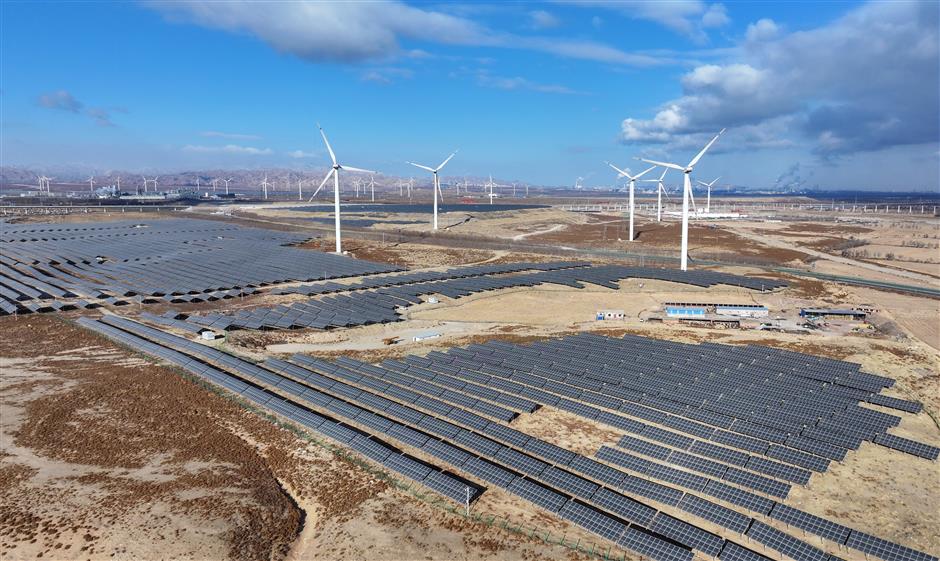
This model is breathing new life into China's western provinces. Where massive wind and solar farms in remote areas of Xinjiang, Ningxia, Gansu and Guizhou traditionally have struggled with "wasted" excess green power due to transmission limitations. The nation's "East Data, West Computing" initiative has turned these regions into the "engine room" of the global AI economy.
By converting surplus green energy into tokens, the value of one kilowatt-hour of electricity is no longer just 0.3-0.4 yuan. It is amplified to include the value of the algorithm, the computational service and the digital asset.
Nvidia Chief Executive Jensen Huang famously noted that computation and inference equal revenue, and the Chinese supply chain has optimized the cost of that revenue to the global limit.
The outlook for 2026 suggests that the Chinese AI industry has moved past the stage of "blindly building models" and into a phase of specialized, high-value breakthroughs.
In early 2025, DeepSeek's architecture reduced reasoning costs by 36 times, compared with ChatGPT 4.0, while excelling in coding and long-text tasks. This year, ByteDance's Seedance has gained global traction by dominating in multimodal domains that create videos vivid enough to be a real cyber security threat.
The political and economic status of the AI industry has reached a zenith. Throughout late 2025, China's top leadership held numerous high-level strategy meetings focusing on the entire AI vertical – from chips and large language models to embodied intelligence robots. AI is now firmly integrated into China's 15th Five-Year Plan (2026-30) as a core national priority.
According to Jian Lian, an economist from the Citic Foundation, regional specialization is now the norm. Major model companies are based in the research and development powerhouse. Beijing has focused on fostering Zhipu AI, while Shanghai has thrown its weight behind MiniMax.
Beyond these core hubs, a clear roadmap for application and infrastructure has also emerged within provincial blueprints. Guangdong is focusing on an "AI + manufacturing" strategy. Zhejiang is building its Digital Zhejiang plan, with a focus on open-source ecosystems. Provinces like Guizhou and Inner Mongolia are doubling down on "green power + computing" plans to become global hubs for data processing.
Since the second half of 2025, the industry has undergone a healthy "demand-driven" transition. Price wars that triggered drops in token prices to as low as 0.0008 yuan per 1,000 tokens have ended. Companies like Zhipu AI have actually begun raising prices for their most advanced coding plans because demand has so far outstripped supply.
This shift from a "gold rush" mentality to a mature, supply chain-optimized industry indicates that the current surge in token consumption is not a temporary spike, but rather it is a structural realignment of the global AI ecosystem.
The fact that Chinese tokens now account for over half of the top-tier global consumption is a victory for global AI proliferation. By leveraging an unmatched full-stack supply chain, integrating data, computing power, hardware, and electricity, this ecosystem is providing the affordable fuel for the next generation of digital labor.
As we move deeper into 2026, the focus is shifting away from who has the "smartest" individual model in a lab toward who can provide the most stable, cost-effective and scalable infrastructure for the millions of agents that will soon run our global economy.
In this new "space race of intelligence," the cables are being laid by engineers in Hangzhou, Beijing, and Shanghai, and the power is flowing from the wind and solar farms of the Gobi Desert. The beneficiaries are developers everywhere, who now have the tools to build a more intelligent world, one token at a time.
(The author specializes in the international expansion of Chinese tech companies in the advanced hardware and energy sectors. He also serves as a geo-economic expert for several think tanks in Beijing.)
Editor: Liu Qi
In Case You Missed It...
 Mar 4, 2026