The Changing Language of Luxury Skincare in China
China's beauty market is no longer enjoying the easy growth of its boom years. But that does not mean consumers have stopped buying expensive skincare.
The market is splitting. Many shoppers are moving toward cheaper, functional products for basic needs such as cleansing and moisturizing. At the same time, premium anti-aging, repair and high-performance skincare remain among the few areas where consumers are still willing to pay more.
A recent skincare symposium in Shanghai showed how that logic is being translated into brand communication. At the technology summit on the West Bund, Dior introduced its Dior Prestige La Crème. The launch still carried the familiar codes of luxury beauty – a rare rose, sensorial texture, scent and brand heritage. But much of the presentation was built around a different vocabulary: skin longevity, biological age and cellular pathways.
This showed how scientific language is becoming part of the way luxury skincare explains value. In a market where consumers are comparing ingredients, reading efficacy claims and asking for visible results, high-end beauty has to explain not only how a product feels, but why it should work.
China's cosmetics retail sales reached 465.3 billion yuan (US$68.66 billion) in 2025, up 5.1 percent from a year earlier, outpacing the country's overall retail sales growth of 3.7 percent. Still, the sector is far from the high double-digit expansion seen in earlier years. Online beauty and skincare sales reached 454.18 billion yuan, rising 9.7 percent.
Within that slower market, premium segments have proved more resilient. China's high-end beauty market is expected to reach 242.9 billion yuan in 2026. Products priced above 500 yuan already account for more than one-third of the online beauty market, while those above 2,000 yuan represent a smaller but meaningful luxury tier.
The more important change is structural. In the first quarter of 2026, products priced below 300 yuan accounted for nearly 60 percent of the skincare market, while products above 1,000 yuan expanded their share. The middle price band narrowed.
In other words, consumers are not simply trading down. They are becoming more selective. For basic functions, they want value. For advanced benefits, especially anti-aging, firming and repair, some are still willing to pay a premium. The weakest position is the middle: products that are neither cheap enough nor clearly differentiated enough.
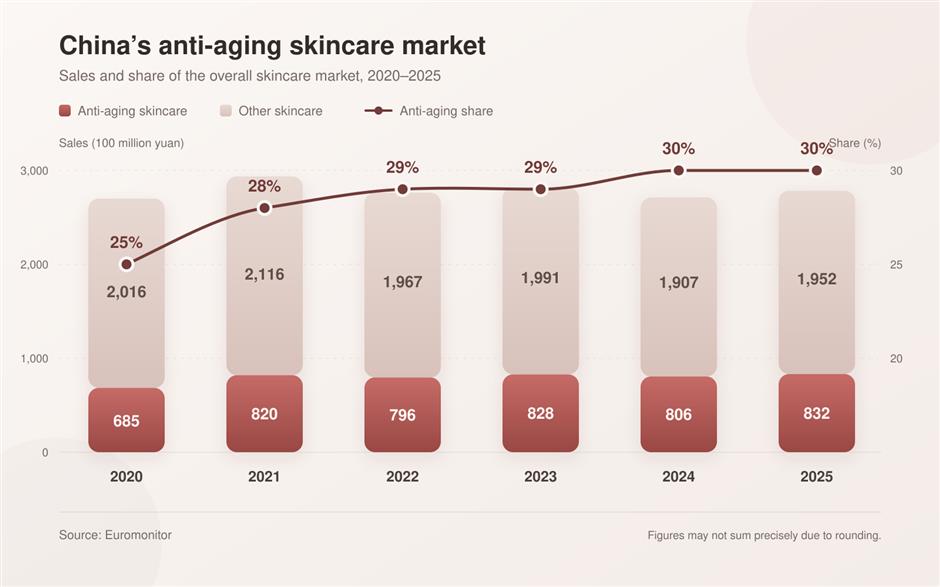
Anti-aging is the strongest engine behind this premium resilience. China's anti-aging skincare market reached 83.2 billion yuan in 2025, with the category's share of total skincare sales rising from 25 percent in 2020 to 30 percent in 2025, according to Euromonitor. As anti-aging shifts from an advanced routine to a daily concern, consumers are paying closer attention to visible results.
This is where the language of luxury skincare is changing.
For years, high-end skincare was sold through store experience, celebrity endorsement, brand history and rare ingredients. Those still matter. But they are no longer enough on their own. Chinese beauty consumers have become highly educated about ingredients, efficacy claims and skincare mechanisms.
CBNData and Tmall research shows that 71 percent of consumers now seek more precise skincare tailored to skin type, while half look at the mechanism and scientific validation behind core ingredients.
The question is no longer only what ingredient is inside the jar. It is what research system stands behind it.
That shift explains why skincare launches increasingly resemble scientific briefings. Brands are not only talking about texture, fragrance and packaging. They are talking about biomarkers, biological age, cellular pathways, clinical tests and efficacy data. Luxury beauty is not abandoning emotion. But in China's more rational consumer environment, emotion increasingly needs technical support.
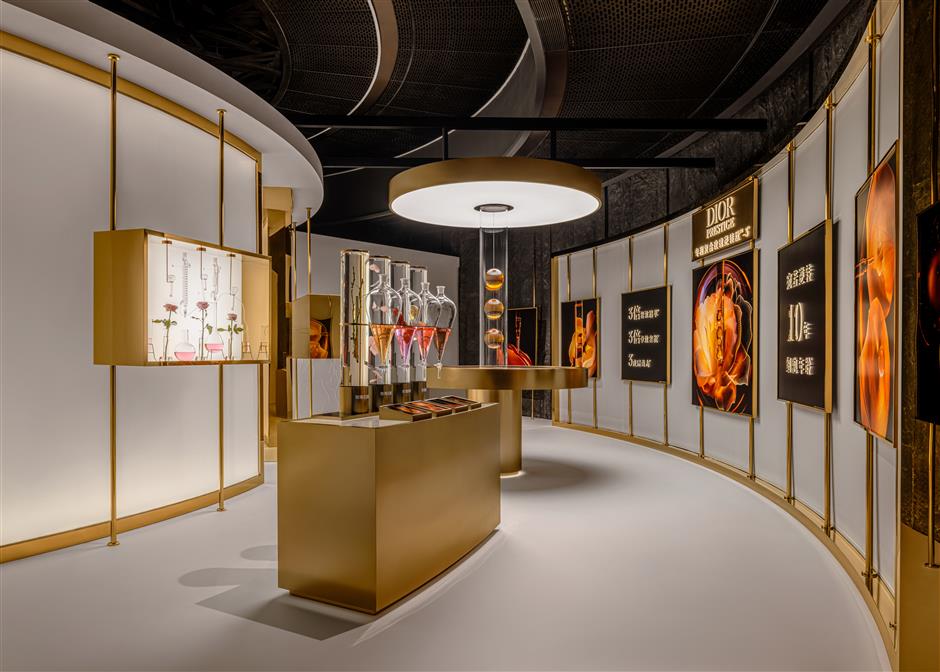
The Shanghai event offered a glimpse of how research is being folded into premium skincare's value proposition. Dior established an anti-aging science committee in 2023, bringing together 19 scientists from fields including biology, biophysics and dermatology, with research focused on skin longevity. The French luxury company also introduced what it calls a "Skin Longevity Compass," a framework that maps 15 skin-aging pathways across three dimensions: skin structure, skin communication and cellular function.
This is increasingly where premium skincare brands are trying to build a moat. A fashionable ingredient can be copied. A celebrity campaign can be replaced. But a research architecture – expert boards, proprietary testing models, published studies, formulation platforms and long-term investment – is harder to replicate quickly.
The business logic is clear. High-end skincare used to draw much of its pricing power from brand heritage and luxury experience. Increasingly, that pricing power also depends on whether a brand can explain efficacy in a way consumers understand and trust.
This shift is especially important in China. Domestic premium beauty brands have gained ground by emphasizing local skin research, ingredient transparency and value for money. From 2021-25, consumer preference for domestic high-end beauty brands rose from 28.4 percent to 46.5 percent, surpassing preference for Western brands for the first time.
For international luxury brands, history and prestige still matter. But they are no longer sufficient. To defend a premium position, they must show not only why a product is beautiful, but why it works – and why it is worth paying for.
The strongest brands in the next phase may not be those that simply look the most luxurious. They may be those that can best answer a more practical question from consumers: What exactly am I paying for?
Editor: Liu Qi
In Case You Missed It...
![[Hai Guide] 2026 The BIG List of 24 Outdoor Pools 2 Cool Down In](https://obj.shine.cn/files/2026/06/01/565bb9fe-c607-4cf9-b720-44926c27571d_0.png)
 Jul 16, 2026
![[Quick News] China Eastern Offers Free Wi-Fi on all Wide-Body Flights](https://obj.shine.cn/files/2026/07/14/34b3188d-0dd6-4c5e-aaa5-b90cfdcf4b51_0.jpg)

![[First in Shanghai] New Stores, New League and New MJ Show](https://obj.shine.cn/files/2026/07/14/c39e500f-f00d-4af2-b87e-a26890665a00_0.jpg)