Fashion Week Runways – Where Movement did Much of the Talking
On Shanghai Fashion Week's runways this season, movement did much of the talking.
Texture shifted, layers opened, hems swung and surfaces caught the light. The most memorable moments were often not the most elaborate ones, but those in which an idea came alive once the clothes began to move.
Across this season, familiar contrasts – tradition and modernity, East and West, restraint and spectacle – were constantly being reworked. Chinese cultural references surfaced in looser, more contemporary forms, while global aesthetics shaped everything from silhouette to styling. The result was less about defining a single Shanghai look than showing how different visual languages can share the same runway.
Hemu: Reworking the Silk Road
Hemu opened Shanghai Fashion Week with a runway steeped in movement and color. A live ensemble of traditional Chinese musicians sat at the center of the space as long swathes of fabric spilled across the floor in rust, ochre, cream and blue, evoking a road unrolling through the desert. Behind them, the screen glowed with shifting golds and browns, sometimes recalling mural fragments, sometimes looking almost like weathered silk.
The Spring/Summer 2027 collection, titled Silk Road, drew from the Hexi Corridor, the Dunhuang caves and ancient textiles. Hemu incorporated yunjin and Song brocade, kesi weaving, gambiered Canton gauze, batik, jiaoxie dyeing, Su embroidery and Miao embroidery, and worked for the first time with national-level yunjin artisan Jin Wen to reinterpret the weaving, color and composition of historic Dunhuang textiles.
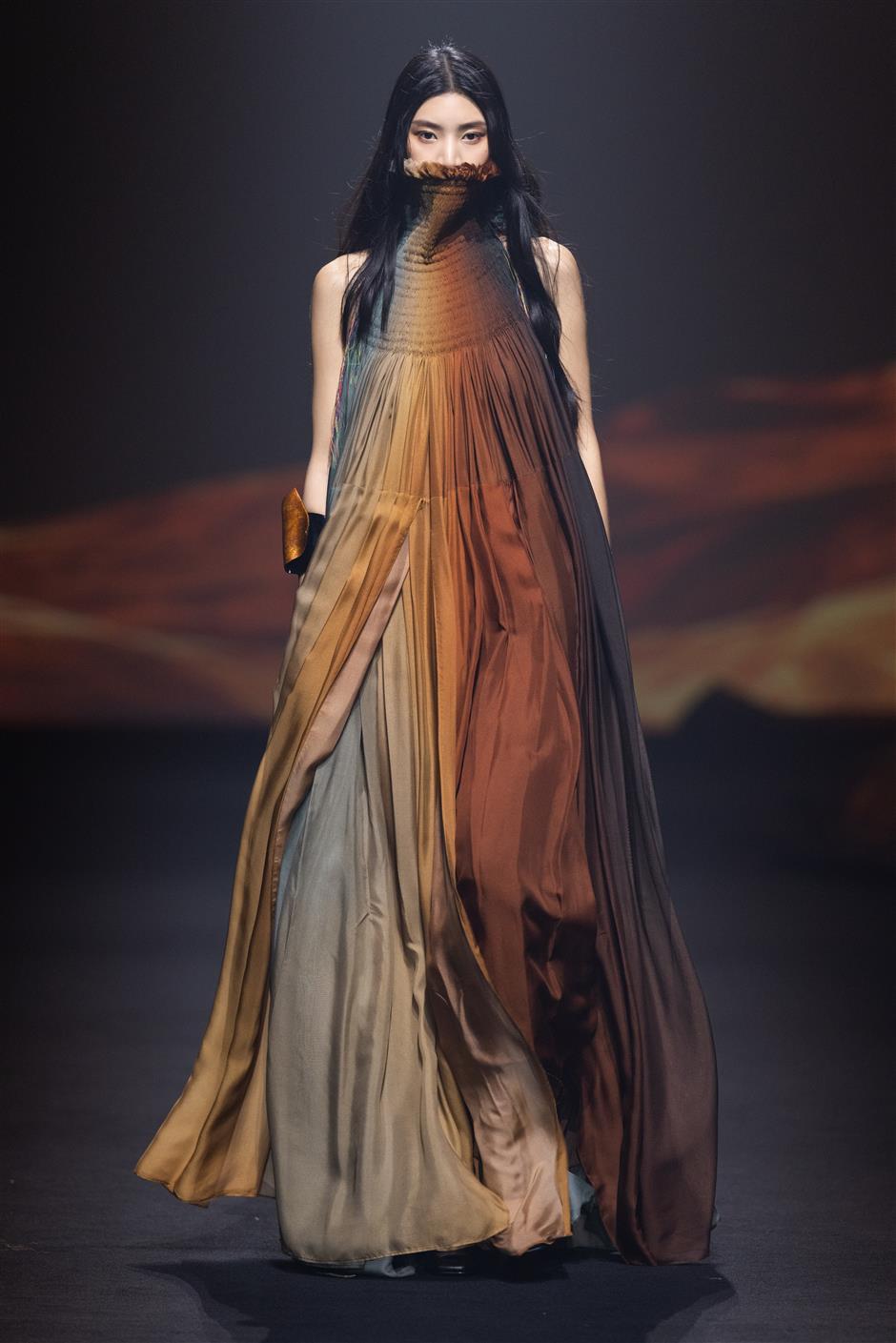
The clothes moved in the same muted, mineral palette. Dusty blue, moss green, ivory, brick red and burnt orange appeared across loose trousers, elongated jackets, layered robes and softly wrapped silhouettes. Some looks floated away from the body; others were denser, built up through brocade, embroidery and heavier textile surfaces. A deep red ensemble caught the light with a lacquer-like sheen, while one of the strongest layered looks mixed earthy green, brown and orange in a way that echoed the fabric installation running through the runway.
What kept the show from slipping into costume was its looseness. The silhouettes remained easy and wearable, allowing the craft to sit within the clothes rather than overwhelm them.
"The vitality of intangible cultural heritage lies in it being used," said founder Yang Fengrui. "Only through use can it be passed on and continue to develop."
That was also the clearest idea in the collection: tradition was treated less as decoration than as material to be worn, layered and moved through the present.
Sevenlong: Dressing for the Jianghu World
A low haze hung over the runway as Sevenlong sent out a procession of loose trousers, wrapped tops and trailing layers that seemed designed to move before they were designed to pose.
The Spring/Summer 2027 collection, titled Jianghu, referenced the traditional Chinese idea of a free-roaming world of martial artists, wanderers and outsiders. Robe-like silhouettes were loosened and cut apart; belts, cords and strips of fabric swung from the waist and sleeves; exposed midriffs and asymmetric hems kept the clothes from feeling overly reverent. Dusty pink, smoke grey, pale green, ivory and flashes of red softened the martial references into something more fluid and contemporary.
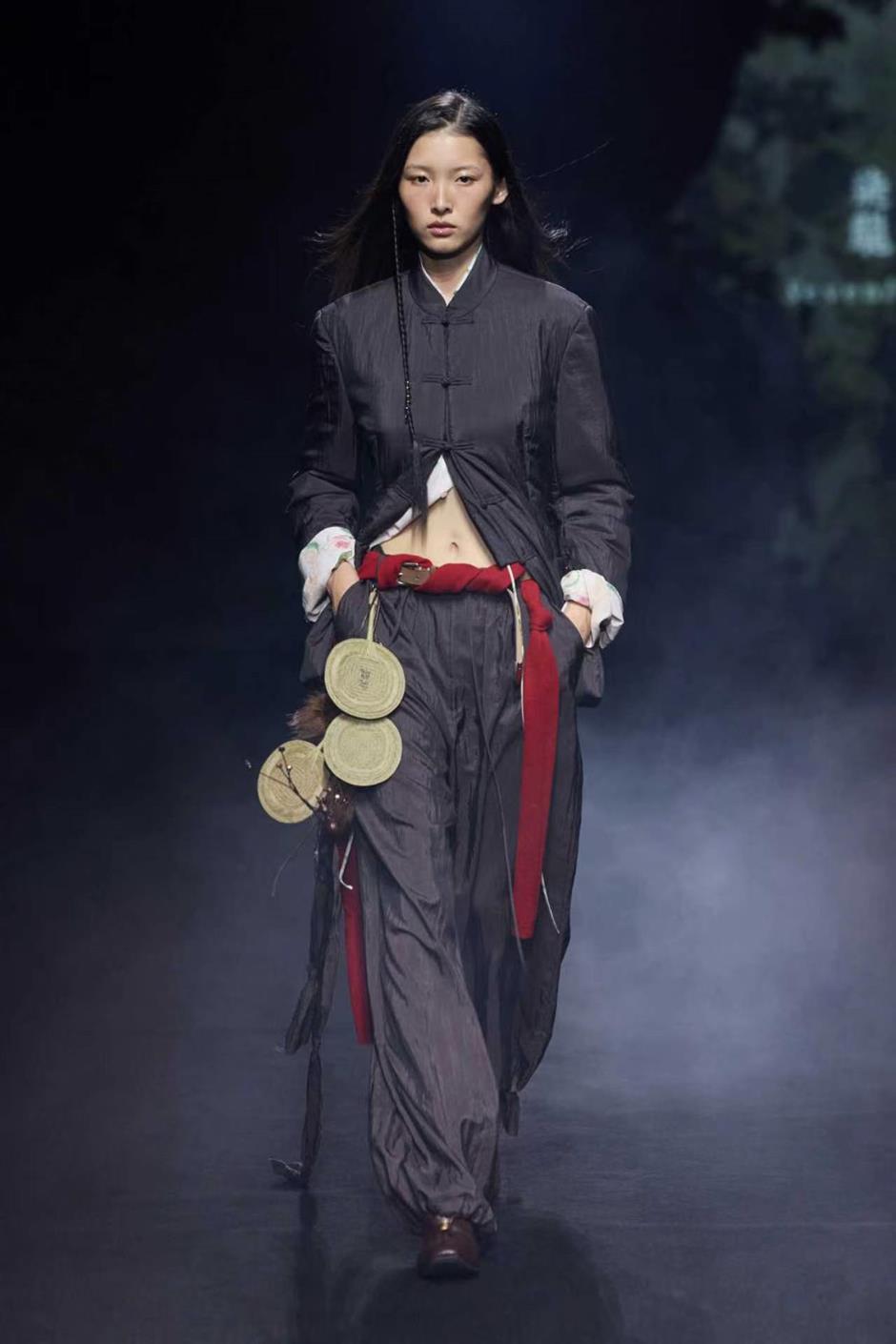
Several looks carried bundles of slender rod-like accessories, while long ties and fringed panels trailed behind the models as they walked. A hooded blush-pink look felt almost monastic, while a red shirt worn with an asymmetric black skirt brought a sharper, more urban edge. Elsewhere, feathered white textures and washed green layers broke up the otherwise muted palette.
The brand describes the collection as an exploration of the jianghu, the imagined world of wanderers and martial artists, for contemporary women. Its "kung fu wardrobe" draws on tai chi, Taiyi Youlongquan and Baduanjin, translating their emphasis on ease, balance and movement into everyday clothes.
What worked best was the refusal to literalize the reference. The show suggested martial arts through posture, movement and construction rather than obvious costume, turning the idea of jianghu into something less theatrical and more wearable.
Transit: Quiet Clothes, Rich Surfaces
Transit approached Spring/Summer 2027 with the confidence of a brand that does not need to shout.
The palette stayed close to the earth: pearl grey, washed blue, charcoal, tobacco brown, ivory and deep navy. Rather than building drama through print or ornament, the collection worked through surface and proportion: crinkled coats, softened tailoring, lightweight layers and trousers cut with enough volume to move easily around the body.
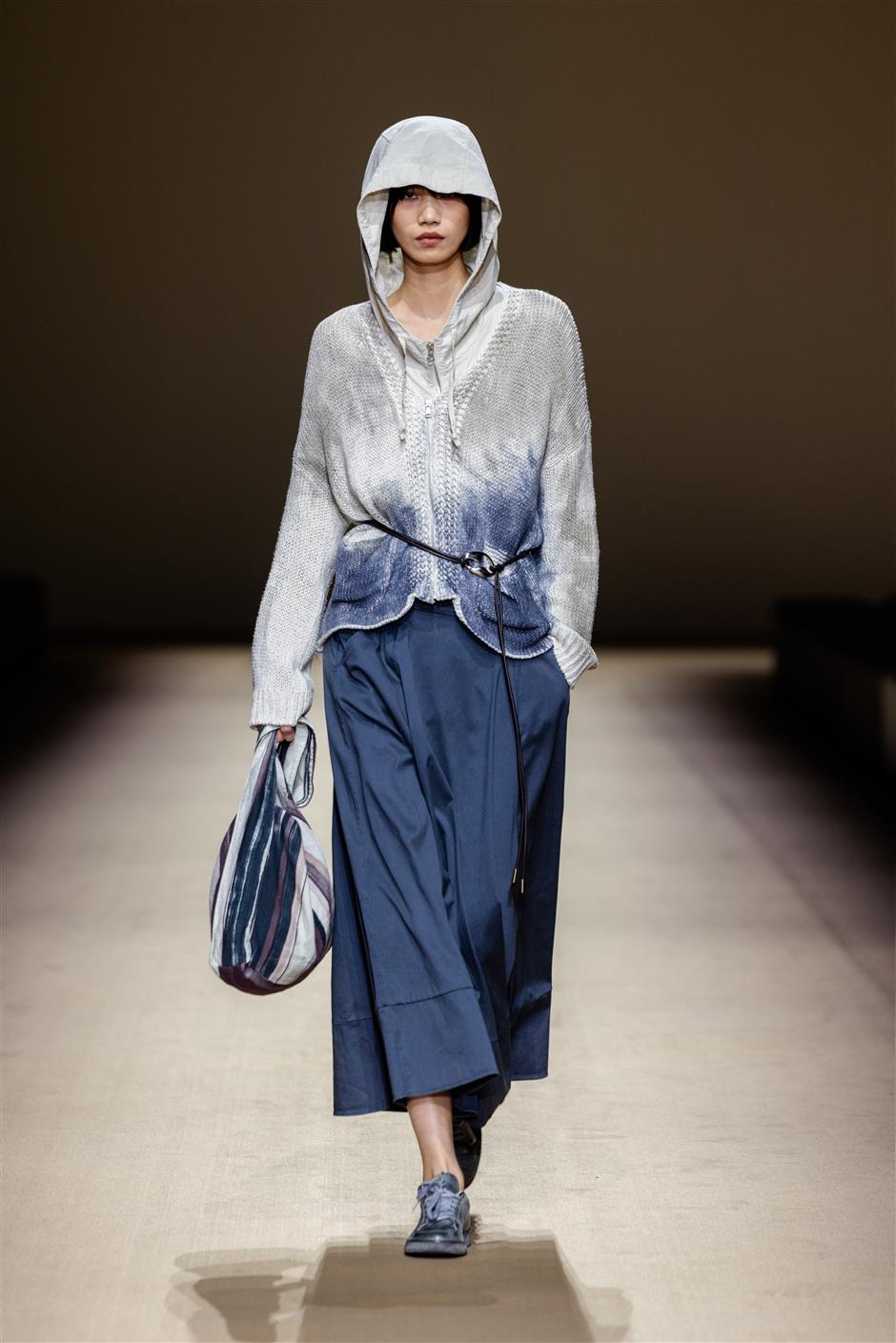
A silver-grey coat looked almost paper-thin and gently crushed, worn over dark drawstring trousers. A hooded knit faded from pale grey into indigo and was cinched loosely at the waist, while a charcoal jacket over a dusty pink shirt showed how the brand uses subtle shifts in texture to keep simple separates from feeling flat. Wide trousers appeared repeatedly, sometimes cropped, sometimes pooled over the shoe, giving the clothes an unhurried rhythm.
That restraint is central to Transit's identity. The Italian label describes its collections as built around natural materials, clean lines and constant experimentation with fabric combinations, with clothes intended to move across seasons rather than chase trends.
On the runway, that translated into clothes whose interest revealed itself gradually. From a distance, the silhouettes looked almost austere; up close, the washed surfaces, uneven textures and soft tailoring did most of the work.
The result was a quiet wardrobe designed to be lived in, layered, softened and worn again.
Stivanano: A Garden in Motion
Stivanano brought a very different kind of romance to the runway with light, tactile and constantly in motion.
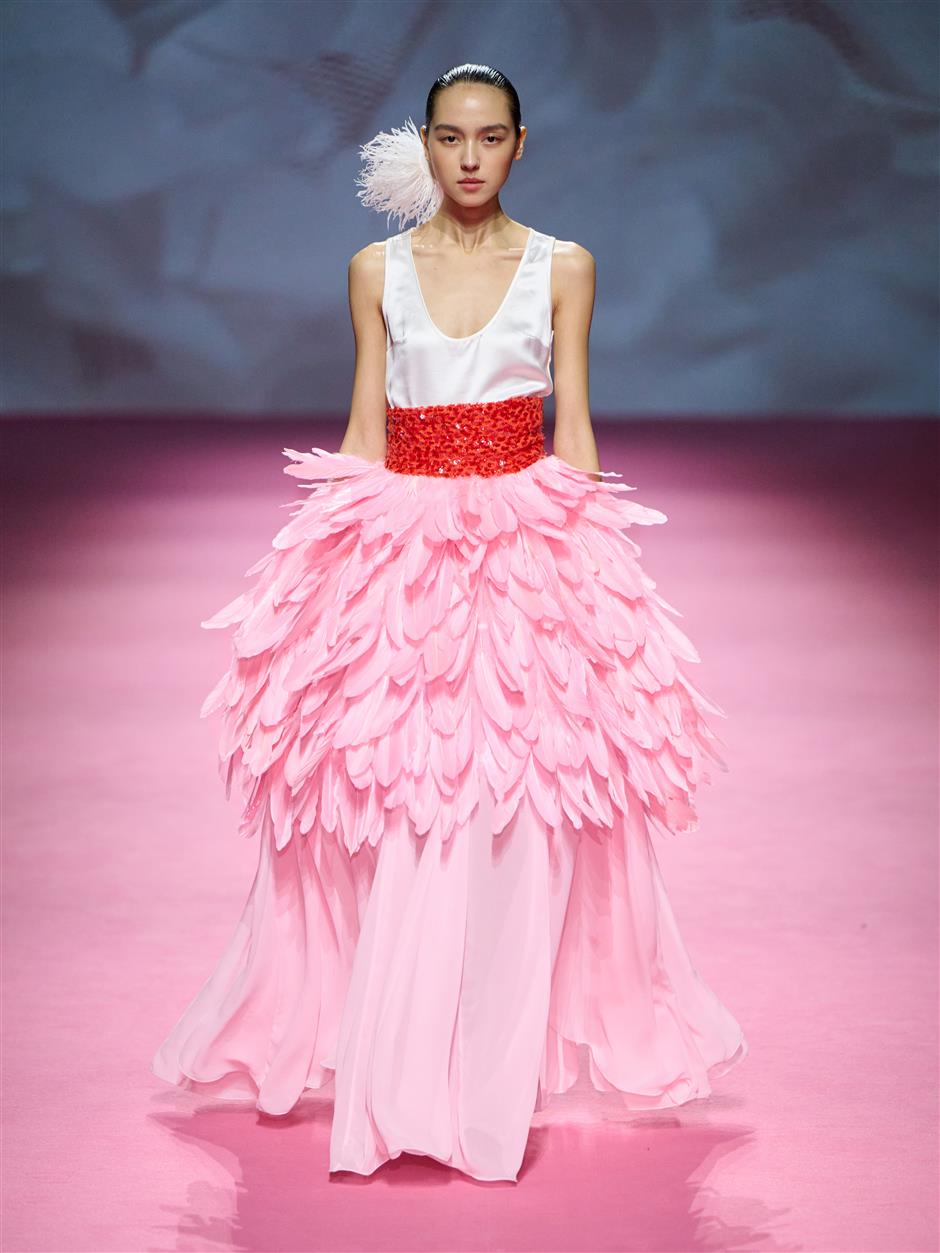
Against a pink floor and a backdrop washed in pale, petal-like forms, the collection moved between soft lilac, powder blue, cream, fresh green and flashes of coral, before dipping into black and white. Feathers appeared throughout, but rarely as heavy decoration. They fluttered around waists, skimmed hems and burst from collars, trembling with each step and giving otherwise clean silhouettes a sense of movement.
One look paired a simple ivory top with a vivid red waist and a cloud of pink feathers over a long skirt. Another pale green textured skirt caught the light beneath a spare white top, while a lavender slip dress used sheer panels and floral detailing without losing its elongated line. More restrained black-and-white looks sharpened the mood: a fitted black top opened into a sculptural peplum above a voluminous dark skirt, while a tailored black jacket was thrown over a softly textured white gown.
The contrast between simplicity and embellishment ran through the collection. Silhouettes were often clean and elongated, allowing texture to carry the drama: feathers, translucency, ruffles and softly shimmering surfaces replaced elaborate construction or loud print.
That balance fits Stivanano's broader language. The Milan-founded womenswear label is known for combining fluid lines and structured tailoring with Italian fabrics, building femininity through proportion and detail rather than overt decoration.
On the runway, the effect was less a literal garden than the sensation of one with color, air and texture shifting as the models moved.
Editor: Yao Minji
In Case You Missed It...
 Oct 11, 2026

Popular Reads
Man's Handmade 'Journey to the West' Theme Park in Sichuan Wins Over Holiday Crowds

AI and IC Innovations Take Center Stage at China's Premier Industrial Show
Poetry, Music Link Young Chinese and Russians on a Walk Through Shanghai's Old Streets