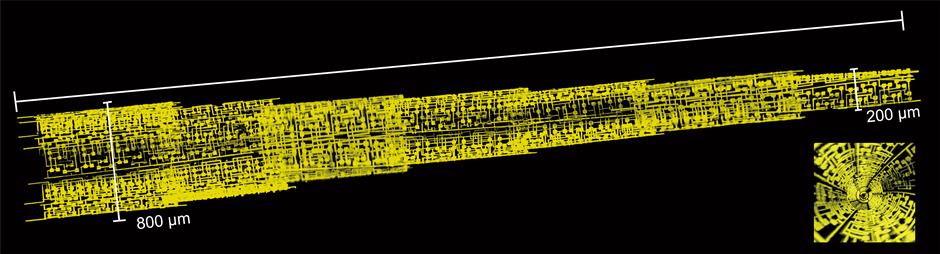
Fudan Researchers Implant IC in Elastic Polymer Fibers
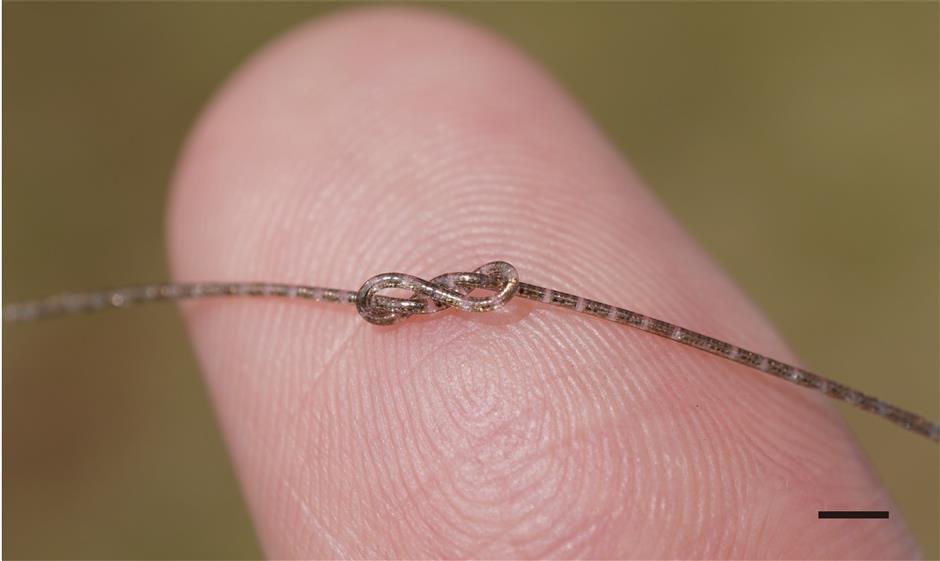
Fudan University researchers developed a fiber-based integrated circuit, or "fiber chip," overcoming a fiber electronics bottleneck and enabling cutting-edge applications like brain-computer interfaces, smart textiles and virtual reality wearables.
For decades, the team incorporated them into fibers with various functions, like power generation, energy storage, sensing and display. This time, they enabled the fiber with the capability of information processing.
The lack of viable information-processing components tailored to fiber systems has been a critical barrier – traditional rigid chips, usually flat and built on stiff materials like silicon, conflict with the flexibility, breathability and wearability required for practical use.
The team, led by Professors Peng Huisheng and Chen Peining from Fudan's Institute of Fibre Electronic Materials and Devices, has developed a way to embed large-scale integrated circuits within elastic polymer fibers.
"As fibers are curved and have very little surface area, it has been difficult to fit enough electronic parts onto them to make them functional," said Chen. "So we turned our eyes inside, instead of the surface. We developed a multi-layered spiral architecture to maximize the internal space utilization within the fibers."
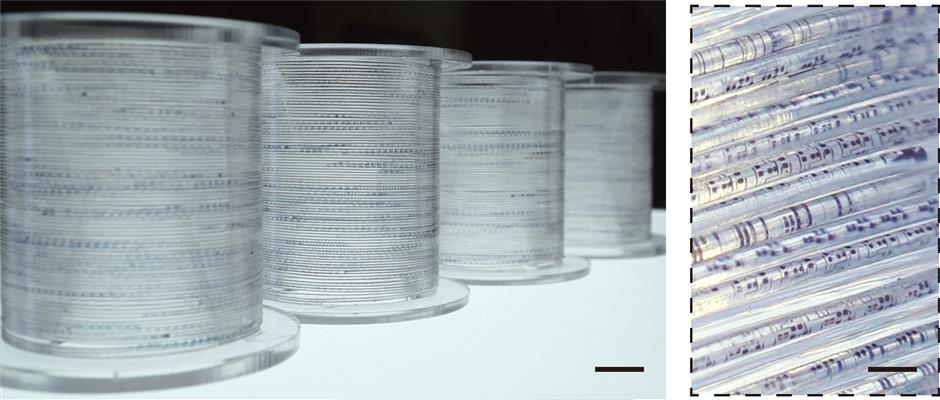
The novel method allows 100,000 transistors per centimeter integration. Based on the processing accuracy of the lab lithography machine, a 1-millimeter segment of the fiber chip can hold 10,000 transistors, and a 1-meter fiber can integrate millions, surpassing the transistor count of early classic computers.
"The fiber chip achieves information processing capabilities comparable to typical commercial implanted chips while retaining the intrinsic advantages of fibers, including flexibility, deformability and weavability; thus, it enables closed-loop systems within a single fiber, integrating power supply, sensing, display, and signal processing without external rigid components," said Chen.
He said this technology can unlock transformative applications across multiple fields, such as brain-computer interfaces (BCI) and virtual reality scenarios.
"Currently, BCI systems typically use probes that must be wired to external computers," explained Chen. "The soft high-tech fiber can fit better onto targeted areas in the brain, sense more accurate signals, and then process the data and even apply medical treatment solutions directly inside the brain."
Also, soft, breathable tactile gloves integrated with high-density sensing arrays can accurately simulate mechanical textures, enhancing interactions in remote surgical procedures and virtual environments.
The breakthrough has been published in the journal Nature.