Market Expansion Main Driver for Chinese Firms Going Global: Survey
Chinese companies' overseas expansion is becoming more structured and systematic, according to a report released in Shanghai on Friday.
The 2025-26 Chinese Enterprises Going Global Survey Report was jointly produced by CPA Australia, the Shanghai National Accounting Institute and Deloitte China.
The survey covered companies in manufacturing, technology, finance and consumer sectors across different ownership structures and sizes, with 175 valid responses collected.
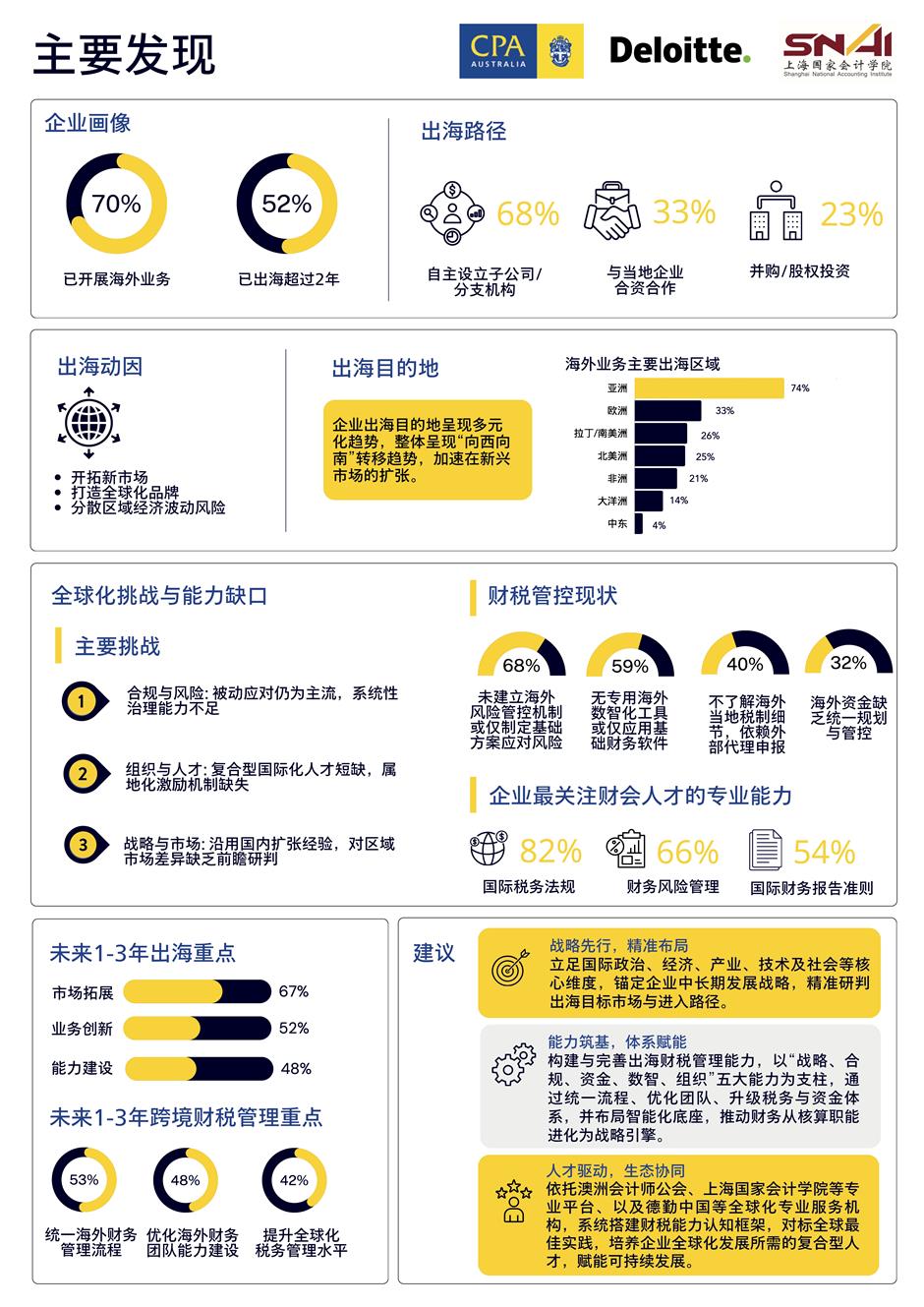
Seventy percent of surveyed companies have overseas operations, while 52 percent have more than two years of international experience. It found 67 percent plan to enter new markets or expand existing overseas operations over the next one to three years.
Asia leads as firms expand global footprint
Market expansion remains the main driver of overseas expansion, followed by brand building and risk diversification, the report noted.
Asia was the top destination for 74 percent of respondents, with Southeast Asia emerging as a key hub due to market size, demographics and internet penetration. Europe and South America accounted for 33 percent and 26 percent, respectively.
In terms of expansion models, 68 percent of companies are setting up local subsidiaries or branches, 33 percent are forming joint ventures and 22 percent are using export agents or cross-border e-commerce to enter new markets.
Compliance, risk and talent gaps emerge as key challenges
Compliance, risk management and talent were identified as the main challenges.
The report found 68 percent of companies have not established a comprehensive overseas risk management system, or rely only on basic response measures. A further 32 percent lack unified oversight of overseas funds.
In taxation, 40 percent still depend on external agencies for basic filing and have limited understanding of local tax systems, while 59 percent continue to rely on manual processes or basic accounting software, indicating relatively low levels of digitalization.
Jin Ke, president of CPA Australia's East and Central China Committee, said companies face multi-layered compliance risks overseas, including sanctions, export controls, data regulations, taxation rules, and foreign investment and national security reviews.
He observed that many firms are still responding reactively and need stronger governance systems. Against a backdrop of geopolitical tensions, rising protectionism and more complex tax regimes, Jin said companies should adopt a phased approach to financial and tax management, from basic compliance in early stages, to centralized control during expansion, and eventually to global data governance and real-time decision-making.
The report also highlighted a shortage of international talent in finance and accounting. Companies cited strongest demand for skills in international tax rules (82 percent), financial risk management (66 percent) and international financial reporting standards (54 percent).
Strategy shift: from opportunity-led to capability-led growth
Chinese companies' overseas expansion is shifting from opportunity-driven growth to capability-led development, with 67 percent prioritizing market expansion over the next one to three years, followed by business innovation (52 percent) and capability building (48 percent).
Key priorities include standardizing overseas financial processes (53 percent), strengthening finance teams (48 percent) and improving global tax management (42 percent), alongside growing demand for tax, policy and compliance support services.
Jin said the success of Chinese companies going global will depend less on market opportunities and more on the ability to build sustainable operating systems. He pointed out that this requires long-term strategic planning, stronger operational foundations and integrated global financial and tax management, as well as cross-disciplinary talent development.
Jin added that companies should draw on best practices by multinationals and leading Chinese firms, while also seeking support from professional service providers where needed, to build data-driven global management systems integrating finance, operations and taxation.
Editor: Liu Qi
Popular Reads

China's Automaking Juggernaut Pushes Into Europe, Shifting the Industrial Landscape

Shanghai's Smart Healthcare Practices Shared at Geneva Conference Empowered by AI

Shanghai Job Fair Merges Music And Tech To Attract Global Talent