Why the World's Most Powerful Families Want Their Kids to Speak Mandarin
When Chinese President Xi Jinping arrived at the White House on September 24, one of the first voices to welcome him did so in his own language. Arabella Kushner, the 15-year-old daughter of Ivanka Trump, greeted Xi and his wife Peng Liyuan in Mandarin at the arrival ceremony, then joined the family at the state dinner that evening.
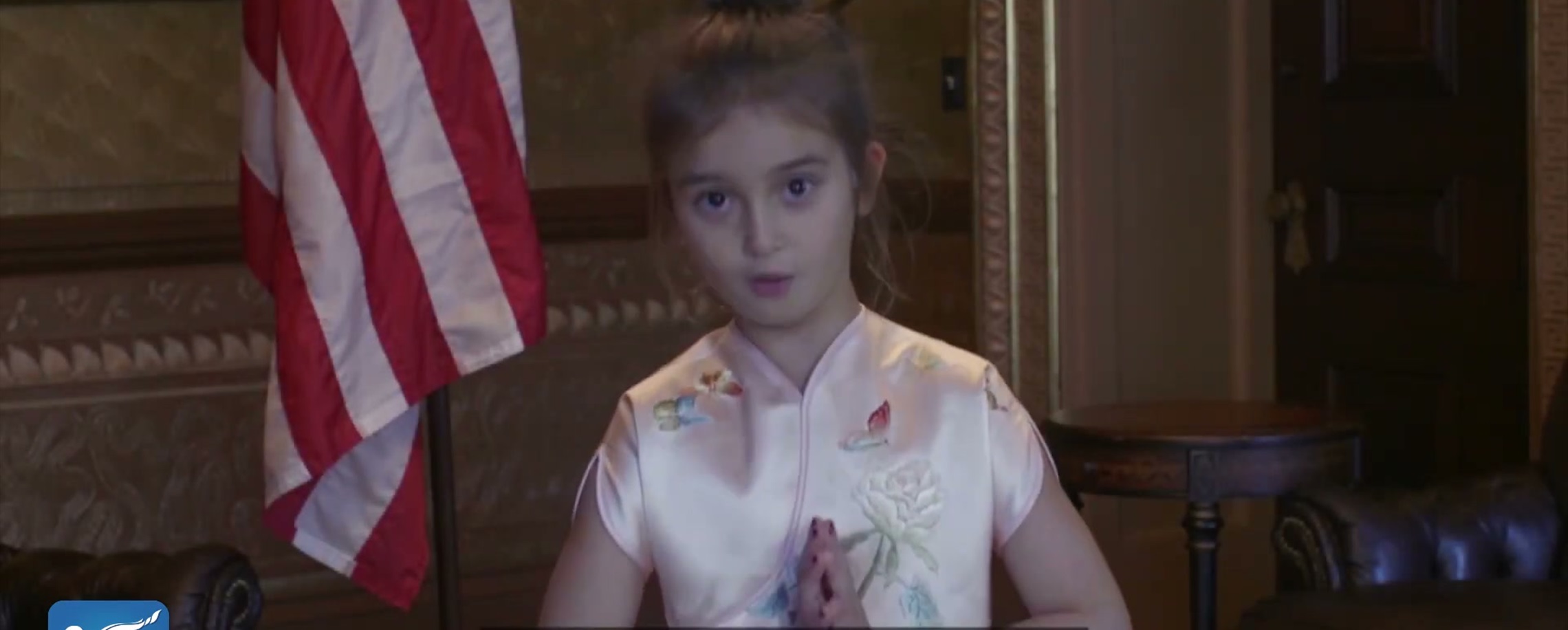
It was not the first time she had charmed the couple. In November 2017, during afternoon tea in Beijing's Forbidden City, US President Donald Trump took out a tablet and played them a video of his then 6-year-old granddaughter in a qipao-style dress.
"Hello, everyone. Let me sing a song," she begins in Mandarin, before launching into the children's song "Our Fields" and reciting lines from the "Three Character Classic," a centuries-old primer for Chinese children, and poems by Tang Dynasty poet Li Bai.
Xi said her Mandarin deserved an "A+," Xinhua news agency reported at the time.
Nine years on, she has plenty of company. Across the families of presidents, billionaires and royals, Mandarin has quietly become part of how the next generation is raised.
In May, Elon Musk brought his 6-year-old son along to Beijing for the Trump-Xi summit. When a user on X asked why, Musk replied in Chinese: "My son is learning Mandarin."
The children of Amazon founder Jeff Bezos and MacKenzie Scott study Mandarin as part of their "global learning" lessons, alongside Singapore math, according to "The Palki Sharma Show" on India Global Review. Meta founder Mark Zuckerberg, who famously gave a talk in Mandarin at Tsinghua University in 2014, posted a video in 2016 of his daughter Max practicing the language with the help of an artificial intelligence assistant.
Royal households are on board, too. Britain's Prince George, eldest son of Prince William, has studied Mandarin at school, while Spain's Crown Princess Leonor took Chinese lessons for several years. Former Serbian President Aleksandar Vucic has called not learning Chinese one of the biggest regrets of his life and says his youngest son is now studying it.
Then there is Russian President Vladimir Putin. Asked at the Valdai Discussion Club on October 1 whether he and Xi ever hit a cultural barrier, Putin said no, although neither speaks the other's language. "My grandchildren will be my interpreters – they speak Chinese," he added.
Some leaders did not leave it to their children.
Kazakh President Kassym-Jomart Tokayev studied Chinese in the early 1980s at what is now Beijing Language and Culture University, as a young Soviet diplomat. His teacher, Liu Shiqin, remembers the age gap: "He was 31, I was 44."
What stuck with Liu most were Tokayev's final five weeks of class. The students watched "Talking About the Yangtze River," a hugely popular Chinese documentary series of the time, then rewrote the narration themselves and dubbed it in their own voices. Tokayev told him he would take that method home with him, Liu told Chinese reporters when Tokayev returned to his alma mater on October 17, 2023. The university still keeps his student record card and grade sheet, along with the 1983 application form on which he wrote the Chinese characters by hand.
Tokayev went on to serve at the Soviet embassy in Beijing and has said he spent nearly eight years in China. He still misses twice-cooked pork, Peking duck and dandan noodles.
He also uses the language on the world stage. At the opening of the Kazakhstan Cultural Center in Beijing on September 2, 2025, he spoke in Chinese, quoting a Chinese saying: "One flower alone does not make spring; a hundred flowers in bloom fill the garden with spring."
Former Ethiopian President Mulatu Teshome also began his studies in China at the same university, making the two heads of state fellow alumni.
China is the world's second-largest economy and will remain a major partner in business and technology for years to come, giving wealthy and powerful families clear commercial and diplomatic reasons to want children who can work with it, Kerry Brown, professor of Chinese studies at King's College London, has said.
But Brown also points to a gap. Ordinary university students in Europe and the US rarely take up Chinese, and he has argued that Western countries need to invest more in language skills if they want to deal with China as equals.
There are signs that ordinary learners are catching up. When a possible TikTok ban sent American users flocking to the Chinese app RedNote, known in China as Xiaohongshu, in January 2025, Duolingo reported a 216 percent jump in new US learners of Mandarin. In its 2025 language report, the app said Chinese was the fastest-growing language on its platform in countries including Brazil, Germany, Indonesia, South Korea, Spain and Thailand, and the second fastest-growing in the US.
"My guess is many people think that being able to speak Mandarin will lead to more job opportunities in the future," Seth Wiener, an associate professor of linguistics at Carnegie Mellon University, told China Daily. He also warned that the speech sounds and the writing system make it a steep climb for English speakers.
Which raises the obvious question: Why spend years on tones and characters when a phone can translate a conversation almost instantly?
Sharma put the question directly on her show. Her answer: "AI can translate a sentence. It cannot automatically give you cultural context. It cannot build trust in a room."
Researchers writing in The Conversation in May made a similar case. Wrestling with grammar and vocabulary engages the brain's memory and attention systems, they wrote, and machine translation "operates through pattern recognition rather than lived understanding," often missing humor, tone and context.
Tokayev's classroom is a case in point. Four decades ago, he learned by rewriting and dubbing a documentary. Today, he quotes Chinese sayings to Chinese audiences, no interpreter required.
Or, as Sharma closed her show: "The languages people choose to learn often reveal where they see their future."
Editor: Liu Qi
In Case You Missed It...
 Oct 12, 2026

![[Cultural Mosaic] Theater as a Bridge: Cross-Cultural Co-Creation is About Building Equal Dialogue](https://obj.shine.cn/files/2026/09/30/f397224f-18e9-4135-adf9-0eead315b847_0.jpg)
Popular Reads
Why the World's Most Powerful Families Want Their Kids to Speak Mandarin
Yau Mathematics and AI Lab Alliance Launched at Tsinghua University

Bridging Cultures Through Music: Ten Years of Sustained Sino-Australian Educational and Youth Exchanges