Yau Mathematics and AI Lab Alliance Launched at Tsinghua University
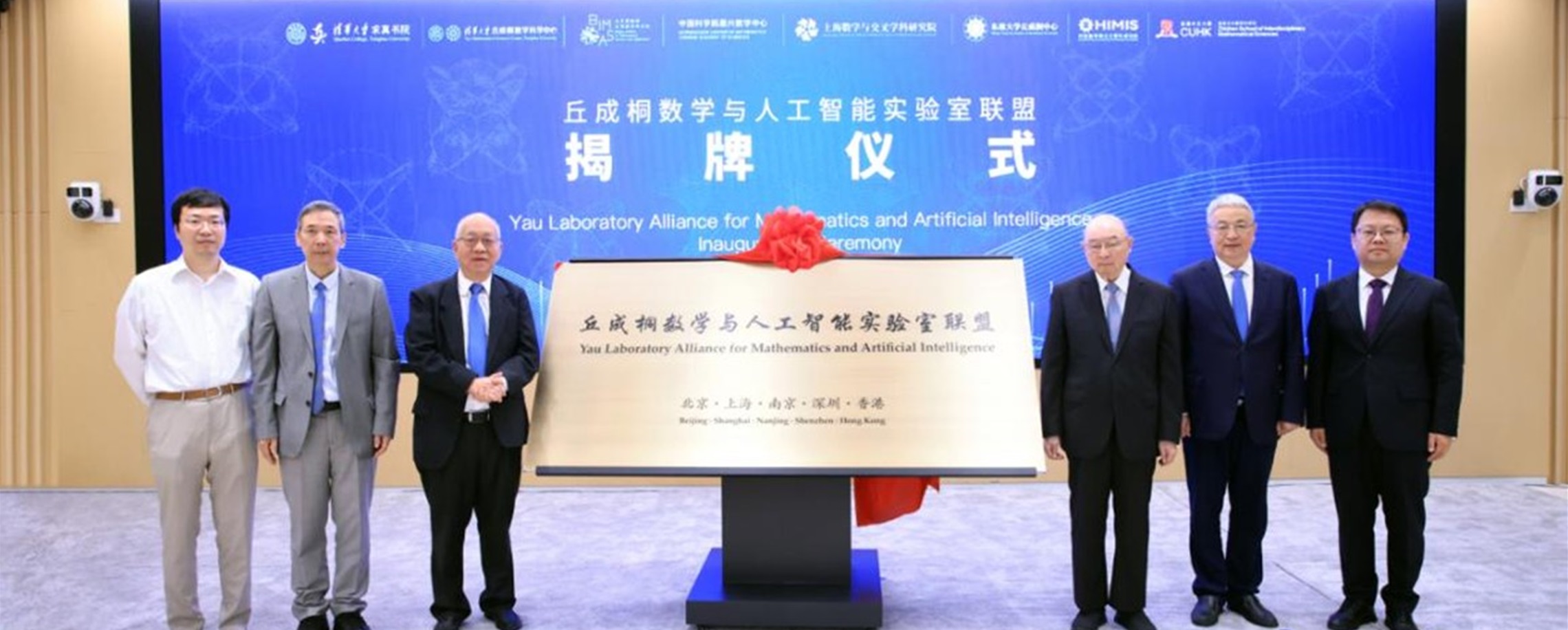
China's higher education sector has further advanced interdisciplinary mathematics and artificial intelligence research, as the Yau Laboratory Alliance for Mathematics and Artificial Intelligence was officially launched at Tsinghua University on Sunday.
Led by Fields Medalist professor Shing-Tung Yau, the alliance integrates eight top Chinese mathematical research institutions and assembles a 1,000-strong research team. It aims to deepen the integration of mathematics and AI and bolster China's high-level sci-tech self-reliance.
Its founding members consist of top research institutions across Beijing, Shanghai, Nanjing, Shenzhen and Hong Kong, including Tsinghua University's Qiuzhen College, the Yau Mathematical Sciences Center, and the Shanghai Institute for Mathematics and Interdisciplinary Sciences.
In his speech, Yau described the current era as uniquely promising yet highly risky for academic research.
"If artificial intelligence is properly harnessed, the scholarship, breakthroughs and impacts it delivers will be epoch-making. Poorly managed, however, it could bring catastrophic consequences, particularly harming the development of China's science and technology sector," he said.
Yau acknowledged that the past half year has brought unprecedented upheaval to academic research. AI has produced numerous pivotal, even groundbreaking scholarly results in a short span, delivering outputs beyond conventional imagination.
He noted that advances in basic science have historically been driven by a small cohort of pioneering researchers. By contrast, AI serves as a powerful synthesizing tool that draws on vast computing power to aggregate humanity's cumulative intellectual insights across history.
Having devoted five decades to mathematical research and witnessed numerous landmark advances in the field, Yau emphasized that the transformative power of modern AI far surpasses any previous scientific breakthroughs he has observed.
He highlighted daunting challenges facing China's AI development, emphasizing that the field grows exponentially rather than linearly.
"Given such exponential growth, we need joint efforts from knowledgeable scholars and innovative young students," Yau stressed.
Established to pool elite academic talent nationwide, the alliance unites 1,000 professional mathematicians across member institutions to develop China's homegrown AI models dedicated to mathematical research, thereby driving nonlinear, leapfrog progress in related fields, he added.
Li Zhihua, vice president of Tsinghua University, said the alliance consolidates national high-end research resources, converting China's solid mathematical research strengths into proactive advantages for AI innovation. It will build a smoother linkage connecting fundamental research, technological advancement and industrial application.
Headquartered in Beijing's Haidian District, the alliance benefits from the area's robust tech ecosystem. Haidian hosts over 2,000 AI enterprises and more than 90,000 AI professionals. Local authorities have pledged full-fledged support, committing to optimize industry-university-research collaboration and foster a high-quality innovation ecosystem to fuel the alliance's development.
Leading academicians pointed out that AI is fundamentally grounded in mathematical theories. While current AI technologies have yielded preliminary progress in mathematical research, they remain insufficient to support systematic and comprehensive theoretical construction in mathematics. By uniting researchers from diverse institutions and disciplines, the alliance will reshape the academic paradigm for integrated mathematics and AI research and facilitate bold explorations of cutting-edge scientific problems.
The alliance has outlined six core priorities: developing specialized AI models for mathematical research, building open public infrastructure to support AI-assisted mathematical studies, advancing AI interpretability and security through fundamental mathematical innovation, extending integrated research to interdisciplinary fields such as quantum computing and life sciences, cultivating high-end talent via international training programs, and launching a flagship academic journal for AI-assisted mathematics.
The alliance's first Mathematics and Artificial Intelligence Laboratory is hosted at Qiuzhen College and jointly run with the Yau Mathematical Sciences Center at Tsinghua University.
Moving forward, partner institutions including the Beijing Institute of Mathematical Sciences and Applications, the Morningside Center of Mathematics of the Chinese Academy of Sciences, the Shanghai Institute for Mathematics and Interdisciplinary Sciences, the Shing-Tung Yau Center of Southeast University, the Hetao Institute of Mathematics and Interdisciplinary Sciences (Shenzhen), and the Zhizhen School of Interdisciplinary Mathematical Sciences at the Chinese University of Hong Kong will sequentially establish mathematics-AI laboratories across five locations: Beijing, Shanghai, Nanjing, Shenzhen and Hong Kong.
Building on their existing research capacity, these sites will accelerate diverse integration between AI, mathematics and related interdisciplinary fields.
Editor: Yang Meiping
In Case You Missed It...
 Oct 11, 2026