Xiaoshan Eyes Another 20 Golden Years with 'Chip-Powered' Leap
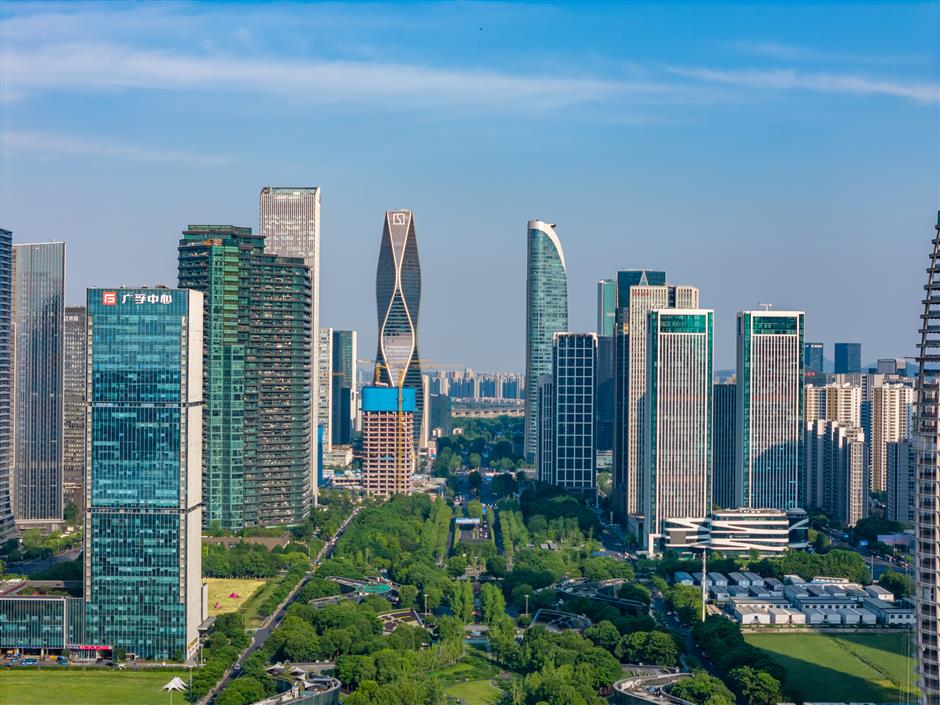
Qianjiang Century City in Xiaoshan District has now become the epicenter of Hangzhou's artificial intelligence (AI) boom.
The innovation hub on the south banks of the Qiantang River has launched the Yangtze River Delta region's first "Chip-Model-Application" full-chain AI industrial community, the Y Community.
Meanwhile, Zhejiang Southeast Space Frame Co Ltd, a Top 500 Chinese enterprise, has announced plans to invest 1 billion yuan (US$141.61 million) in building a global innovation center here. China's e-commerce giant JD.com has also unveiled a regional center project in the area.
With these AI-driven initiatives, Xiaoshan aims to make a shift from the traditional growth drivers to AI and kick off another 20 golden years of high-quality growth and continue its glory as Zhejiang Province's economic powerhouse. Xiaoshan was the province's first district to surpass 100 billion yuan in investment, consumption and exports.
Bridging innovation and industry
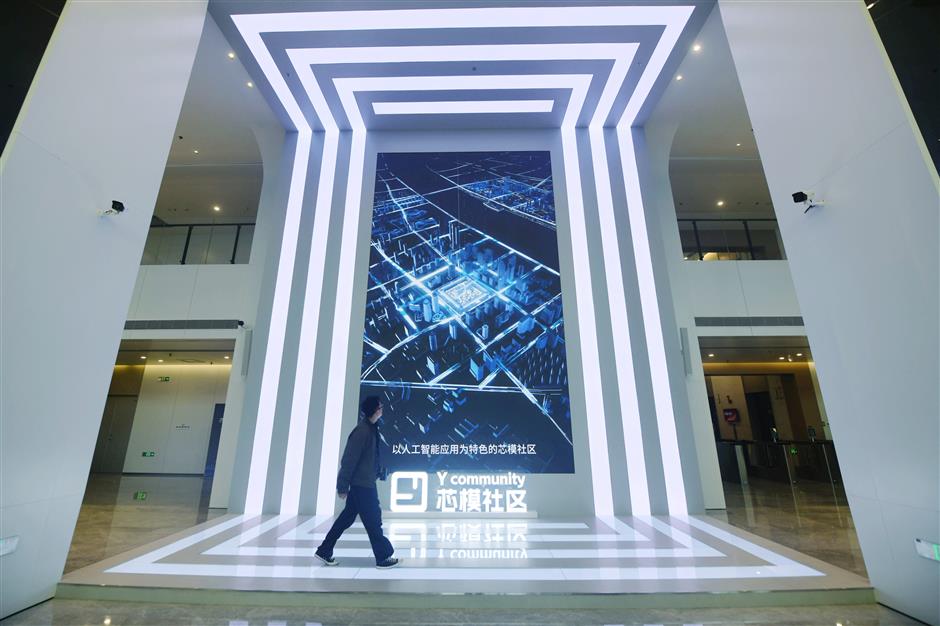
The name of Y Community clearly shows the emphasis on AI applications, according to Gu Chenyi, operating officer of the chip-model community.
"Y is a symbol of connection that links the three pillars of the AI industry – chips, models and applications," he explained.
While domestically developed chips are based on different large models, "bridges" are necessary to match the chips and models, thus, a potential market. By integrating the 10-plus domestically produced GPU (graphics processing unit) chips and the 80-plus mainstream models, the chip-model community has developed an open service system featuring hardware testbeds and model asset libraries.
With its support, Hangzhou Wanjie Universe Technology Co Ltd has managed to greatly improve the efficiency of its self-developed AI advertising production system. Now, the production period of a single television commercial (TVC) has been cut from 21 days to just one day, with the production efficiency boosted five times and the costs cut by 60 percent.
"It allows small- and medium-sized enterprises to afford our TVC products," said the company's managing officer.
This is a credit to Xiaoshan's efforts to construct a R&D-adaptation-verification-application closed loop to integrate the AI technologies.
Starting August last year, Xiaoshan has been developing three AI industry communities, focusing on chip-model, chip innovation and chip mechanism, respectively. Chip-model emphasizes application, chip innovation stresses data and chip mechanism relies on computing hardware.
Take the chip innovation community for example. It leverages the national AI medical pilot test base in Xiaoshan to make breakthroughs in data barriers, a problem that has long plagued the medical sector, promoting the legal applications of clinical data. The Xiaoshan test base is one of the two national AI medical pilot test bases in China, with the other located in Shanghai.
Besides the industry loop, the district has striven to build an innovation ecology for the AI industry,ranging from the Turing Town planned as early as seven years ago to the AIGC computing center jointly developed with H3C Group.
The chip communities are the district's latest move aimed at exploring a new industry development path that can be replicable and promoted, said Luo Jun, director of the Xiaoshan District Development and Reform Bureau.
They are expected to foster a brand-new industry cluster in the long term, Luo added.
AI landmarks
In October, Hangzhou put forward the "296X" advanced manufacturing cluster plan, of which the "2" refers to the AI and visual intelligence sectors that each is targeted to develop into a 1-trillion-yuan advanced manufacturing cluster.
In this ambitious move, Xiaoshan will take the lead. Over the past five years, the district has coughed up tens of billions of yuan of investment and gathered innovation platforms, including the Hangzhou International Innovation Center of Zhejiang University and the Hangzhou Institute of Technology of Xidian University.
"In the 15th Five-Year Plan (2026-2030), Xiaoshan has added an indicator of AI application rate in the manufacturing sector to encourage more pioneering applications of AI models and agents," Luo said.
This innovation within the AI sector has spilled over to other industries district-wide. So far, related innovation projects have locked up 20 billion yuan in investment.
In the visual intelligence sector, investments in the China Visual Intelligence Valley now total 25 billion yuan, aiding the valley to emerge as a new industrial landmark in Xiaoshan, according to Zhang Ge, vice director of the Hangzhou Economic and Information Technology Commission.
At the Y Community, young people are embracing the energy and vitality of the AI era. Xiaoshan is increasingly attractive to young talent with the youth population reporting an annual growth of 74,000 people. The district has rolled out measures to attract talent, from overseas returnees to domestic professionals.
Editor: Li Qian
In Case You Missed It...
 Aug 15, 2026
![[Current Trends] Tourists Pay Top Dollar for a Front-Row Look at China's Tech Boom](https://obj.shine.cn/files/2026/08/12/b6608561-313a-4d20-bef4-c108cda6c188_0.jpg)


![[Quick News] Shanghai Braces for More Downpours as Typhoon Dolphin's Remnants Linger](https://obj.shine.cn/files/2026/08/14/02b5f6e6-2a23-4295-9d21-fa727ce23c37_0.jpg)