Tech Innovation a 'New Core' in Driving Shanghai's Development
Editor's Note:
Amid changes unseen in a century, Shanghai is now focusing on a key question – how to further broaden the development space for "Five Centers" by leveraging the centers' pioneering role, leading with science and technology innovation, advancing coordinated efforts, and serving national strategies.
This is the first of a series of articles recently published by Jiefang Daily and Shanghai Observer to explore the direction and opportunities for the next phase of the "Five Centers" construction in line with the proposals for the 15th Five-Year (2026-30) Plan. For Shanghai, technological innovation is not merely one of the "Five Centers" tracks; rather, it is the "new core" that provides powerful momentum for the city's development.
Shanghai Daily translated and edited these articles.
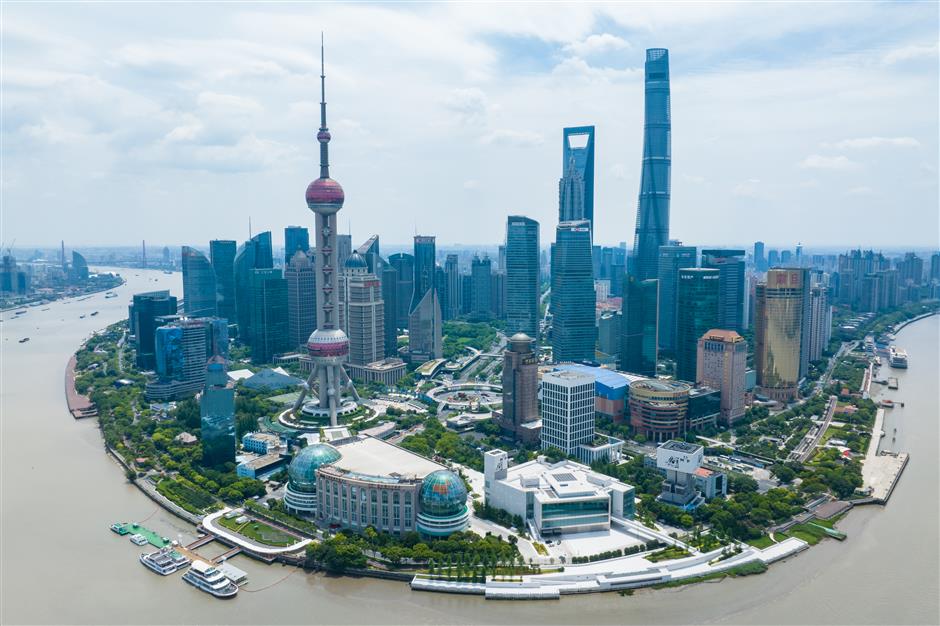
The rise and expansion of cities are driven by the clustering of capital, the flow of goods, and the gathering of residents. However, during certain critical periods of human development, technology has proven to be a more decisive factor.
The widespread adoption of the steam engine propelled London to surpass Amsterdam and become the heart of the world's factory. The electrification revolution and the rise of skyscrapers established New York as a new global benchmark. The eruption of the information revolution positioned Silicon Valley as the world's hub of innovation.
The ascent of every world-class city has been accompanied by a profound transformation of its driving forces. In 2024, Shanghai's urban economy entered a new phase, surpassing 5 trillion yuan (US$714 billion) in economic scale. Given this new starting point of a 5-trillion-yuan GDP, a pressing question demands an answer: Where will the future momentum for the "Five Centers" – economic, financial, trade, shipping, and technological innovation – come from?
Today, humanity once again stands at the threshold of new technologies, as waves of artificial intelligence, biotechnology, and quantum computing surge forward. The underlying logic of global urban competition is undergoing profound changes, and top-tier cities must identify the driving forces for their future development.
For Shanghai, technological innovation is not merely one track among the "Five Centers" but rather a "new core" that provides powerful momentum for the city's development. Building a globally influential center for technological innovation is akin to implanting a "fusion heart" in Shanghai, driving it toward a leap in energy and dynamism.
Scientific innovation defines the future
More than a century ago, within the historic buildings along the Bund of Shanghai, capital flowed, and stock and bond transactions flourished. On the Huangpu River, steam vessels laden with goods shuttled back and forth, their whistles echoing across the water. Situated at the confluence of river and sea, Shanghai thrived and grew, powered by its waterways.
Lin Lan, a researcher at the Institute of Urban and Population Development of the Shanghai Academy of Social Sciences, notes that throughout the history of urban development, technological innovation has been a decisive factor shaping a city's functions and spatial structure. As the world enters an era of intelligence and green transformation, technological innovation has become the fundamental driving force enabling cities to continually carve out new paths.
Lin offers a vivid analogy: If the economic center is seen as a "container," and the financial, trade, and shipping centers as "pipelines," then the scientific and technological innovation center serves as the "new core" – a common variable that influences all other functions. "Without the support of technological innovation, finance, trade, and shipping could all slide into low-end cycles."
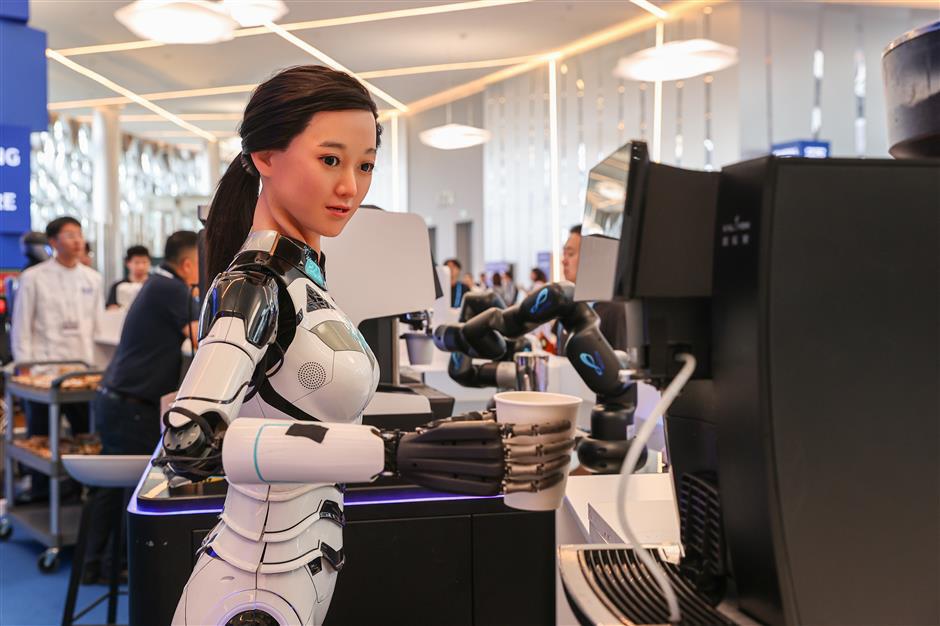
In Shanghai today, the empowering effects of sci-tech innovation are felt everywhere.
Sci-tech innovation energizes the economic center.
At Baosteel's "dark factory," AI-controlled production has increased line efficiency by 40 percent. Last year, Baosteel rolled out 125 AI-enabled scenarios, generating economic benefits exceeding 100 million yuan. At the Waigaoqiao Shipbuilding Yard, the second domestically built large cruise ship utilized 3D digital technology to integrate 60,000 drawings and 25 million components, cutting design modification time by 80 percent. During construction, RPA (robotic process automation) robots were deployed for visual management, significantly boosting efficiency and cost control. In Zhangjiang, Harbour BioMed and Insilico Medicine joined forces, using AI to accelerate the development of novel therapeutic antibodies.
Sci-tech innovation elevates the quality and efficiency of financial services.
With the help of large models, Guotai Junan Securities' "Junhong Lingxi" can learn from massive volumes of research reports, automatically answer user inquiries, and has served over 22 million users, saving more than 10,000 staff hours. Bank of Communications employs AI tools to analyze "asset-light" enterprises, helping solve the financing difficulties of tech firms. Bank of Shanghai launched "Xiao Wei Kuai Dai" (Fast Loan for Small Businesses), which can complete pre-approval within one minute and has cumulatively disbursed 185.8 billion yuan. China Pacific Insurance introduced the "Kechuang Wu You" (Innovation Care) integrated service package, benefiting 75,000 technology companies in the first half of the year and charting a new growth curve.
Sci-tech innovation reshapes trade patterns and rules.
Pinduoduo leverages digital-intelligent means to keenly capture shifts in global consumption trends, enabling thousands of small- and medium-sized factories to respond agilely and expand overseas via the "Duo Duo Chu Hai" initiative. Ouyeel has built a digital supply chain where each coil of steel is tagged with a "digital ID" upon warehousing and transaction, adding credit endorsement to bulk commodity trade. Envision Digital has created the world's largest AI-powered electricity system driven by an energy-sector large model, using 100 percent green electricity to produce green hydrogen and ammonia, thereby providing a "green passport" for Chinese manufacturing.
Sci-tech innovation turns port throughput into value-added gains.
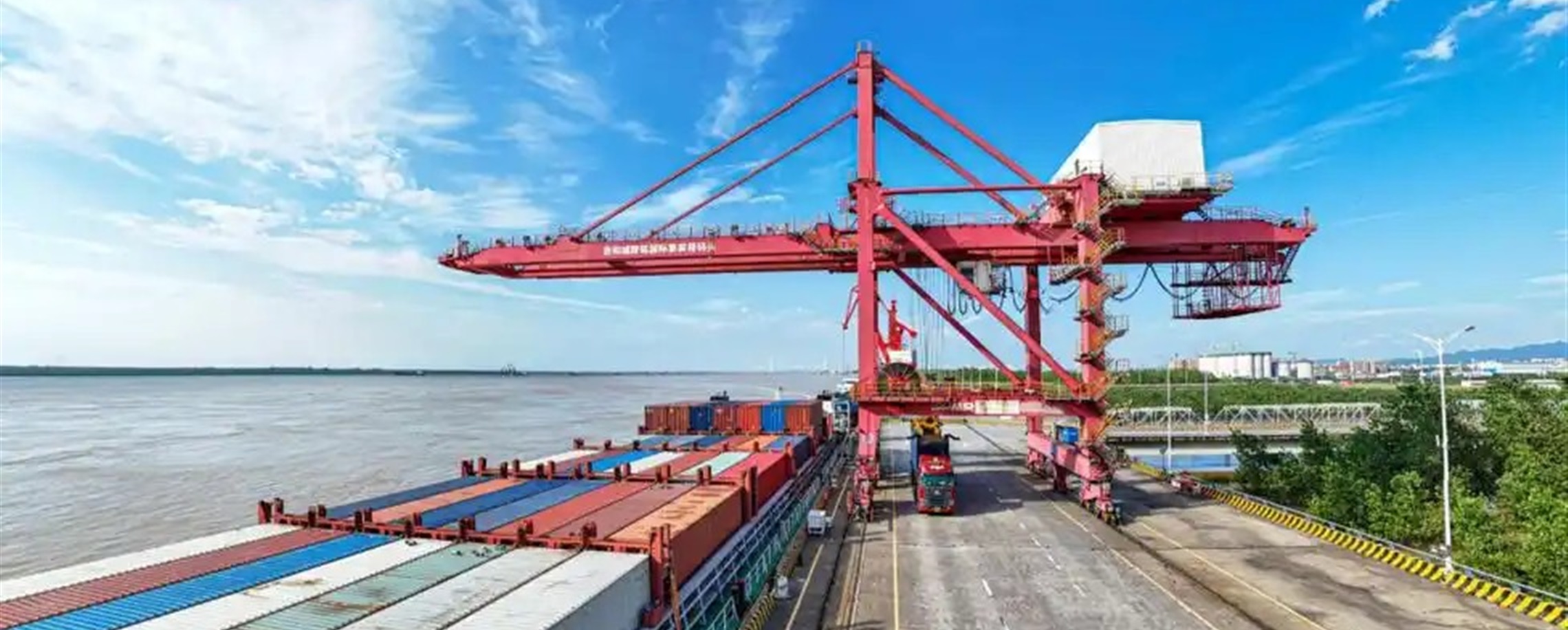
At night in Yangshan Port, rows of unmanned AGVs (automated guided vehicles) operate in an orderly flow. Even when typhoons strike, Shanghai Port's container throughput still reaches new monthly highs. COSCO SHIPPING, based on its big data product "Ship Vision," offers clients a full suite of services, including global demand forecasting, estimated arrival information, and supply-demand scheduling and matching. The Hi-Dolphin shipping large model is already applied in daily operational scenarios.
It is no wonder some experts observe that while the economic, financial, trade, and shipping centers define Shanghai's present, a strong scientific and technological innovation center will determine Shanghai's future.
"The 'Five Centers' form an interconnected, ascending spiral, with sci-tech innovation as the driving force," notes a study by the Fudan Development Institute on deepening Shanghai's "Five Centers" construction. The study's first conclusion states: "The interrelationships among the 'Five Centers' must be understood anew – the scientific and technological innovation center is the top priority, while the other centers provide the demand and application scenarios for sci-tech innovation."
Unleashing the momentum for development
During the National Day and Mid-Autumn Festival holiday in October, the Shanghai Urban Planning Exhibition Center was bustling with visitors. Audiences of different ethnicities were astonished by a series of figures: Shanghai is the first city in China with a GDP exceeding 5 trillion yuan, home to over 1,000 regional headquarters of multinational corporations, and a hub for 1,782 licensed financial institutions. It leads the world in port trade and has maintained the top spot in container throughput for 15 consecutive years.
From the perspective of globally renowned sci-tech industrial regions, a high-density, high-level overlay of functions creates a powerful gravitational field. Examples include the close synergy between London's financial district, Canary Wharf, and the "Silicon Roundabout" tech hub, as well as the industry-finance linkage between Tokyo's Marunouchi CBD and the Keihin industrial zone. Such long-accumulated structural advantages form the foundation of Shanghai's confidence in global competition.
"Shanghai possesses strong structural momentum, and it must also stimulate two additional types of momentum: generative momentum arising from technological innovation and industrial upgrading, and adaptive momentum resulting from institutional innovation and governance adjustments," Lin said.
Strengthening generative momentum is precisely driven by technological innovation. In recent years, Shanghai has accelerated the development of a modern industrial system, all of which is underpinned by technology. Efforts include promoting digital and green low-carbon transformations, especially in traditional industries, vigorously developing three leading industries – integrated circuits, biomedicine, and artificial intelligence, building six pillar industrial clusters (next-generation electronic information, smart and connected new-energy vehicles, high-end equipment, advanced materials, new energy and green low-carbon industries, and fashion consumer goods), and fostering six future industries. In this blueprint, Pudong New Area, as the core bearer of the "Five Centers," has taken the lead in realizing the clustering of the three leading industries, providing solid support for sci-tech-driven development.
To this end, Shanghai has established a 100-billion-yuan parent fund for the three leading industries and a future industry fund. Shanghai Guotou Company manages 22 industrial funds with committed capital exceeding 250 billion yuan. By pooling resources from government, industry, academia, research, finance, services, and application, Shanghai accelerates the deep integration of technological and industrial innovation.
Globally, this nurturing of emerging industries is similar to the increased investment in green technology mentioned in New York's 2050 strategy, and echoes the approach of the "Future Tokyo" strategy, which leverages digital twins and carbon neutrality as new urban growth engines. It reflects the strategic foresight of global cities: Only by continuously generating new economic forms can they break free from path dependency and seize favorable positions for the future.
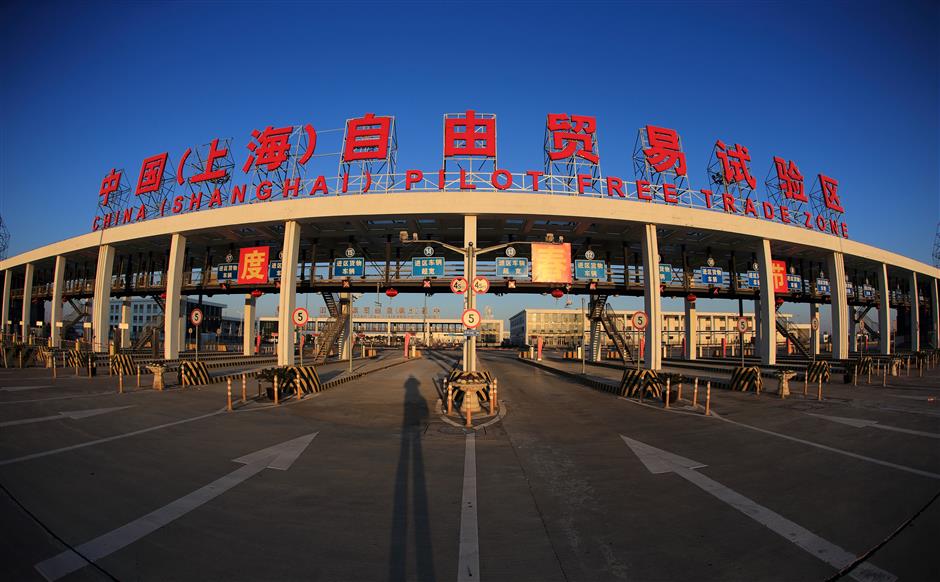
Enhancing adaptive momentum requires the city to adopt a flexible and agile approach to promote technological innovation. From the establishment of the China (Shanghai) Pilot Free Trade Zone 12 years ago to the launch of the Science and Technology Innovation Board and the pilot registration system six years ago, these institutional breakthroughs demonstrate Shanghai's commitment to aligning with high-standard international rules.
From the exploration of the "Two Networks" governance in megacities to legislative trials in autonomous driving and cross-border data flows, and to optimizing the business environment in line with World Bank standards and creating the Eastern Hub International Business Cooperation Zone, Shanghai continuously removes institutional barriers and improves governance, enabling the freer flow of innovation factors.
Zheng Yongnian, dean of the School of Public Policy at The Chinese University of Hong Kong (Shenzhen), believes that Shanghai should build a new "troika" driven by fundamental research, applied technology transformation, and financial services, grounded in the real economy and centered on technological innovation.
"In the competition among top cities, structural momentum determines how steadily one can run, adaptive momentum determines how long one can run, and generative momentum centered on technological innovation determines whether one can continually carve out new tracks," Lin said.
This is precisely the underlying logic behind Shanghai's emphasis on its role as a source of scientific and technological innovation.
Striving for global excellence
Every city aspiring to be first class must benchmark itself against the highest standards and chart a clear path forward. Shanghai must continue climbing to become a top-tier science and technology innovation center.
"Top global innovation centers usually meet three essential conditions: the ability to cluster resources, the ability to translate scientific research achievements, and the ability to lead in global innovation networks. These are all areas in which Shanghai should strive. Perhaps the most important is not the clustering of research, but the clustering of institutions and networks," Lin said.
Benchmarking point by point, Shanghai has made encouraging progress and also possesses great potential in these capabilities. The clustering power of a science and technology innovation center is reflected not only in the physical density of research institutions, but also in its ability to become a source of innovation that attracts the world's brightest minds and most active capital.
The future planning of both New York and London implies a common view: Innovation is not planned, but "grown." A better institutional environment, greater research freedom, and more convenient international living conditions are essential. Shanghai possesses the "golden triangle" of "major science facilities + top universities + R&D centers of leading enterprises". It now needs to build a first-class innovation ecosystem and industrial ecosystem to foster the free growth of innovation.
The future competition among cities will be a competition of "intelligence density." In Shanghai's Zhangjiang, the density of innovation factors continues to increase. For instance, next to "national treasures" such as the Shanghai Synchrotron Radiation Facility and the National Facility for Protein Science in Shanghai, Zhangjiang Laboratory invites scientists worldwide to jointly explore the deep mysteries of photon science. Similarly, beside the COMAC Shanghai Aircraft Design and Research Institute, the Tsung-Dao Lee Institute advances research on topological quantum computing, with about 40 percent of its permanent researchers being international scholars.
The ability to translate scientific research achievements can turn knowledge dormant in papers into productivity. Silicon Valley's success benefits from the close interaction among Stanford University, venture capital on Sand Hill Road, and surrounding tech giants. Shanghai urgently needs to strengthen the linkage between the Science and Technology Innovation Board and Zhangjiang Science City, the Lingang Special Area, and other innovation-active zones, building a closed loop of "research-capital-industry" to form a virtuous cycle of hard-core sci-tech innovation, industrial support, and financial empowerment, thereby improving the efficiency of creating industrial giants based on scientific research.
In recent years, Shanghai has accelerated the formation of a closed loop that enables a leap "from 0 to 1 to N." The Science and Technology Innovation Board has enabled nearly 590 "hard-tech" companies to go public, helping to open exit paths for early-stage investment and encouraging more patient capital to flow into original innovation.
Since Shanghai launched reforms in 2023 to promote the translation of scientific and technological achievements, 153 companies have been started or reorganized by researchers, attracting over 6.8 billion yuan in investment, with an average of more than 36 million yuan of social funding per achievement.
In terms of leadership in global innovation networks, Shanghai already accounts for one-third of China's papers published in the three top international journals – Cell, Nature, and Science – but merely counting papers or patents is not enough. A top-tier innovation center must define industry standards, shape global rules, and innovate governance models.
Shanghai is also making progress in this regard.
The World Artificial Intelligence Conference held in the city in 2024 and 2025 released the Shanghai Declaration on Global AI Governance and the Action Plan for Global AI Governance, drawing worldwide attention. Moreover, through institutional pioneering, Shanghai is taking the lead in the Lingang Special Area to explore institutional arrangements for data-element rights confirmation and cross-border flow, digital asset trading, and governance of intelligent industries. Simultaneously, in areas such as AI, digital trade, and green finance, the city is promoting the joint development of international rules, upgrading the "Shanghai model" into national standards and, further, into international examples. Greater breakthroughs may be achieved in the 15th Five-Year Plan period.
Professor Liu Yuanchun, president of Shanghai University of Finance and Economics, noted that as the country addresses future risks, especially the uncertainties brought by the new round of technological revolution and industrial transformation, Shanghai should become a test field for technological innovation and a pressure-testing ground for modern risk management, daring to take the lead and bravely seize opportunities.
Undoubtedly, the science and technology innovation center will be Shanghai's "new core." Shanghai should embrace this ambition: in the future, it will not be measured by how many skyscrapers it has, nor by its container throughput, but by how many world-changing original innovations it gives birth to, how many future-leading great enterprises it cultivates, and how many intellectual achievements that shape human civilization it contributes to.
Editor: Su Yanxian
In Case You Missed It...
![[Weather] Typhoon Champi Closes Shanghai Attractions, Disrupts Weekend Events](https://obj.shine.cn/files/2026/10/23/b4b6f81b-9cac-4715-aeef-c0966ff96c99_0.jpg)
 Oct 23, 2026
![[Weather] Shanghai Braces for Heavy Rain As Typhoon Champi Approaches](https://obj.shine.cn/files/2026/10/23/5a1f85ca-5b01-42ee-ab14-b60cf2f87f9b_0.jpg)
![[Weather] Typhoon Champi Closes Shanghai Attractions, Disrupts Weekend Events](https://obj.shine.cn/files/2026/10/23/f76ff132-9477-4587-8eed-3b9812ed7f4f_0.jpg)