China Circuit Board Makers at the Chokepoint of the AI Race
SinoArk
This column intends to take deep dives into how today's industrial change is being woven by China – its factories, markets, and clusters that provide the threads. Each story will follow a cast of people and companies – engineers and founders, suppliers and shop-floor managers – whose daily choices animate China's innovation engine. We tell their stories closely, in human scale, and then pull back to read the larger weave: How domestic design, scale and supply-chain craft ripple outward and reshape industries across continents.
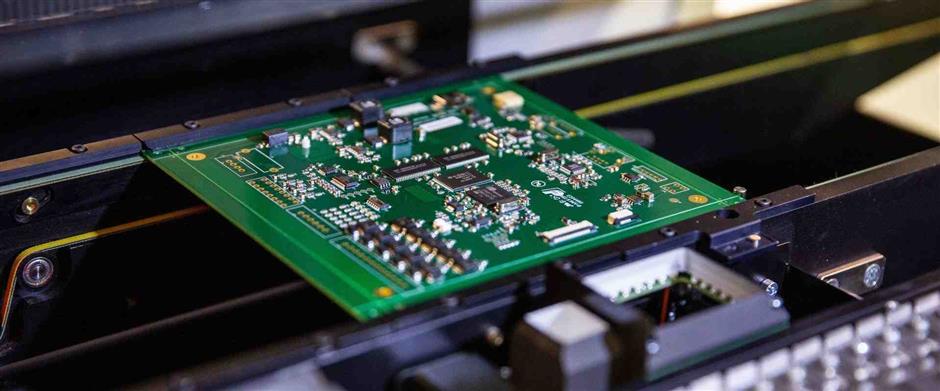
The global buzz around artificial intelligence may fixate on microchips, specifically the power of Nvidia graphics processing units and the foundries that manufacture them, but beneath the headlines lies the real race for supremacy in advanced AI technology.
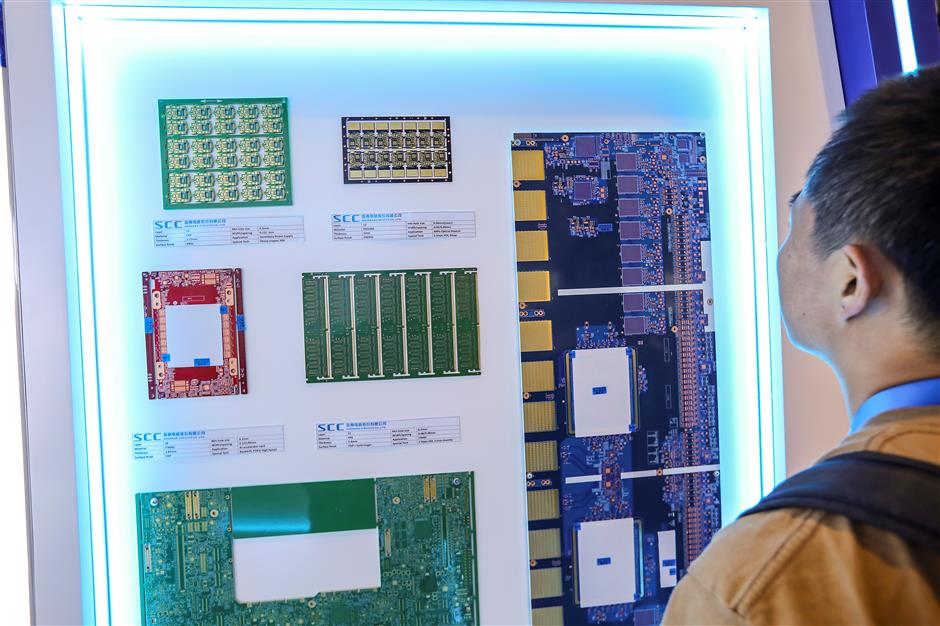
Printed circuit boards, the unassuming copper wiring on a fiberglass base, are becoming a major bottleneck in the drive to accelerate performance in artificial intelligence technologies.
The potential scope of this manufacturing chokepoint is best illustrated by the sheer volume and velocity of money being poured into the sector. Major cloud players, including Microsoft, Amazon and Meta, are estimated to have spent an aggregate US$330 billion on AI data center infrastructure in 2025, a 50 percent increase from a year earlier and almost equivalent to the size to the whole Greek economy.
This unprecedented outlay translates directly into a technical challenge for makers of printed circuit boards.
An AI supercomputer, such as a large-scale server module housing multiple powerful graphic processing units, pushes the limits of physics. The boards must handle immense power – over 700 watts per processor – while simultaneously allowing ultra-low-loss data to race across the network at 112 gigabits per second.
As a result, printed circuit boards must simultaneously be thinner, denser and better-cooled than any previous generation. Without these highly specialized boards, even the most brilliant Nvidia chips remain nothing more than a collection of brilliant, but disconnected, components.
Rapid, radical change
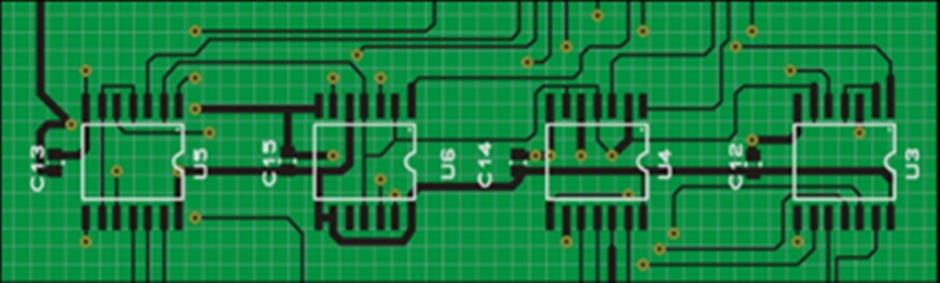
The industry is being radically redefined. Simple, conventional boards are being rapidly replaced by high-density interconnective products, characterized by complex wiring layers and microvias.
As the technology advances, so do prices. Boards with 18 or more layers now command a unit price three times higher than their simpler counterparts. The manufacturing volume for high-layer boards has soared by over 35 percent in a single year, highlighting the massive demand for advanced capacity.
This new technical frontier has created a deep industry divide: the smaller, older manufacturers, on the one hand, who are struggling along, and a handful of Chinese mainland "hidden champion" companies that make the advanced circuit boards and seek to close the gap with established global players in capturing demand from AI next-generation servers and high-performance electric vehicles.
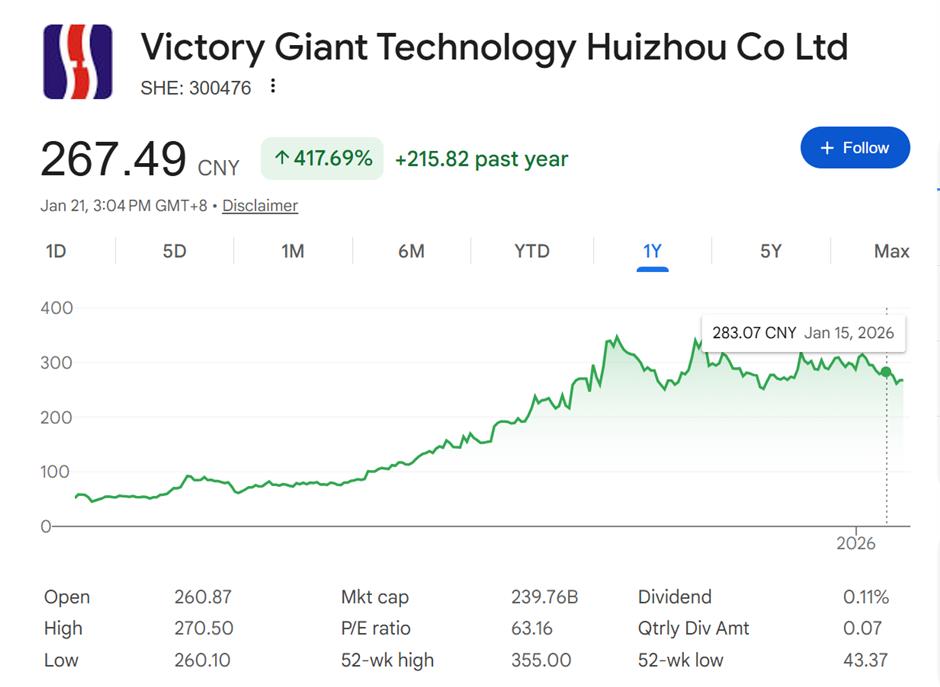
Shenzhen-listed Victor Giant Technology (stock sticker: 300476.SZ) is among the companies already achieving mass production of complex 70-layer boards.
Chinese mainland has a modest 8.3 percent share in the high-end of the printed circuit market, but that proportion is rapidly growing. Taiwan companies, above all, are the industry powerhouse, with a 34 percent market share.
Industry titans like Taiwan's Unimicron are not just manufacturers but strategic partners within a highly integrated "chip-to-package-to-board" ecosystem. This means they have co-developed their manufacturing processes alongside giants like Taiwan Semiconductor Manufacturing and Nvidia for more than a decade, giving them an imposing lead in technical know-how and integration.
This dominance stems from achieving consistently high manufacturing yields, often above 90 percent. In advanced electronics, percentage yield is a crucial figure because it ensures reliable, high-volume production, creating a bond of trust with customers that can take new market players years to overcome. Mainland competitors, by contrast, still have yields lagging by 10-15 percentage points for the most complex 14-plus layer boards.
Deep loyalty extends beyond AI chips into high-end consumer electronics. Apple's supply chain, for example, operates under an unofficial "no substitution for core components" principle. For flagship products, the choice of supplier is driven by a non-negotiable demand for stability and yield, solidifying the position of Taiwan companies in flexible circuit boards and complex chip carriers.
Breaching tripartite domination
Chinese mainland's strategy to breach this formidable wall of tripartite domination is to focus on scale, superior cost structure and substitution within the massive domestic market.
Mainland firms are aggressively expanding production capacity at a rate reportedly three times faster than their Taiwan rivals. Shenzhen-listed Shennan Circuits (002916.SZ) is one example, with a competitive edge defined by cost and capacity scale.
Cost is particularly critical for capturing high-volume demand from server and electric vehicle markets. The unit cost for advanced chip carriers from Shennan Circuits is estimated to be 18 percent lower than those from Taiwanese market leaders such as Unimicron.
Facing geopolitical tensions, China tech giants like Huawei are actively "de-risking" their supply chains by shifting up to 30 percent of their high-end, base station chip carrier orders to mainland suppliers like Shennan Circuits.
China's entire strategy is backed by the depth of investment in research and development. Shennan Circuits is spending 8.2 percent of its revenue on research and development, outpacing Unimicron's 5.1 percent and Samsung Electronics' 6.3 percent. The intensity is driving critical technical breakthroughs, pushing prototypes to ultra-fine 10-micrometer line widths and rapidly closing the technical gap in core metrics required for the next generation of AI chips.
Upstream bottlenecks
Despite all the progress, supply-side chokepoints remains in the upstream value chain, specifically related to critical raw materials and high-end equipment. Those are aspects where Japanese, European and US companies still hold the advantage.
Raw materials account for about 60 percent of printed circuit board production costs, and the AI segment demands highly specialized compounds. The global deficit for highly specialized copper foil used for 112 gigabit-per-second data transmission is estimated to exceed demand by some 40 percent. Until recently, ultra-thin copper foil was exclusively produced by only a handful of Japanese and European companies, creating limits for Chinese mainland manufacturers.
Similarly, the world faces a shortage of high-grade glass fiber materials vital for advanced substrates, with demand exceeding supply estimated at 50 percent this year.
A second crippling bottleneck is manufacturing equipment. Producing cutting-edge boards, especially for advanced chip carriers, requires highly precise, micrometer-level laser drilling and high-precision exposure tools.
These core processing machines have traditionally been monopolized by overseas suppliers, resulting in prohibitively high costs and lengthy delivery times.
Mainland companies are taking countermeasures, with leading printed circuit board makers forming partnerships with upstream material suppliers to create domestic substitutes. In copper foil, Shenzhen-listed Defu Technology (301511.SZ) is now supplying high-performance foil used in Nvidia's server supply chain.
Similarly, in specialized laminate, Shanghai-listed Shengyi Technology (600183.SS) has captured 30 percent of the domestic high-speed, high-frequency board market, offering a crucial cost advantage estimated at 15 percent lower than Japanese rivals.
Furthermore, manufacturers are also collaborating directly with domestic equipment suppliers such as Han's CNC Technology (301200.SZ) , leading to the development of bespoke all-in-one machinery tailored specifically for the rigorous demands of AI circuit boards, including high-precision back-drilling.
The final step is translating technical breakthroughs into commercial success. Victor Giant Technology, for example, has become the exclusive supplier of specialized 24-layer boards for Tesla's Cybertruck and holds an estimated 75 percent market share for specific Nvidia acceleration cards in domestic supply chains.
Push to go global
China's printed circuit board makers are keen to expand their profile and sales overseas, with many choosing nearby Southeast Asia as their launchpad.
The goal is to mitigate the risks associated with geopolitical tensions while at the same time increasing international orders from US-based companies under government restrictions related to mainland manufacturing but not to production in Southeast Asian countries like Thailand.
In the past two years, 60 percent of investment in Thailand has come from Chinese companies, with emphasis on sectors such as high density, multi-layered printed circuit boards for the AI industry and new energy vehicles.
However, underdeveloped local supply chains in Thailand have forced board makers to initially focus on simple assembly, leaving a wide gap in supply of circuit boards most in demand.
This supply chain shortfall directly impacts efficiency. The Thai factory of Shanghai-listed Kinwong Electronics, for example, saw its operating rate drop by 25 percentage points compared with mainland sites due to delays in securing specialty materials.
A second bottleneck overseas manufacturing is a critical shortage of technical talent in local markets. Advanced processes require highly specialized expertise. Chinese mainland firms like WUS Printed Circuit cited that factor in acknowledging that achieving yield of about 90 percent at it new Thai sites is expected to take between 18 and 24 months. To bridge this gap, some companies are forced to staff up to 40 percent of overseas facilities with expatriate Chinese personnel, significantly raising costs.
But headwinds aren't deterring expansion ambitions. For leading mainland printed circuit board makers, establishing non-mainland capacity is an essential step in achieving global recognition and scale. Their efforts will determine global leadership in the AI era in coming years.
(The author specializes in the international expansion of Chinese tech companies in the advanced hardware and energy sectors. He also serves as a geo-economic expert for several think tanks in Beijing.)
In Case You Missed It...

 Oct 22, 2026