China Math Whiz's Award Dispels Old Clichés, Magnifies New Realities
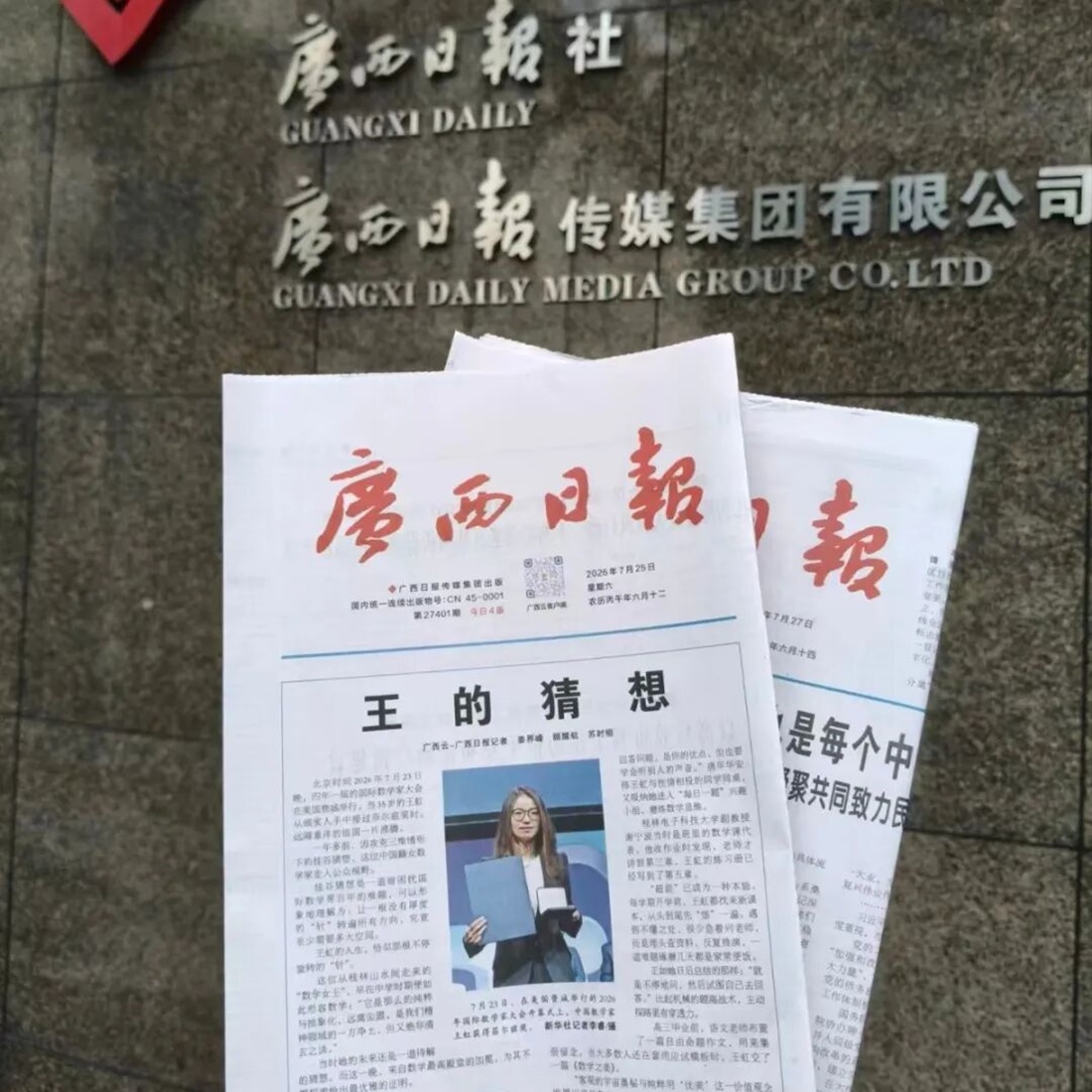
When Wang Hong and Deng Yu became the first Chinese-trained mathematicians to win the coveted Fields Medal at the International Congress of Mathematicians in late July, Chinese social media published a story about Wang's depressing undergraduate years at Peking University.
It went viral within hours, feeding an old stereotype that China is not fertile soil for exceptional talent, who can shine only overseas.
Within two days, the viral story was overwhelmed by interviews and posts from prominent scientists describing the "golden generation" of Peking University's mathematics department and the "platinum generation" that followed.
Wang's research is complicated to understand by those not grounded in math. The Fields Meal was bestowed for her research focused on Fourier analysis and geometric measure theory. She and colleague Joshua Zahl presented a paper last year proving a longstanding conjecture at the intersection of math and geometry called the three-dimensional Kakeya conjecture. It showed that a Kakeya set in three-dimensional space can occupy zero volume and still have dimension of exactly three.
Wang, 35, is the first Chinese woman and only the third woman in history to win the coveted math award, sometimes called the "Nobel Prize for mathematics."
After earning a bachelor's degree in mathematics in 2011 from Peking University, Wang went to France's École Polytechnique for a master's degree and then on to the Massachusetts Institute of Technology (MIT), where she completed her PhD in 2019.
A Quanta magazine article on Wang describes her as a quiet, self-effacing woman, who works with the devotion and discipline of a cloistered nun or an elite athlete. She denies herself time-consuming indulgences like reading books or having a dog, the article said, though she does make time for friends, yoga and early-morning walks.
The viral, somewhat petty version of her story claimed that the mathematics department at Peking University refused to write Wang a recommendation letter for graduate study in France, and that her only recommendation came from a class adviser in the unrelated Department of Earth and Space Sciences, where she originally enrolled before transferring to math.
The story also drew on an interview where Wang herself described feeling that she had merely survived, not excelled, as an undergraduate. It's possible that she was describing a common feeling among young people enrolled in a top institution like Peking University or Harvard, when they find themselves somewhat over-awed to be in the company of the best brains in the world.
Biologist Rao Yi, a prominent public critic of Chinese academia, said for the record that Wang had received multiple recommendations letters, not one.
The more interesting question isn't whether Wang had recommendations or not. It's why such a snarky version of her academic life was instantly believed by so many.
The rumor took hold because it fed into the old assumption that Chinese education in science, technology, engineering and mathematics is based on rote learning aimed at exam-taking and doesn't foster independent thinking.
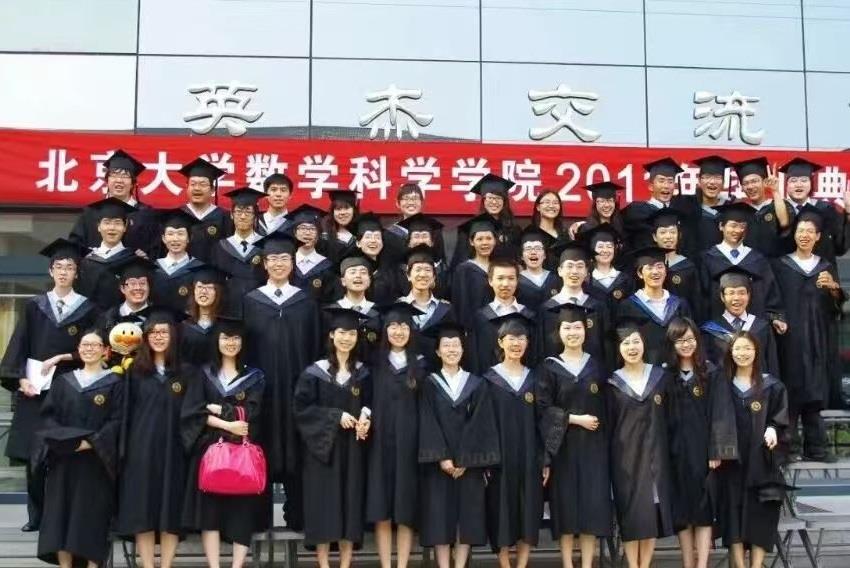
Peking University's illustrious alumni certainly debunk that view. In addition to medal winners Wang and Deng, the university trained the so-called "math monk" Wei Dongyi, whose ascetic lifestyle belies a very distinguished career as professor on the campus.
Peking University ranked 13th this year in the Times Higher Education List of the best universities in the world, with Beijing's Tsinghua University a notch above at 12th. Five Chinese universities ranked in the top 40.
Tsinghua's Yao Class, founded in 2005 by Turing laureate Andrew Yao, was created explicitly to avoid rote pedagogy. It encompasses English-language instruction from year one, an MIT-derived curriculum from year three, direct classroom access to Turing and Gödel Prize winners, and "teach to aptitude" philosophy over standardized progression. Nearly 750 students have graduated since 2005, with 30 now in top positions at leading mainland universities.
Recently, a screenshot that shows AI startup DeepSeek hiring interns from the Tsinghua Yao Class at a daily wage of US$810 sent posts about the class circulating on social media. Though the claim was not verified by either DeepSeek or Tsinghua, the eyebrows it raised reflect how valuable its graduates are viewed.
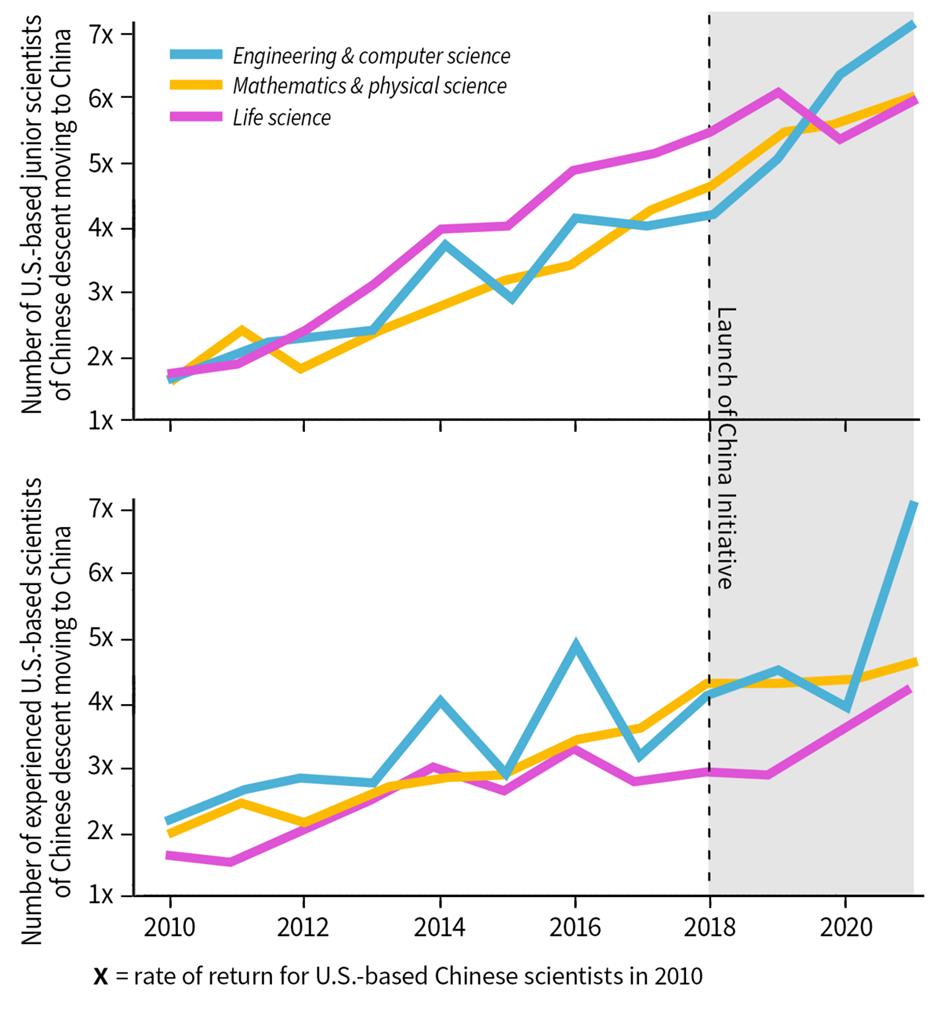
Individual talent will always seek its own path forward, with career decisions difficult to pigeon-hole. But there's a growing trend for Chinese students who study abroad to return to China to pursue careers in business, scientific research and academia.
CNN counted at least 85 scientists moving from US institutions to Chinese research institutions since the start of 2025, and Princeton researchers separately found about 50 tenure-track scholars of Chinese descent leaving US universities for China in just the first half of 2025. A Stanford survey found 62 percent of 1,304 scientists of Chinese descent in the US are considering leaving.
One high-profile returnee is Moonshot AI founder Yang Zhilin, a Tsinghua computer sciences undergraduate who went to the US for further studies and returned to found a company that seized world headlines recently with the release of its Kimi K3, the world's first open-source in the 3-trillion-parameter class. That led some US netizens to wonder online "why couldn't we keep Yang in the US?"
Most Yao Class graduates go abroad for doctoral studies, but there is an increasing trend toward staying at home to earn advanced degrees. By 2024, 45 percent of Yao Class graduates had chosen to stay in China for further study or employment, a marked change from a decade earlier when overseas careers were the default position of the program's strongest graduates.
This isn't an argument that China's education system has overtaken America's. It's just a reflection of shifting attitudes as China emerges as a global leader in AI, robotics, biotech, green energy and other advanced disciplines – opening wider opportunities for its best and brightest talent.
Fields Medal winner Wang remains in the US for now, a mathematics professor at New York University. But no matter where she resides, her story remains an inspiration for a younger generation. Born to parents who were both schoolteachers in the southern Chinese city of Guilin, she developed an interest in geometry at age 6. She was so bright, she skipped two grades in primary school.
The Fields Award is just one in long series of honors recognizing her achievements. She has also been bestowed with the Maryam Mirzakhani New Frontiers Prize, the Salem Prize, the Ostrowski Prize and the Sadosky Prize, to mention just a few.
Her achievements are the real story that social media should be focused on.
Editor: Yao Minji
In Case You Missed It...
 Jul 29, 2026
![[Hai Guide] The Inner Ring Road Is Getting Repaired – Here's Where You'll Feel It](https://obj.shine.cn/files/2026/06/18/51ce3ba3-3451-4273-b40f-12e0377275f5_0.jpg)
![[Weather] Shanghai Bears Brunt of Rain, Wind as Typhoon Dolphin Makes Landfall](https://obj.shine.cn/files/2026/08/09/78f7e76c-2da3-4a70-af37-a0d89800f42b_0.jpg)
![[Weather] Get Ready for Summer's Wettest Typhoon as City Issues Dolphin Alert](https://obj.shine.cn/files/2026/08/08/e2607c40-c6d9-42fe-bcbb-10b987cc5d39_0.jpg)
