China Stocks Fall Victim to Global Volatility Over Trade Tensions
Volatility in global markets as investors veered between hope and despair this week over the China-US trade standoff sent the Shanghai Composite Index down nearly 2 percent on Friday, with chip and power equipment shares leading declines. The Shenzhen Component Index and tech-heavy ChiNext lost about 3 percent.
"The unexpected downturn on Friday indicates how politics can shake up markets and eat up hard-earned gains," said Mu Yiling, an analyst with Sinolink Securities. "Still, investors should not get in panic at the moment because trade talks are still underway."
On Thursday, US Treasury Secretary Scott Bessent rattled markets by calling Beijing an "unreliable" trading partner over its tightened export controls on rare earth minerals critical to industrial production. On Friday, those concerns eased somewhat on news that he would hold a phone conversation with his Chinese counterpart to discuss trade tensions.
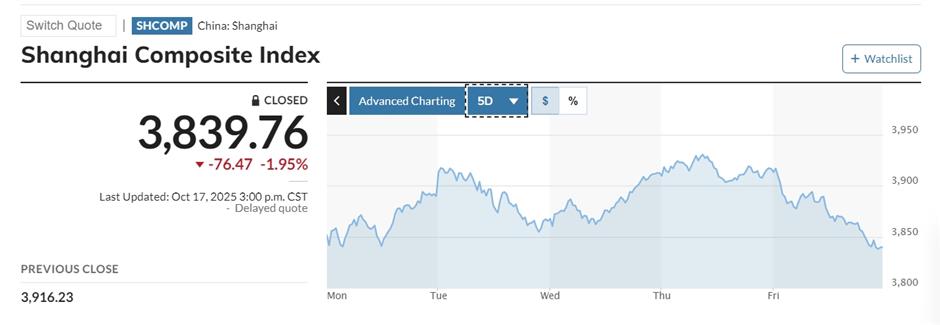
Asian markets remained on edge. Hong Kong's Hang Seng Index lost 2.4 percent, and the Nikkei in Japan shed 1.4 percent on Friday. South Korea's Kospi eked out a 0.01 percent gain on some positive sentiment toward US-South Korea trade talks.
Thomas Gold, a professor of sociology at the University of California, Berkeley, said in Shanghai this week that US tariffs and other sanctions on Chinese goods have stimulated China's innovation rather than hurt the Chinese economy much.
"It's like a boomerang," he told the second World Conference on China studies. "You throw it, and it comes back to hit you in the face. That's one thing people like (Donald) Trump are not prepared to consider."
China signaled its resilience when the Ministry of Commerce used the domestic WPS format, developed by Beijing-based Kingsoft, to release its announcement of rare earth export controls, replacing its traditional use of Microsoft formats.
Even strong third-quarter results on Friday from chipmaker Cambricon, often called "China's Nvidia," and gold mining giant Zijing Mining failed to lift investor spirits, with shares of both falling. Shares in electric carmaker BYD tumbled after the company's largest recall of vehicles was announced.
Amid all the uncertainty, the Shanghai Mayor Gong Zheng hosted the annual meeting of his Business Leaders' Advisory Council last week, promising to remove all regulatory hurdles for foreign investors to set up manufacturing businesses related to electric vehicles, telecommunications, biotech and medical care.
European shares dropped on Friday as US concerns about bad loans at regional lenders washed over the continent. The broad Stoxx600 index dropped 1 percent. But concerns about bank credit eased in New York, with the S&P 500 ending up 0.5 percent.
Gold retreated from record highs after US President Donald Trump said a "full-scale" tariff on China would be unsustainable, which was interpreted as a climb down from his threat to impose a new 100 percent import levy on China come November 1. Spot gold fell 2.6 percent to US$4,211.48 an ounce.
Editor: Yao Minji
In Case You Missed It...

 Sep 23, 2026
![[Chinamaxxing] Qiufen, AKA Autumn Equinox](https://xinyue-v30o.yueliu.cloud/coverImg/project/video/a63975834f8c1c4a9b608db31bd97c90-766a82b2a26925f900b40de97bbd201f/j54802db6b66111f1985e71dcdd286c0b_0.jpg)