Chinese Tech, Auto Shares Lead Declines in Equity Markets, Iran War in Focus
China's stock market this week lagged behind other markets in Asia, with tech and auto shares suffering among the biggest setbacks on Friday. Swings in sentiment toward an end to the war in Iran also guided investor sentiment this week.
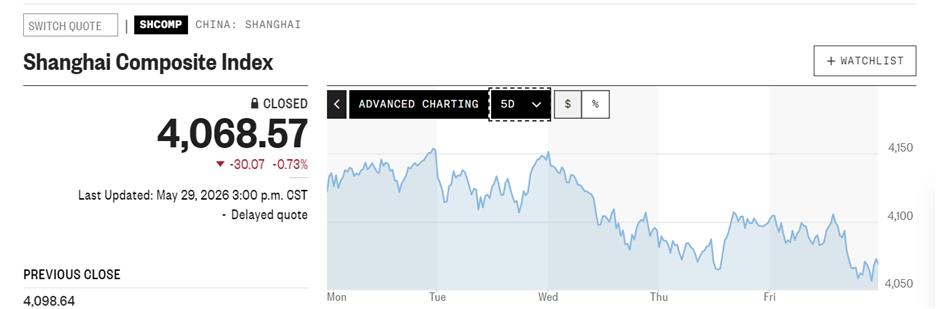
The benchmark Shanghai Composite Index shed 0.73 percent on Friday to end at 4,068 points, wrapping up the week and the month with declines of 1.1 percent.
The Shenzhen Component Index slumped 1.8 percent on Friday for a weekly slip of 0.14 percent. The tech-focused ChiNext retreated 2 percent on Friday, but thanks to earlier rallies, it posted a 2.5 increase for the week.
Hong Kong's Hang Seng Index lost 1.65 percent for the week, with its tech index losing 1 percent.
"The sharp declines on Friday were led by tech shares, especially the semiconductor sector, after Chinese funds were reported to be selling shares in some companies," said Wang Daji, an analyst with Zheshang Securities.
According to public statements, the China Integrated Circuit Industry Investment Fund, which is invested jointly by firms including China Development Bank Capital and China Mobile, reduced its holdings in National Silicon Industry Group, Darbond and Semiconductor Manufacturing International Corp, among others. The SMIC, Chinese mainland's largest chipmaker, fell 8.9 percent on Friday.
Shares in tech startup Zhipu AI fell 1.4 percent on Friday, and Kingsoft, which develops WPS Office tools to rival Microsoft Office, lost 1.4 percent.
Investors also pared holdings in auto stocks amid poor earnings results. Hong Kong-listed shares in Xiaomi, the world's third-largest smartphone maker and a manufacturer of electric cars, ended the week with a loss of 6.5 percent after reporting a 56.5-percent drop in first-quarter profit.
Li Auto lost 4.3 percent on Friday after swinging to a first-quarter net loss pf 2.3 billion yuan (US$340 million) from a year earlier profit of 650.2 million yuan, and carmaker Xpeng tumbled 3.8 percent after reporting its first-quarter loss widened to 1.78 billion yuan. William Li, chief executive of Chinese carmaker Nio, said the golden era of China's auto industry is over and unlikely to return.
US shares in PDD Holdings, a Chinese online retailing giant that operates the Temu discount e-commerce platform overseas and the Pinduoduo platform on Chinese mainland, fell 10 percent this week after missing analysts' forecasts with a 15-percent decline in first-quarter net profit.
On the plus side, shares in Chinese robotaxi company Pony.ai rose 3.3 percent on Friday, despite reporting this week that its first-quarter net loss widened to US$53.5 million from US$37.4 million a year earlier. Kuaishou, a leading Chinese developer of a mobile app for sharing short videos, rose 1.5 percent even after reporting a 27-percent decline in first-quarter profit to 2.9 billion yuan.
Japanese and South Korean equities were the star Asian performers this week. Japan's Nikkei rose 4.7 percent in the past five trading days, and South Korea's Kospi surged 8 percent thanks to continued strength in tech shares. Chipmaker SK Hynix, joined the elite global club of companies with market capitalization of US$1 trillion after its shares rocketed 11 percent on Wednesday.
An exchange of limited air attacks between Iran and the US this week that threatened renewed tensions was mitigated by reports that both sides are nearing agreement on a framework for a peace settlement. Oil prices abated.
In overseas trading, the Stoxx600 index in Europe rose 0.14 percent, and Wall Street markets closed the week at record highs on lower global oil prices and bets that Iran and the US will agree to a tentative peace agreement on the table. For the week, the broad S&P 500 index rose more than 1 percent, and the tech-heavy Nasdaq added 2 percent. Benchmark Brent crude futures ended the week at US$92.05 a barrel after hitting US$98 earlier in the week.
Editor: Liu Qi