War, Corporate Earnings Sway Chinese Investors, Main Indexes Drop
Chinese stocks joined markets around the world in feeling the brunt of the Middle East war, which is crimping global supplies of oil, natural gas, helium and fertilizer produced in Gulf states, and raising concerns about inflation.
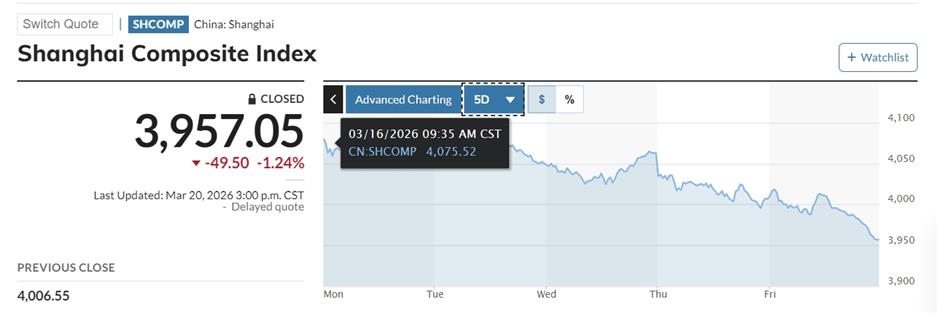
The benchmark Shanghai Composite Index fell 1.2 percent on Friday, closing below the psychologically sensitive 4,000 level to end with a weekly loss of 3.4 percent. The Shenzhen Component Index lost 2.9 percent in the last five trading days. Hong Kong's Hang Seng Index dropped 0.74 percent for the week, while Japan's Nikkei lost almost 2 percent.
"The market has suffered a long steak of losses amid fears of a prolonged war in the Middle East that has put the global oil supply at risk," said Yang Chao, an analyst with Galaxy Securities. "But the renewable sector may be among the few beneficiaries."
Indeed, one bright spot in Chinese mainland markets was solar-related stocks, which rose Friday on reports that Tesla Chief Executive Elon Musk is looking to buy US$2.9 billion of equipment from Chinese suppliers to manufacture solar panels and cells. That boosted the ChiNext tech market in Shenzhen on Friday by 1.3 percent. Share of Risen Energy surged 8 percent, Trina Solar was up 6 percent, and Junda rose 7 percent.
Technology companies, especially chipmakers and those that rely on semiconductors, fell this week after Iranian missiles heavily damaged Qatar's largest natural gas processing hub, where helium, a key material in manufacture of chips, is produced as a by-product. In Hong Kong trading on Friday, Semiconductor Manufacturing International Corporation, the Chinese mainland's biggest chipmaker, fell 2.8 percent, MiniMax lost 5.4 percent and Zhipu shed 4.3 percent.
War-related woes were compounded by some disappointing earnings reports. Chinese conglomerate Alibaba Group fell 6.3 percent on Friday after reporting profit in its third fiscal quarter plummeted 67 percent, mainly due to a nearly 75 percent decline in operating income, largely on fast food-delivery costs.
Tencent shares fell 3.6 percent after China's largest company by market cap reported double-digit increases in revenue and profit but curtailed buybacks and failed to deliver a clear vision of how it will profit from AI assistant development. Cosco Shipping shares fell almost 1 percent after the company eked out a 1.1 percent profit increase for 2025 and warned about repercussions this year from shipping blockages in the Gulf.
In China's automotive sector, Geely shares rose 6.4 percent on Friday after the automaker reported 2025 revenue rose 25 percent on a 39 percent rise in vehicle sales. Shares in Leapmotor rose 0.6 percent after earlier reporting its first annual profit. However, Chery, the Chinese mainland's largest auto exporter, fell 5.7 percent, after revenue for 2025 came in below analysts' estimates, despite a 36-percent surged in net profit.
On Wall Street, major averages posted their fourth losing week in a row. The S&P 500 on Friday lost 1.5 percent, and the Nasdaq tumbled 2 percent. The Stoxx600 index in Europe shed 1.8 percent. Benchmark Brent crude closed out the week at US$112.20 a barrel, paring steeper prices during the week.
Editor: Liu Qi
In Case You Missed It...
 Mar 16, 2026