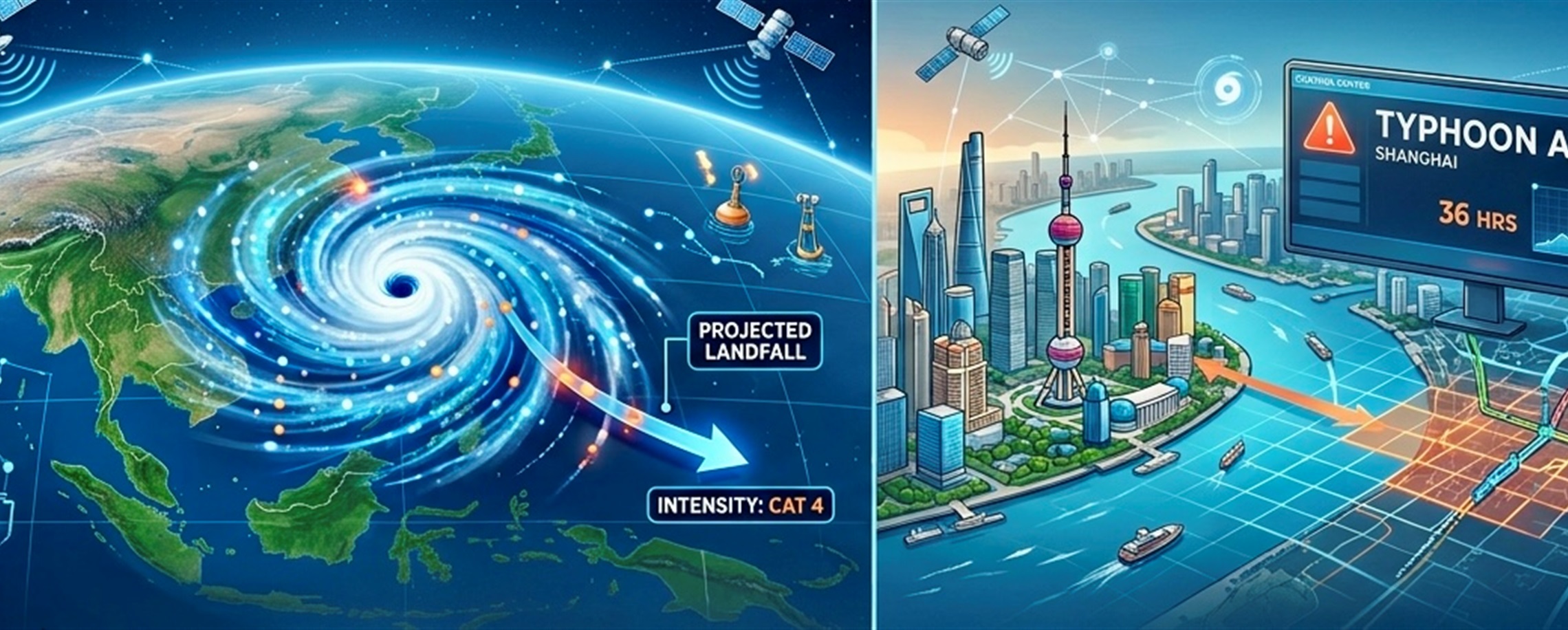
AI to the Rescue as China Endures a Strong Summer Typhoon Season
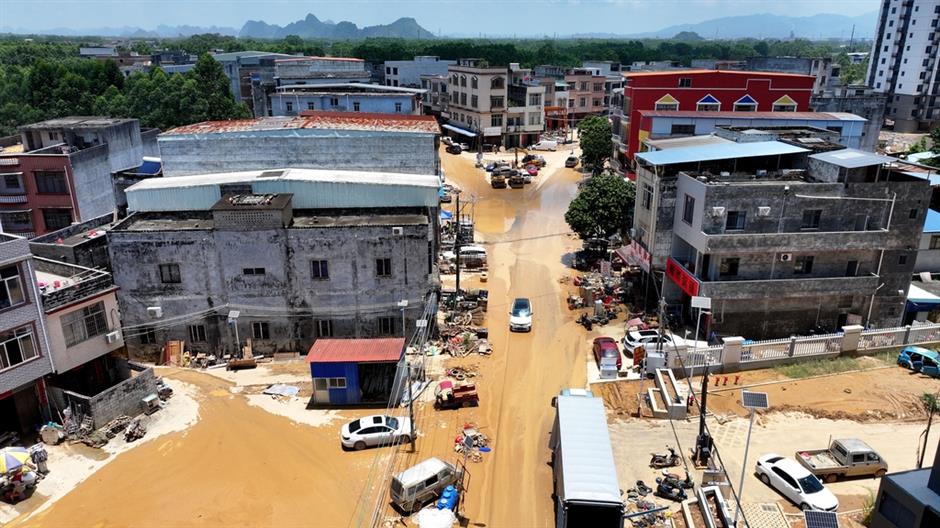
China is confronting another reminder of how difficult extreme-weather forecasting remains. Three typhoons were active around the country on Monday, with storms already bringing heavy rain to parts of southern and southeastern China, while Super Typhoon Saudel was moving toward the East China Sea.
Saudel, the strongest of the systems, was forecast to enter the East China Sea on Wednesday before turning toward the Fujian-Zhejiang coast, putting eastern China on alert later this week.
It reinforces a question becoming increasingly urgent as China deploys artificial intelligence to improve forecasts and early warnings: How much more accurately, and how much earlier, can technology tell people what is coming?
The tech revolution can't prevent violent storms from hitting Shanghai and other coastal Chinese cities, but it is supplying AI-driven tools to predict, prepare for and survive extreme weather.
This comes as the UK predicts an El Niño event developing over the Pacific Ocean is likely to be the strongest in living memory, poised to disrupt weather patterns globally and heightening the incidence and severity of typhoons in East Asia.
In the latest tropical storm to hit the China, Typhoon Maysak struck the southern Guangxi Zhuang Autonomous Region, leaving 159 dead and 10 missing across the cities of Nanning and Guigang until Friday. The typhoon affected 1.65 million residents.
Super Typhoon Dolphin struck Shanghai on August 9, the 13th typhoon to make landfall on the Chinese mainland this year. It forced the city to evacuate hundreds of thousands of residents living in high-risk zones and to deploy emergency crews to flooded roads and affected Metro networks.
In July, major typhoons Maysak, Bavi and Noul hit the Chinese mainland, causing widespread destruction.
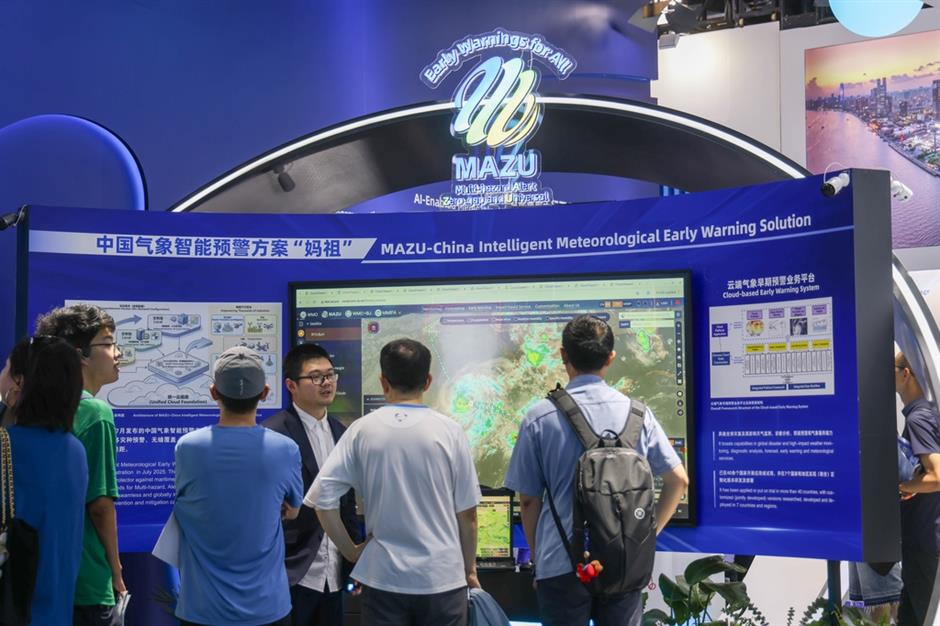
Artificial intelligence is rapidly complementing traditional forecasting methods. By analyzing massive historical datasets, large AI models extrapolate weather patterns to predict a typhoon's track, intensity and landfall probability up to seven to 10 days in advance.
Traditional physical models rely on supercomputers to solve complex fluid dynamics equations, taking hours to run a global forecast. AI models deliver results within minutes, or even seconds and demonstrate superior accuracy over traditional numerical models when predicting typhoon paths three to five days out.
However, forecasting sudden shifts in typhoon intensity remains a global challenge.
"AI models possess strong forecasting capabilities, but currently face bottlenecks like a lack of extreme weather data and insufficient model reliability," said Pan Jinjun, chief engineer at the China Meteorological Administration.
China's national blueprint called "Scientific and Technological Innovation in Typhoon Research" aims to integrate AI with physical models to reduce 24-hour track forecasting errors by five kilometers and overall location and intensity errors by 20 percent by 2030.
During Typhoon Dolphin, Shanghai's AI-powered early warning system broadcast alerts simultaneously to all 6,671 residential community committees. High-precision 1-square-kilometer grid forecasts were sent directly to transport authorities to assess wind probable impact on specific subway lines, while public alerts were sent to 13 major platforms, including Amap, Meituan and Hello Bike, to notify couriers, drivers and commuters in real time, according to the Shanghai Meteorological Bureau.
The domestic pioneers in meteorological technology include university students providing some of the computing muscle behind these models.

At the recent Priority Research Application contest of intelligent computing at Tongji University, organizers showcased China's first domestically developed 1,000-card engineering-grade computing cluster. The system supports Chinese AI models, including Alibaba's Qwen and Huawei's Pangu models, to run on hardware built by Shanghai-listed Hygon.
"Meteorological research falls under the category of 'AI for Science' and has long been a prime example of the convergence between high-performance computing and artificial intelligence," said Ying Zhiwei, vice president of Hygon.
The newest meteorological model was a major feature at the contest. It showed how open-source AI weather models can be linked to public weather services and disaster mitigation, covering a seven-day mid-range weather forecast.
Forecast results can be delivered within seconds, assisting meteorological departments in rolling updates to forecasts. The system also covers extreme weather warnings, to simulate typhoon paths and predict intensities, heavy precipitation and severe convection. It also assists in the assessment of secondary disasters, such as landfalls, flash floods and urban flooding, providing knowledge needed in decision-making related to public services and the necessity for evacuations.
Unlike Western setups where central processing and graphics processing units operate separately, Hygon's architecture enables its deep computing units and central processing units to work in concert at the hardware, operating system and compiler levels to maximize processing power, said Ying.
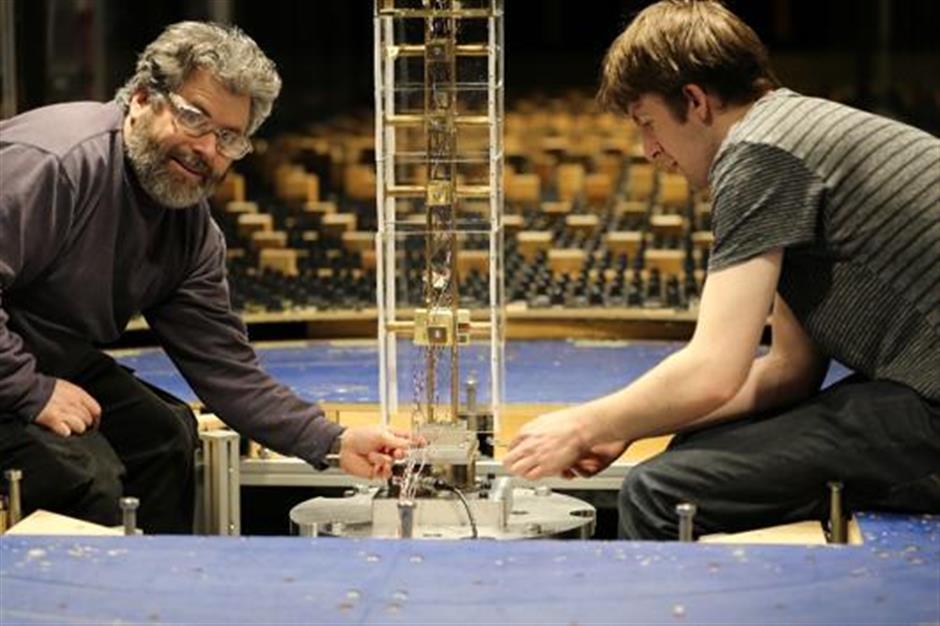
Mitigating typhoon damage also requires reimagining urban infrastructure.
Build environment consultancy Arup and Imperial College London in August unveiled a structural design concept that uses a tall building's own weight to suppress wind sway and earthquake movement.
Traditional skyscrapers are built with massive, space-consuming dampers suspended near the top. The new design decouples a block of usable upper floors from the building's central core, connecting them via springs and dampers. The design reduces wind-induced acceleration by up to 70 percent compared to conventional towers, improving structural resilience while cutting material usage and construction costs.
Arup plans to advance the structural design to large-scale trials and real-world project demonstrations. They may cover high-density cities such as Hong Kong, Manila, Taipei, Xiamen and Shantou – no strangers to the dual risks of typhoons and earthquakes.
The company previously collaborated on Shanghai Urban Drainage Master Plan and engineered the 370-meter Xujiahui Center tower, the current highest building on Shanghai's western shores.
Editor: Liu Qi
In Case You Missed It...
![[Weather] Shanghai Stays Hot and Humid as 3 Typhoons Crowd Nearby](https://obj.shine.cn/files/2026/08/24/0ac63553-f21c-4422-8c64-101d90666fbd_0.jpg)
 Aug 24, 2026

![[CNS Survey] Shanghai Healthcare Survey: International Community](https://obj.shine.cn/files/2026/08/21/108102a8-f58e-4fe8-a2fe-88638d0caf6b_0.jpg)