From Firefighting to Tourism: Industrial Robots Secure Major Deals and Real-World Jobs

Robots are evolving from expensive novelties built for show into practical tools ready for real-world deployment, including high-risk environments. The latest 2026 World Artificial Intelligence Conference (WAIC) in Shanghai may well be remembered as a historic turning point, where embodied AI stepped off the exhibition floor and into the fabric of everyday life.
"China's embodied intelligent robots are transitioning from technology validation to commercial deployment, with their practical value continuing to be realized as industrial adoption proceeds in phases," research firm IDC China said in a note on Monday.
At WAIC, exhibitors did more than just reveal new models – they signed commercial deals and outlined concrete deployment plans, bringing robotics closer to commercial reality.
Robotics firm Runke Tongyong signed with Shanghai Huayan Fire Protection Engineering Co for fire emergency applications. The deal includes an intent to purchase 100 units of Runke's Centaur robot, which is designed for high-risk tasks such as inspection, obstacle clearance and search-and-rescue during fire emergencies.
Runke has developed a range of specialized form factors – including quadrupeds, robotic arms, centaur-style hybrids and planetary rovers – tailored for nuclear facilities, oil fields, mining sites and emergency services. According to Runke CEO Zhou Bin, the company expects to announce additional commercial orders in the fourth quarter.

Meanwhile, AgiQuad, a quad-foot robotics developer backed by AgiBot, showcased its D1 series quadruped inspection robots. Capable of autonomously monitoring temperatures, detecting gas leaks and identifying fire hazards, 26 unit robots have already been deployed in a chemical industrial park in Shaoxing, Zhejiang Province.
AgiQuad and partner Haochen Technology also debuted the world's first rideable robot at WAIC, opening global pre-orders with initial small-scale customer deliveries in September. Built to navigate complex terrains, the robot features autonomous navigation, smart follow-me functionality, active obstacle avoidance, and dynamic route planning.

Meanwhile, AI model firm ModelBest unveiled MiniCPM-RobotTrack, a lightweight model engineered specifically for robotic vision. The system enables fully local, vision-based instruction and target tracking – allowing robots to track single, dynamic multiple or ambiguous targets using only onboard cameras and local compute, without relying on cloud connectivity.
ModelBest, which has already commercialized its AI models across smartphones and connected vehicles, partnered with Intel to power edge-based smart cockpits. That automotive technology is projected to be installed in 300,000 mass-produced vehicles by the end of this year.
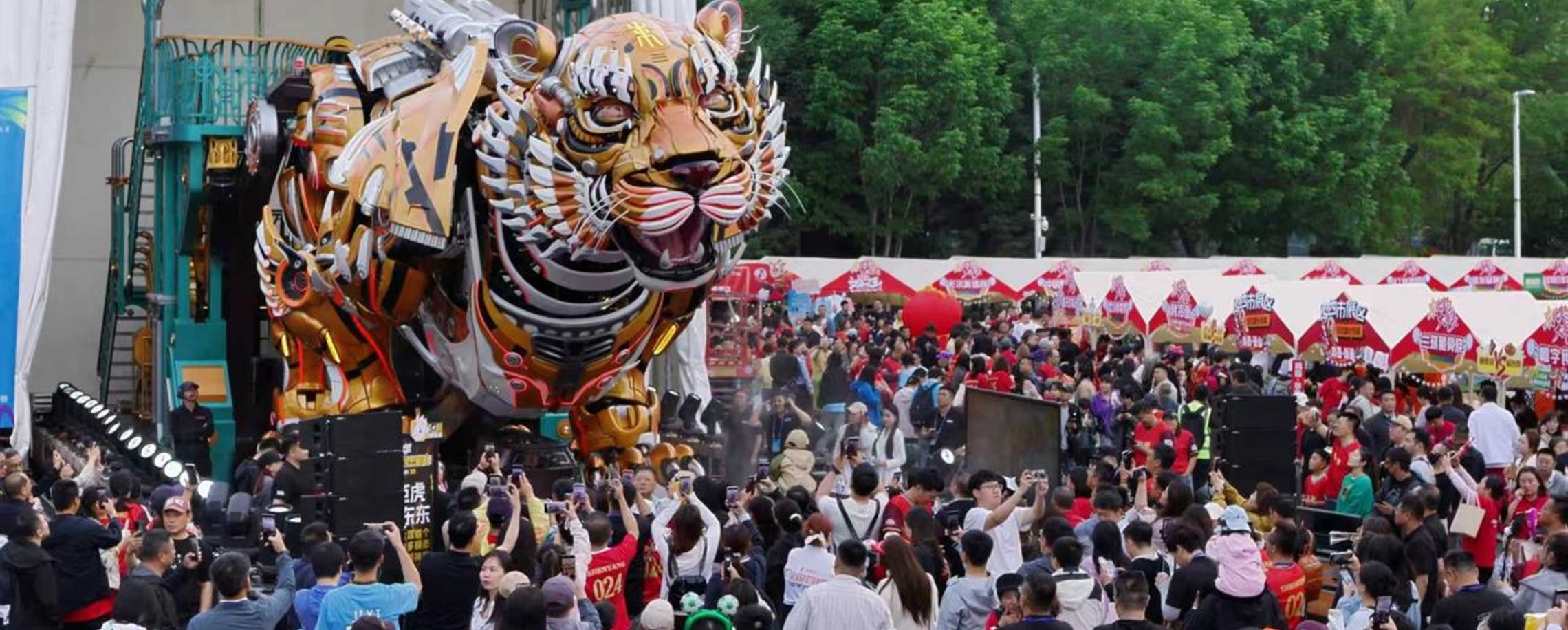
Beyond heavy industry and public safety, robots are also making inroads into entertainment. Betop Culture Technology showcased mega-sized animatronic and robotic installations tailored for the culture and tourism sectors, featuring giant mechanical horses, tigers and legendary creatures from Chinese folklore.

Editor: Liu Qi
In Case You Missed It...

 Jul 21, 2026
![[China Maxxing] The Weather We're Having Now Is Called Dashu](https://obj.shine.cn/files/2026/07/21/b6ef5abf-03bc-4e52-a44a-02119977c26a_0.jpg)