Wuzhen Tech Expo Showcases AI Tools Powering Chinese Enterprises in Global Expansion
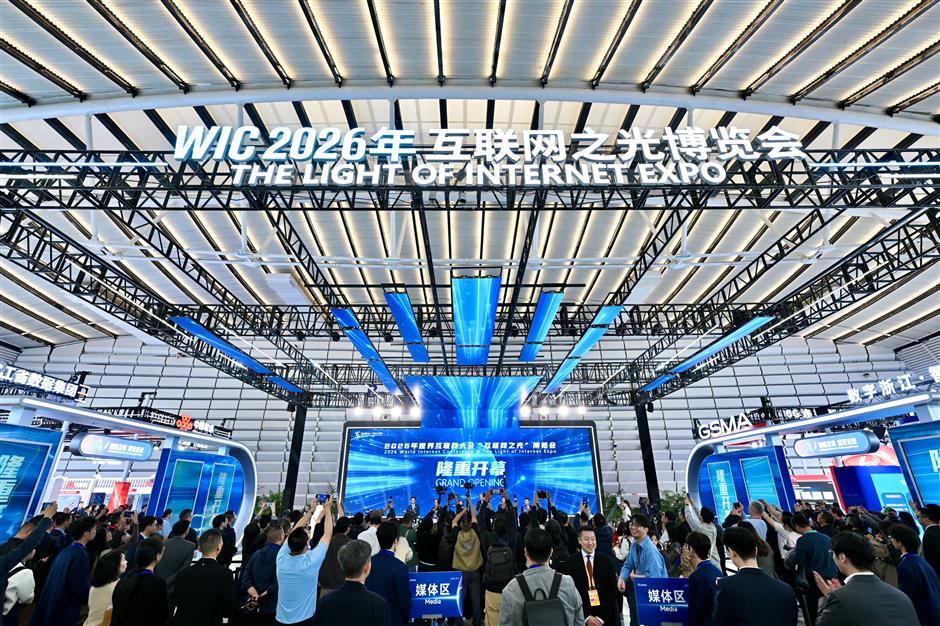
Beyond the eye-catching humanoid robots and smart gadgets filling the exhibition halls, artificial intelligence (AI) applications took center stage at this year's Light of Internet Expo, the core exhibition of the 2026 World Internet Conference being held in Wuzhen, neighboring Zhejiang Province.
A central theme emerged across the show: using cutting-edge AI to power Chinese businesses as they expand globally. From cross-border e-commerce and digital marketing to automated customer service and robust cyber defense, tech providers showcased tools designed to help enterprises navigate international markets securely and efficiently.
The four-day expo, which kicked off on Monday, drew 671 enterprises and institutions from 54 countries and regions. Together, they debuted over 1,000 new technologies and products spanning satellite Internet, quantum communication, 6G, intelligent agents, large language models (LLMs), embodied AI and cybersecurity governance.

Tech giant Alibaba Group showcased Accio, a global digital product named after the summoning charm from Harry Potter. Combining general-purpose AI agent capabilities with deep optimizations for e-commerce, Accio automates tasks across the entire business cycle – from customer acquisition and market insights to product selection, listing and ad spend analytics.
Since its launch in April, the tool has attracted 10 million small and medium-sized enterprise (SME) users. Notably, Accio operates beyond Alibaba's ecosystem, integrating with competing international platforms, including JD.com, Temu and Amazon.
Alibaba executives noted onsite that Accio allows individual entrepreneurs and small teams to launch global e-commerce operations rapidly, bypassing traditional hurdles related to multi-platform management, complex technical application programming interfaces (APIs) and high labor costs.
Highlighting its broader open-source philosophy, Alibaba Chairman Joe Tsai emphasized during the opening ceremony that open models slash research and development (R&D) costs for SMEs, particularly in developing nations and non-English speaking regions. Open-source AI ensures the technology is no longer exclusive to a few tech superpowers, but remains an ecosystem where global developers can participate.
Nasdaq-listed Aurora Mobile showcased its evolution into an AI-driven customer engagement platform. Currently serving over 800,000 developers and 1,000 global enterprises, the platform processes more than 12 billion messages daily across 200 countries and regions.
At Wuzhen, Aurora Mobile presented three core product lines: EngageLab, an AI-native global customer engagement platform; MoonFox Data for data insights and analytics; and Modellix.ai, an aggregator for global multimodal models. The new Modellix.ai provides a unified API, allowing businesses to switch dynamically between open-source and proprietary models based on scenario needs and cost efficiency – preventing vendor lock-in.
Addressing global strategy, Aurora Mobile identified Southeast Asia as its fastest-growing market due to its young demographic and high mobile Internet adoption, according to Ma Chao, Vice President of Public Affairs at the Shenzhen-headquartered company.
Offering advice to Chinese enterprises going global, Ma said: "First, prioritize compliance – understand local data privacy and personal information protection requirements from the outset. Second, commit to localization from Day One. It is not just about translation; user demands vary drastically across different markets."
As AI applications proliferate globally, cybersecurity has become a critical battleground.
Cybersecurity firm Kaspersky highlighted its AI Protect solution, tailored specifically to secure AI deployment environments, at the expo.
"AI-generated tools enable attackers to modify and change their tooling very quickly," said Igor Kuznetsov, Director of the Global Research & Analysis Team at Kaspersky.
To combat new vectors such as data leakage, prompt injection and model file poisoning during LLM and AI Agent development, Kaspersky's AI Protect supports high-concurrency large-file scanning and offline updates. This ensures AI applications remain secure even in strictly isolated, air-gapped network environments.
For Chinese businesses venturing overseas, Kaspersky showcased its Managed Detection and Response (MDR) services.
Addressing key pain points, like fragmented security coverage across international offices, strict local compliance rules and regional tech talent shortages, Kaspersky combines AI automation with analyst oversight to deliver native security management and rapid incident response.
To reassure global clients on data privacy and transparency, Kaspersky has invested US$10.2 million since 2018 to establish Transparency Centers across 13 countries in Europe, Asia, the Middle East, Latin America and Africa, with case coverage spanning 18 nations.

Editor: Yao Minji
In Case You Missed It...

 Nov 4, 2026