Shanghai's Smart Healthcare Practices Shared at Geneva Conference Empowered by AI
Supported by big data, knowledge graph, retrieval-augmented generation and multi-agent technology, Shanghai has significantly enhanced its capabilities in public health risk identification, intelligent early warning and precise intervention, demonstrating the solid progress of China's intelligent public health development, local health officials told an international health conference in Switzerland.
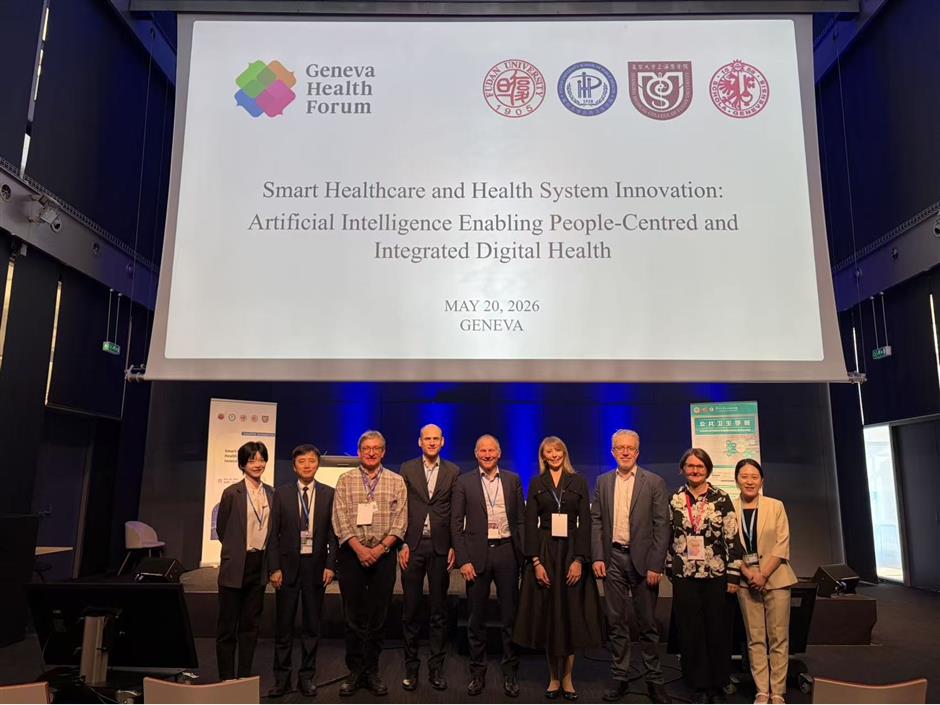
As a key side event of the 79th World Health Assembly, the international conference "Smart Healthcare and Health System Innovation: Artificial Intelligence Enabling People-Centered and Integrated Digital Health" convened experts from 62 countries, including the World Health Organization, top global universities, national health authorities and leading medical enterprises to explore the transformative role of artificial intelligence in advancing integrated digital health.
According to Chen Xin, director of Shanghai CDC, its framework is anchored in a dual-base infrastructure: a data platform aggregating 42 systems to build a high-quality, multi-modal public health corpus, and an AI computing backbone supporting multi-agent collaboration and vertical-specific large language models. This foundation enables the translation of complex public health workflows into scalable AI-driven solutions.
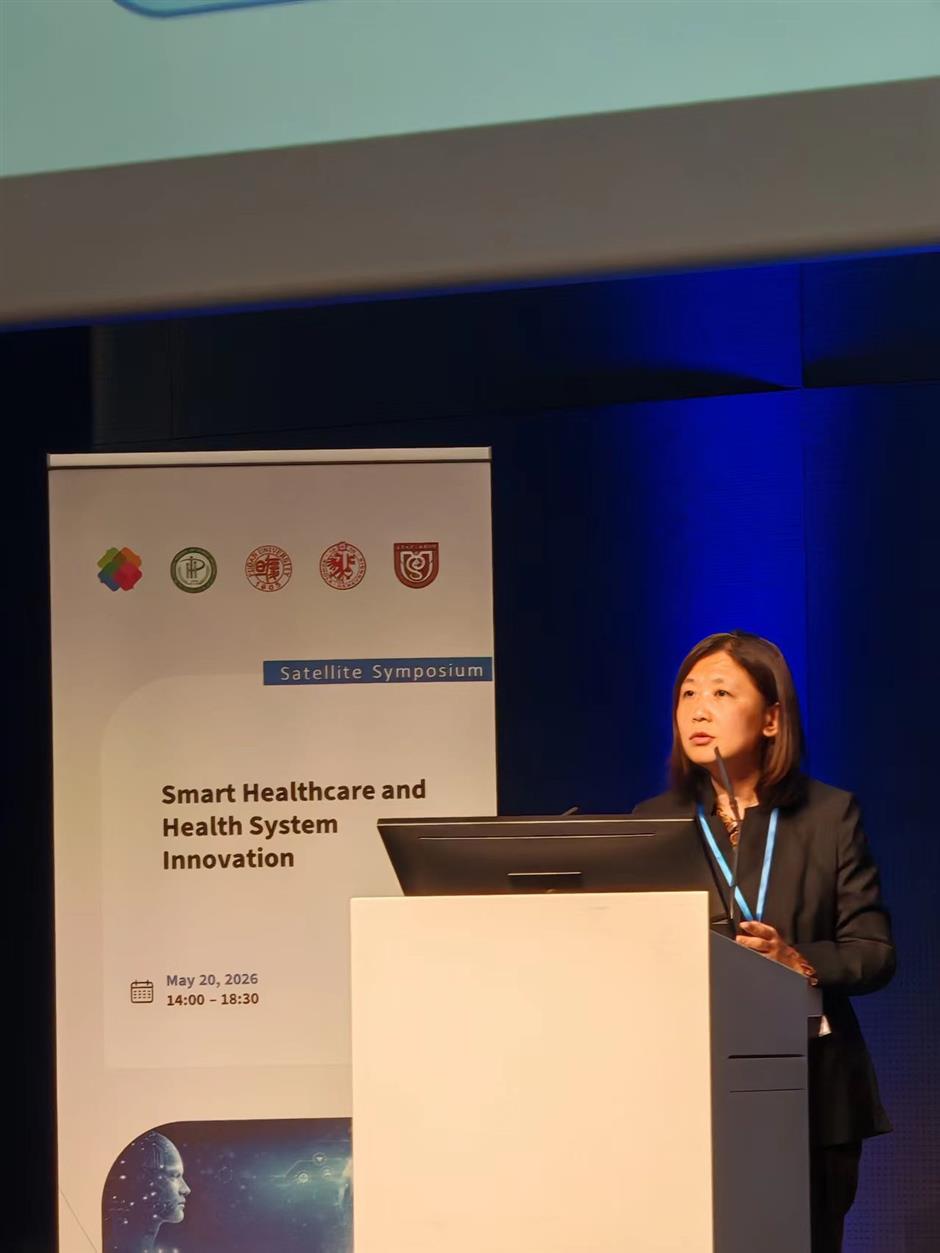
Beyond infectious disease surveillance, Shanghai CDC has developed AI-powered population health services spanning the full life cycle. Tailored for adolescents, working-age adults, and the elderly, the system employs three intelligent agents: a label annotation tool for high-quality data governance, a digital twin cohort model to simulate health evolution, and a personalized health assessment and intervention service. Mobile applications support chronic disease management through interactive health portraits and dynamic risk evaluations, delivering customized guidance and community care referrals via retrieval-augmented generation (RAG) technology.
International experts also shared frontier technological explorations in clinical practice. Olivier Michielin, head of Oncology at Geneva University Hospital, elaborated on AI applications in precision oncology. He noted that artificial intelligence can integrate clinical data, multi-omics data, digital pathology and spatial omics data, breaking the limitations of traditional one-size-fits-all diagnosis and treatment models. The technology enables individualized cancer treatment, bringing new therapeutic hopes for cancer patients globally.
Deep AI adoption has delivered remarkable outcomes for pulmonary nodule screening, lung cancer imaging interpretation and pathological diagnosis at Shanghai Pulmonary Hospital, said vice president Tao Rong.
She pointed out that the biggest hurdle currently lies in legally and compliantly sharing in-hospital medical data, while ethical concerns also hinder cross-hospital promotion of relevant technologies.
Wang Dahui, vice president of Children's Hospital of Fudan University, noted pediatric medical consumables management is plagued by insufficient data, ambiguous accountability and isolated information systems. He suggested adhering to the principle of AI-assisted decision-making and tackling these challenges by setting up data-sharing alliances and hierarchical service platforms.
Industry insiders said large-scale rollout of medical AI is restricted by poor connectivity in data, medical services and payment systems and stressed the necessity to formulate specialized evaluation criteria for healthcare AI, so as to realize effective interaction between medical practitioners and service users.
Luo Li from Fudan University's School of Public Health emphasized that AI application in the health sector is a global cause beyond regional boundaries. He advocated a dialectical and rational perspective on artificial intelligence, fully recognizing its enormous potential while guarding against risks arising from improper technical application. Luo stressed that a sound institutional system is urgently needed to regulate and guide the sound development of AI.
"In the health sector closely related to public well-being, the people-centered principle must always be upheld to ensure AI technology empowers high-quality human health development," he said.
Editor: Fu Rong
In Case You Missed It...

 Oct 10, 2026
![[Fashion Files] Beyond the Runway: Shanghai's Fashion Ambitions](https://obj.shine.cn/files/2026/10/09/36f592c5-63eb-4ee5-abe1-7d6c79ca9b62_0.jpg)