AI Won't Replace Humans. It May Affect How the Young Acquire Judgment and Instinct
Systems & Signals
Business landscapes are shaped not just by headline disruptions, but by the structural shifts beneath them. This series decodes the forces transforming China and global markets, from AI adoption and innovation ecosystems to trade recalibration and institutional strategy. Drawing on on-the-ground reporting and strategic analysis, the column offers executives and policymakers timely insights into how technology, governance and human capability coevolve in an age of rapid change.
A student recently showed me a research paper she had written with the help of artificial intelligence. The structure was clean, the grammar was polished and the citations were properly formatted.
In truth, the paper already looked better than much of the material produced by junior employees inside large companies. What it lacked was harder to define. Curiosity? Judgment? Perhaps simply ownership?
When I asked why she had framed one section of the argument in a particular way, she paused for several seconds before answering.
"I'm not really sure," she admitted. "AI suggested it."
That moment has stayed with me more than the endless debate over whether artificial intelligence will replace human jobs.
Recently, Nvidia CEO Jensen Huang argued that AI would create employment rather than destroy it. Critics warn that automation will wipe out entire professions. Tech executives promise a productivity revolution. Investors alternate between panic and euphoria depending on the week.
Both sides may be asking the wrong question.
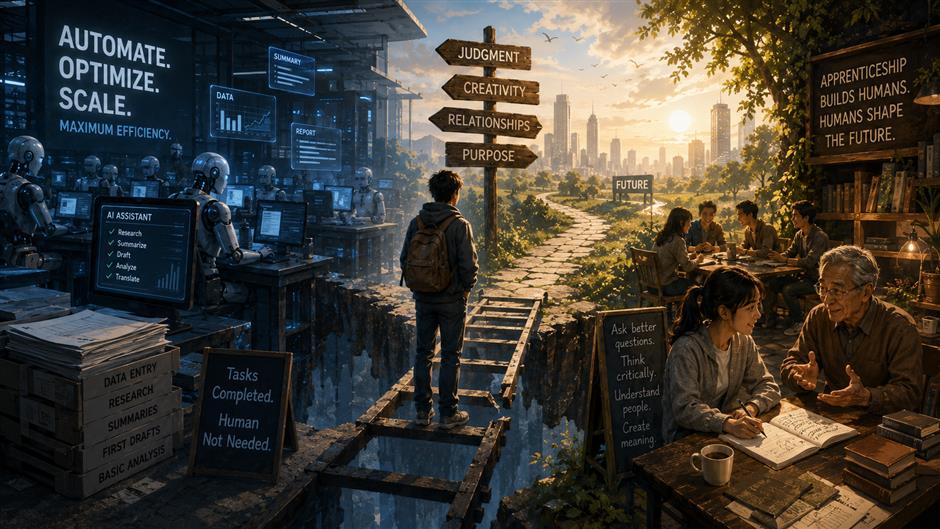
AI is not simply changing work. It is changing how young people become adults.
Over the past few months, I have been testing an AI assistant developed with several friends for students studying journalism, communications and public relations. The students adapted almost immediately. Many now use AI daily for research, drafting and information gathering.
What surprised me was not their technical ability, but their relationship with the technology itself.
Most students treat AI as a faster search engine or a machine for generating passable text. Very few use it as a genuine assistant that requires supervision, direction and skepticism. The bottleneck is often not the software. It is the question.
Many students struggle to ask precise, layered and logical questions. Some of this reflects limited experience. Some reflects gaps in knowledge. But much of it reflects training. For years, schools rewarded students for producing correct answers rather than framing meaningful problems.
AI quietly reverses that hierarchy.
In the emerging economy, the premium may shift from answering questions to asking better ones.
This matters because AI does not merely automate tasks. It reshapes the process through which people learn judgment.
The modern economy has always depended on inefficient forms of apprenticeship. Junior lawyers once spent nights reviewing contracts, not because it was intellectually glorious but because repetition trained instinct. Young reporters rewrote press releases because somebody had to learn which facts mattered and which did not. Entry-level consultants assembled endless slide decks because eventually they needed to understand how organizations actually functioned beneath corporate slogans.
Much of this work was boring. Some of it deserved to disappear.
But these jobs served a purpose beyond productivity. They exposed young workers to reality.
A first job is not merely a source of income. It is where people develop intuition about deadlines, office politics, accountability, difficult clients and human behavior. It is where competence stops being theoretical.
AI is beginning to remove parts of that developmental layer.
No managing partner wants to tell clients they are paying hundreds of dollars an hour for a junior associate to summarize PDFs that software can process in seconds. Media companies increasingly automate basic reporting tasks. Professional services firms already use AI tools to handle research and drafting once assigned to younger employees.
The result may not be mass unemployment, at least not immediately. The deeper risk is slower maturity.
Many graduates now face a strange paradox: companies demand experience while automation quietly removes the jobs that once created it.
This is why so much public discussion around AI feels strangely shallow. The debate usually centers on whether machines will replace humans. The more unsettling question is whether society still knows how to cultivate human experience in the first place.
The anxiety surrounding AI has also become its own industry.
Silicon Valley has discovered that fear scales up well. If AI merely helps accountants work faster, the valuation story weakens. If AI threatens civilization itself, investors reach for larger checkbooks.
Catastrophic predictions about labor displacement often function less as economic analysis than as marketing strategy. To justify trillion-dollar valuations, AI companies must promise extraordinary outcomes: massive productivity gains, historic disruption, entire industries rebuilt from scratch.
The narrative requires urgency. It requires fear of missing out. It requires fostering the suspicion that everyone who fails to adapt immediately will become irrelevant.
Young people absorb this atmosphere quickly.
I increasingly meet students who treat life as a permanent optimization contest. They collect certificates, productivity systems and technical skills with quiet desperation, hoping enough preparation might purchase stability. Underneath the ambition sits something more fragile: fear.
Sometimes I wonder whether my generation helped create this anxiety.
We told young people that every hobby should become a side hustle, every hour should become productive and every weakness should become improvable. Now many encounter AI not as liberation, but as another competitor entering an already crowded race.
History suggests some caution here.
Every major technological cycle attracts exaggeration. During the dot-com boom, investors believed the internet would rewrite every business model overnight. Many companies vanished before the transformation fully arrived. The mobile internet produced similar waves of speculation and panic.
People rarely miss technological revolutions entirely. What they often lose is perspective.
This does not mean AI lacks importance. The technology is real. Some tasks will disappear. Entire industries will reorganize around machine-assisted workflows. But fear distorts judgment.
When people become obsessed with the future, they often stop paying attention to the present.
Near my apartment is a small bookstore that probably makes little economic sense. The owner remembers customers by reading habits rather than names. We talk about novels, rent prices and occasionally politics. Sometimes I leave without buying anything.
AI can already recommend books more efficiently than he can. It can summarize them too. That is not why people enter bookstores. People do not seek information alone. They seek recognition.
The same principle increasingly applies to language. Recently I tested several multilingual voice models connected through GPT application programming interfaces. Their fluency was astonishing. Translation quality improves almost monthly. Yet the experience reinforced something unexpected: as translation becomes cheaper and easier, face-to-face communication may become more valuable, not less.
Software updates quickly. Human beings do not.
A conversation still carries signals beyond vocabulary: timing, hesitation, humor, eye contact, body language, trust. Deals often emerge from small talk before formal negotiations begin. Friendship rarely scales like software.
As machines become more polished, human roughness may become more valuable.
The unscripted joke, the eccentric obsession, the wandering conversation, the strange personal taste that no algorithm would optimize for – these qualities increasingly feel less like inefficiencies and more like evidence of humanity.
This is why individuals and companies alike need to abandon what I think of as the exam mindset.
Too many people still approach AI like anxious students searching for the correct answer sheet. They chase every new platform, every trend, every productivity ritual. But the future may reward something else entirely: people deeply rooted in a specific craft or industry who understand both the technology and the human needs surrounding it.
The winners may not be those sprinting toward every new wave, but those standing where the wave eventually arrives.
AI alone will not build durable businesses or meaningful lives. Real industries still depend on trust, taste, judgment and relationships. Tools matter. Direction matters more.
Jensen Huang is probably right that AI will create enormous wealth and economic activity. History suggests that new technologies usually generate more work over time than they eliminate.
But the central challenge is not whether human beings will continue to have jobs.
It is whether societies can still help young people become confident adults.
That process requires time, mistakes, mentorship, emotional resilience and human contact. None scales up particularly well. None fits neatly into a venture capital presentation either.
AI may eventually produce competent essays, competent presentations and competent strategy memos.
What it still cannot produce is a young person who knows who they are.
(The author is an adjunct research fellow at the Research Center for Global Public Opinion of China, Shanghai International Studies University, and founding partner of 3am Consulting, a consultancy that specializes in global communications.)
Editor: Liu Qi


![[First in SH] Neo Young 6, K-Pop Debuts, and the Mall Wars](https://obj.shine.cn/files/2026/05/12/5396b5c2-9d47-4c33-9358-bd01e9afcca3_0.jpg)

