China Backs Shanghai's Push for Global Green Shipping Hub Status
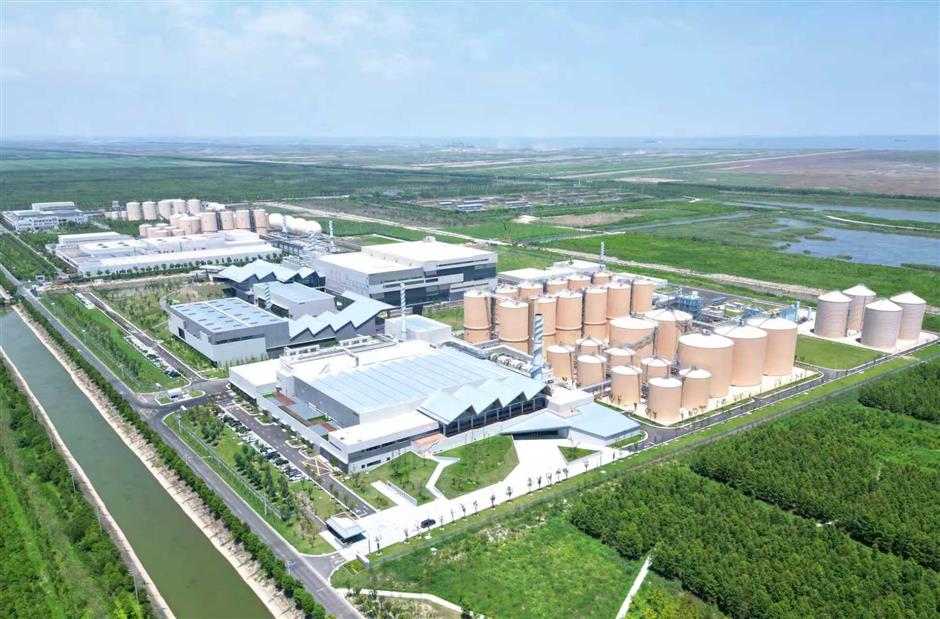
What starts as food waste at Shanghai's Laogang Renewable Resource Recycling Center could soon help power ocean-going vessels, as China throws its weight behind the city's push to build a global hub for low-carbon shipping.
The move follows a national blueprint, jointly issued by 10 central government bodies, which sets a clear goal: by 2030, Shanghai aims to establish itself as an international center for green marine fuel bunkering and trading.
Bunkering is the supply of fuel to vessels for propulsion and onboard operations.
Under the plan, Shanghai targets a bonded liquefied natural gas (LNG) bunkering capacity of 1 million cubic meters, alongside 1 million tons of bunkering capacity for green methanol and biofuels.
Turning Waste into Power
To expand fuel supply, the plan encourages cooperation with regions with strong green fuel production capacity and allows new projects to be developed in chemical parks and other suitable industrial zones.
Shenergy Group, working with other state-owned partners, highlighted Shanghai's first "locally produced, locally bunkered" green methanol project, which began operations on December 29 last year.
"We convert biomethane from food waste into green methanol and then supply it to ships through port operators," said Lu Qiang, deputy general manager of Shanghai Shenji Energy & Environment Technology. "The facility is designed to produce up to 100,000 tons a year."
The project has completed full-chain certification under both ISCC EU (International Sustainability & Carbon Certification European Union) and ISCC PLUS standards, covering feedstock sourcing, production, and final delivery.
Lu added that food waste alone cannot support large-scale production, prompting efforts to diversify feedstocks. Plans include using agricultural residues such as straw and landscaping waste, processed into green methanol via biomass gasification.
A gasification plant with a planned annual capacity of 200,000 to 300,000 tons is expected to begin operations in 2029.

Both greener and cheaper
Scientists from East China University of Science and Technology have achieved a revolutionary breakthrough in converting biogas into green marine fuel, boosting efficiency and cutting costs by 30 percent.
Led by Chen De, a visiting professor and European Academy of Sciences member, the team reached nearly 100 percent carbon utilization, a major improvement over traditional methods that only use methane and release large amounts of carbon dioxide, leading to severe carbon waste and reduced environmental value of end products.
They developed the BESTm (Biogas Energy Science and Technology to Methanol) technology, specially designed for biogas, which is 70 percent methane and 30 percent carbon dioxide. Using electric-driven reforming and catalytic hydrogenation, nearly all carbon is converted into green methanol.
According to team core member Professor Duan Xuezhi, 8 tons of food waste can produce about 1 ton of green methanol with the new technology. For Shanghai, which produces around 3.5 million tons of food waste yearly, this could generate over 400,000 tons of green methanol to supply Shanghai Port.
Cost has long been a major barrier. Traditional green methanol costs over 9,000 yuan per ton, while heavy fuel oil is only about 3,000 yuan.
The new technology reduces production costs by more than 30 percent. At low electricity prices, it can even match the cost of coal-based methanol.
BESTm has also received ISCC international certification, allowing it to enter the global green marine fuel market.
The team plans to build a 10,000-ton industrial demonstration project in and around Shanghai to test large-scale production.
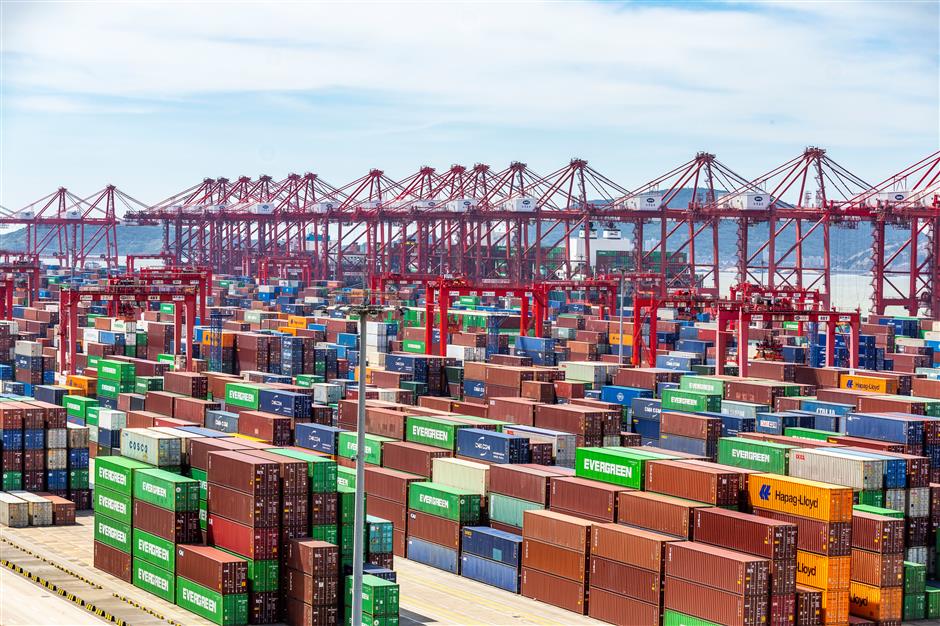
With the world's busiest container port, Shanghai is well-placed to become a Asia-Pacific green fuel hub. Professor Chen said the city can build a complete industrial chain, including production, storage, transportation, refueling and certification, to help China lead global green shipping development.
Speed, SIMOPS, and Cost Incentives
The policy also focuses on improving bunkering efficiency, a key consideration for shipping lines seeking to minimize time spent in port.
Shanghai will support multiple bunkering methods, including ship-to-ship and shore-based operations. It is also promoting simultaneous operations (SIMOPS), allowing vessels to bunker fuel while cargo is being loaded or unloaded, reducing delays at berth.
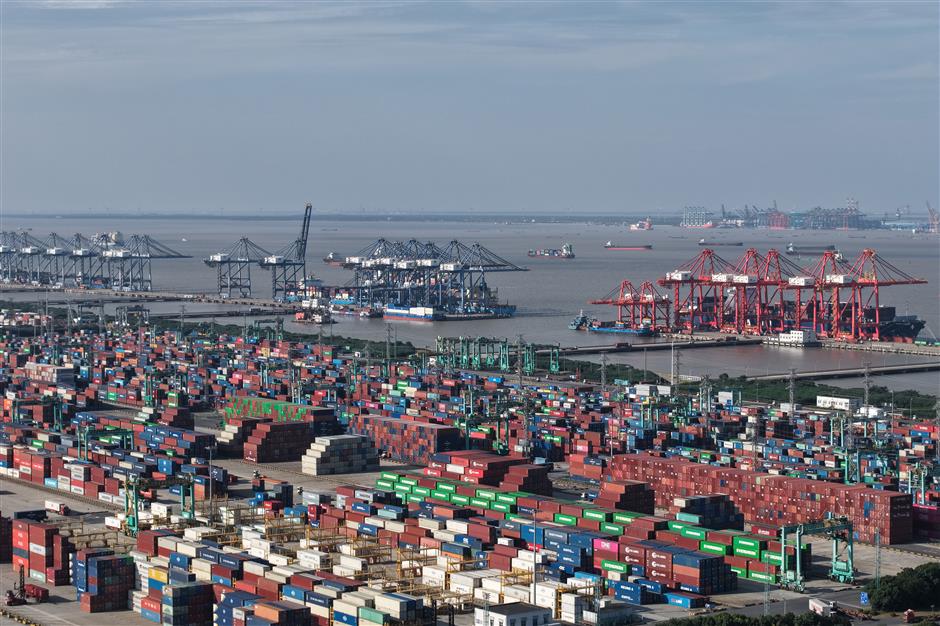
The port will also explore night-time bunkering for green fuels, with dedicated anchorages for bunkering vessels. Shanghai Port has already launched pilot night bunkering operations in the Yangshan deep water port area.
"With broader and more flexible bunkering options, ships can spend less time in port, which makes Shanghai more attractive to international shipping lines," said Wang Jie, commercial director of Shanghai International Port Group.
Shanghai Port also offers a 50 percent discount on berthing fees for vessels that use alternative fuels or shore power while alongside, providing a direct cost incentive for greener operations.
Cross-customs and cross-port bunkering operations are also encouraged, easing coordination between Shanghai and neighboring provinces.
Defining the Rules of the Game
Beyond physical supply, the policy highlights the role of trading platforms.
The Shanghai Shipping Exchange will play a central role in facilitating green fuel trading, publishing transaction data and price indices, and speeding up the development of LNG-related futures products.
"The focus is 'transaction plus service'," said Chen Lixiao, an official with the exchange. The platform aims to bridge information gaps between producers and buyers while offering cross-border settlement and financing services to make transactions more efficient.
The exchange also plans to introduce a closed-loop system to track green fuel credits across their lifecycle, from certification and registration to final cancellation at the point of bunkering.
Standards and certification are another key pillar.
Li Shibo from Shanghai Maritime University noted that while the International Maritime Organization has yet to finalize its net-zero framework, the direction of emissions reduction in shipping is increasingly clear.
"Carbon pricing will change the math for shipowners," Li said. "That makes transparent, life-cycle-based certification essential if green fuels are to be accepted by the international market."
Officials said it is uncommon for so many central government agencies to jointly support a single city's green shipping fuel initiative, underlining expectations for Shanghai's role as China advances its maritime decarbonization agenda.
In Case You Missed It...
 Sep 22, 2026
![[Inside China] Did You Know Xuhui Has a Center to Help Foreign Businesses?](https://obj.shine.cn/files/2026/09/20/e7485259-6a51-478d-93dd-13a6c1691cb9_0.jpg)