Familiar Fragrance: The Late Blooming Osmanthus in Shanghai
Summer overstayed its welcome in Shanghai this year. One hundred and 58 days of heat – the second-longest stretch on record.
For nearly a month, the air sat still and heavy; streets glimmered with the white haze of exhaustion. Then, suddenly, after October 20, the temperature dropped. The wind off the river turned cold, the sky cleared to a sharper blue, and autumn arrived all at once – the kind of swift, decisive change that reminds you the seasons have rules, even in a restless city.
By then, I had given up on the osmanthus. The tiny yellow flowers that usually fill Shanghai's lanes with perfume had not bloomed all season. I thought the heat had beaten them, that I would have to wait until next year to breathe that delicate sweetness again. But one evening, cutting through a narrow alley between brick row houses, I caught it – a faint, honeyed scent drifting through the air. It stopped me in my tracks.
I looked around, searching for the source, but the fragrance had no center, no direction. It was simply there – familiar, invisible and unmistakable. As the ancient poet Li Qingzhao wrote almost a thousand years ago: "Pale yellow, tender in body, distant in heart – only the scent remains." And indeed, it had remained. The osmanthus had come after all, just later than expected.
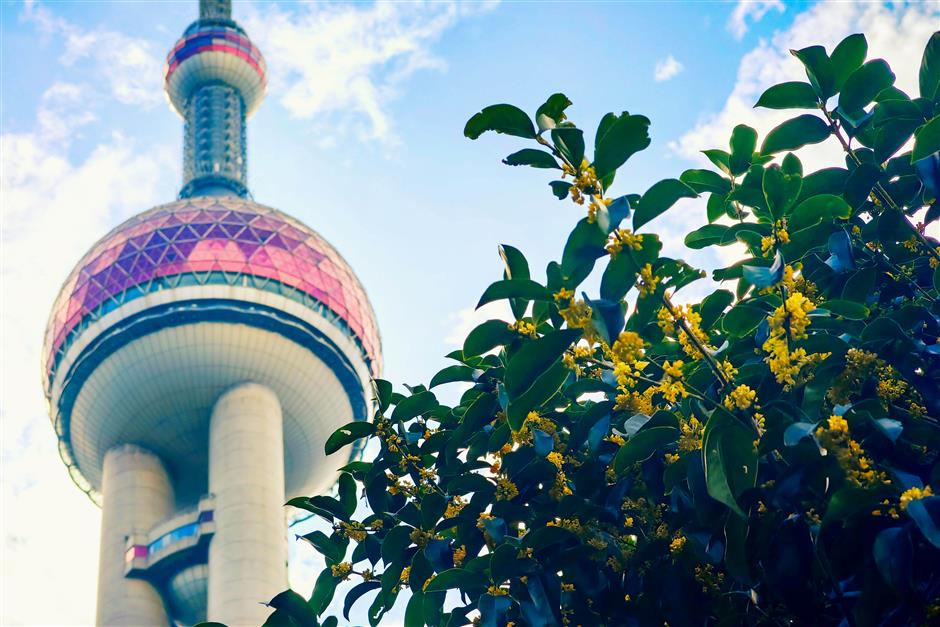
In Chinese, the flower is called guihua (桂花). Its name comes from the word gui, meaning a jade tablet – a symbol of purity and refinement. It also goes by muxi (木樨), a name that describes the fine grain of its wood as rhino-like hide. Its Latin name, Osmanthus fragrans, tells its story directly: osme "scent" + anthos "flower" + fragrans "fragrant." The flower of fragrance, fragrant still.
It is native to China, a small evergreen tree with leathery leaves and clusters of tiny blossoms that appear each autumn in shades of cream, amber, or orange-red. In Shanghai, you'll find them near schoolyards, old walls and apartment courtyards, releasing a scent that seems to soften the entire neighborhood.
In English, osmanthus has had many names – sweet olive, tea olive, fragrant olive – but more and more, people simply say osmanthus. It's one of those words that doesn't need translation anymore. It sounds modern and ancient at once, elegant but familiar, like jasmine or magnolia.
You find it everywhere: in tea, wine, cakes and candies. In autumn, bakery windows glow with trays of osmanthus cake and osmanthus jelly, each a translucent square flecked with petals. The flower's fragrance is part of the city's memory – soft, persistent, impossible to describe without recalling a place or a person.
There's another "osmanthus," too – or rather, a culinary echo of it. In northern China, cooks use the word muxi (or moo shi) not for the flower, but for beaten egg – scrambled lightly into soup or stir-fry so that the yellow shreds resemble falling petals. The most beloved of these dishes is muxu (moo shu) pork – slices of pork stir-fried with eggs, wood ear mushrooms, and scallions. The name muxu is a folk simplification of muxi, a small linguistic accident that stuck. By the 19th century, the dish was already popular enough to appear in Qing Dynasty (1644-1911) writings.
One scholar noted that "in northern taverns, pork fried with egg is called muxi meat, for the yellow bits resemble osmanthus blossoms." He also tells a story: A southern traveler, who refused to eat eggs, once ordered "muxi meat" at an inn, thinking it was safe. When the dish arrived – rich with scrambled eggs – he could only laugh at his mistake. Even misheard, the word carried the taste of home.
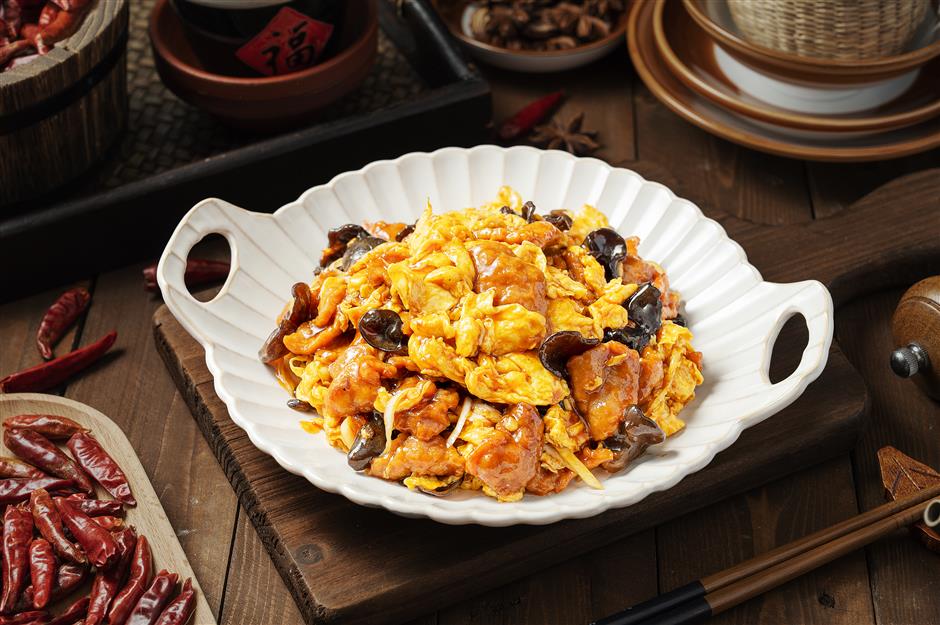
Now, as Shanghai finally exhales into autumn, I think of both the flower and the dish – the fragrant and the edible, the poetic and the ordinary. Perhaps that is what the osmanthus teaches: that beauty can arrive late and quietly, and that scent, like memory, needs no announcement.
You can follow it to a corner bakery and buy a piece of osmanthus cake, or you can order moo shu pork in a noisy restaurant, honoring the same name in a humbler form. Either way, you're eating with the season, keeping faith with time.
In a city that changes faster than its people can catch their breath, the osmanthus still blooms when it chooses. It reminds us that even after a summer too long and too hot, there are things that return on their own schedule – tender, fragrant and steadfast, as if to say: You have waited, and the waiting was not in vain.
(The author, who earned a PhD in linguistics at the University of Illinois Urbana-Champaign, is a professor of English and college dean at Sanda University in Shanghai.)
Editor: Shi Jingyun