Palmier: Shanghai's Butter-Flaky Treat with East-West Roots
When British Prime Minister Keir Starmer visited Shanghai recently, he wandered through the historic Yuyuan Garden Malls, where he bought a box of palmiers at the takeaway window of the time-honored restaurant Lu Bo Lang (Green Wave Pavilion).
The brief, unscripted purchase quickly drew attention to a pastry that has long been woven into Shanghai's culinary fabric.
Known locally as hudie su (蝴蝶酥), or "butterfly crisps" for their distinctive shape, palmiers are widely believed to have originated in Europe. They arrived in Shanghai in the early 20th century alongside foreign residents and traders, and over time became part of haipai cuisine, a Shanghai culinary tradition shaped by both Chinese techniques and Western tastes.
Wang Shijia, deputy general manager of Lu Bo Lang, describes the pastry as distinctly hybrid. Butter, rather than the lard traditionally used in Chinese pastries, forms its foundation. Yet the technique behind it reflects Chinese pastry craftsmanship.
Unlike many Western pastries that rely on fillings for sweetness, palmiers incorporate sugar directly into the layering of the dough, Wang said. As the dough is folded and rolled, sugar is sprinkled between the sheets.
The method echoes techniques found in traditional Chinese layered pastries such as qian ceng you gao (千层油糕), a specialty from Yangzhou, Jiangsu Province, in which lard and sugar are worked between delicate strata of dough to create a finely defined, multi-layered texture.
This careful combination of ingredients and technique makes the pastry deceptively simple in appearance but challenging to master.
The most technically demanding step is the lamination itself, the repeated folding and rolling that gives the pastry its signature layers. Precision is crucial. Too much pressure, or dough rolled too thick, will compress the layers and prevent them from rising fully in the oven. Too little tension, and the pastry may spread or lose its defined butterfly shape.
Temperature and humidity further complicate the process, requiring adjustments at every stage. Success depends less on machines and more on the baker's skill, timing, and intuitive feel for the dough.
Today, several of Shanghai's historic bakeries are celebrated for their palmier. The Park Hotel, which opened in 1934, introduced the pastry from the very beginning and remains one of the city's most sought-after spots, often drawing long lines. Harbin Food Factory, a longtime local confectioner, is another well-known producer.
Lu Bo Lang has experienced a noticeable uptick in palmier sales since Starmer's visit. Wang notes that the takeaway counter now sells between 3,000 and 4,000 pieces daily.
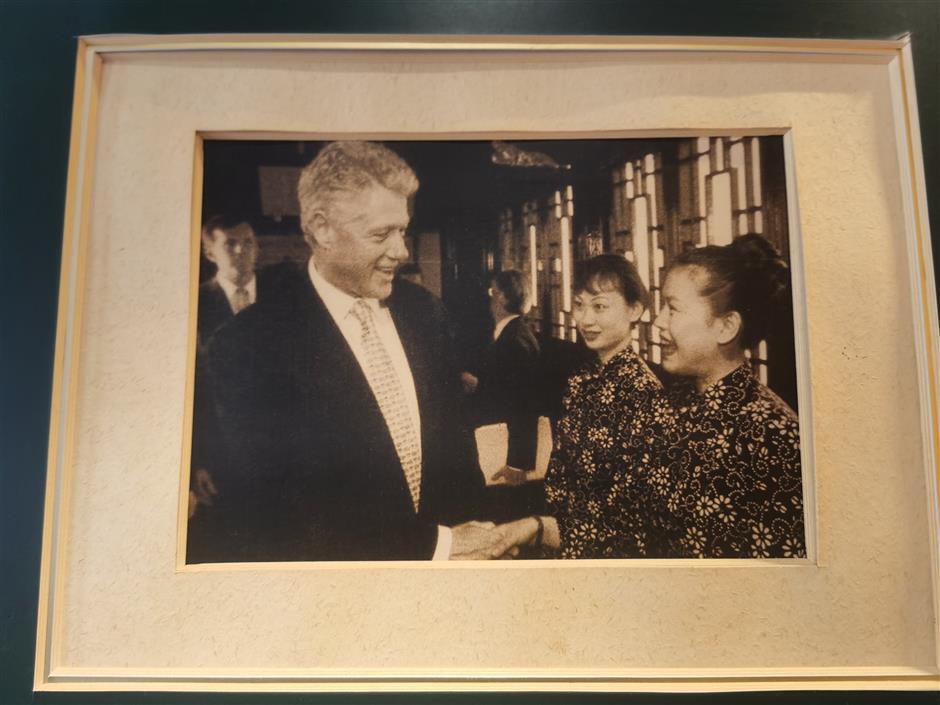
The restaurant itself, located beside the Zigzag Bridge of Yuyuan Garden, has hosted more than 80 visiting foreign dignitaries over the past half century.
In 1986, Queen Elizabeth II of Britain dined at the nearby Huxinting Teahouse, with pastries supplied by the restaurant.
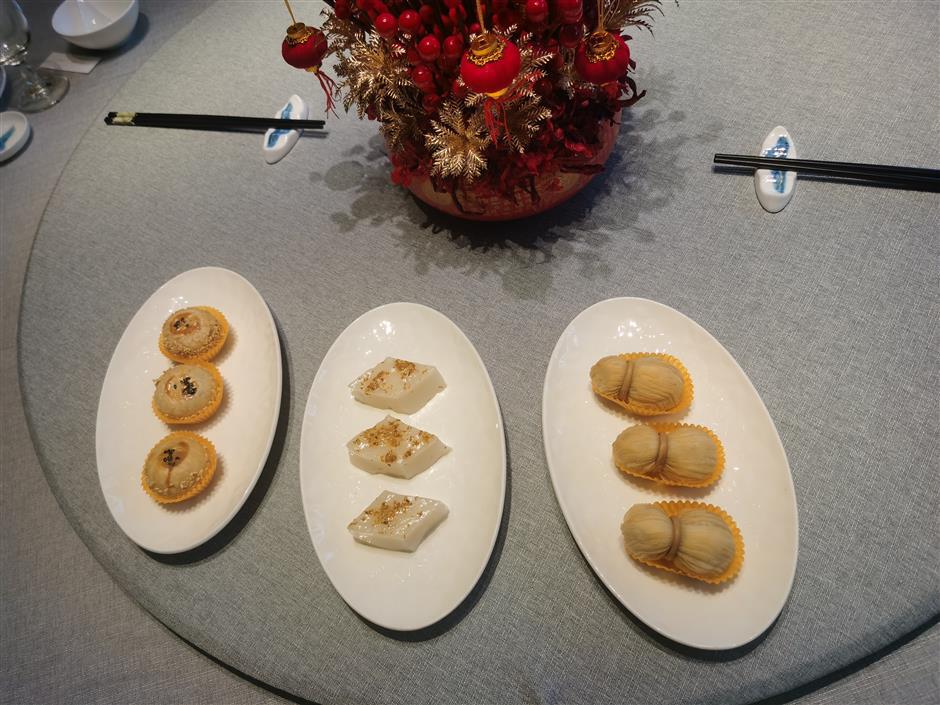
In 1998, US President Bill Clinton visited and struggled, despite months of practice, with a sticky rice cake known as lagao (拉糕). After switching chopsticks several times and receiving assistance, he was able to enjoy the dessert. The experience highlighted the cake's unusual texture, which sticks to the plate and chopsticks but not to the teeth. The dish later earned the nickname "Clinton's rice cake."
Beyond palmiers and lagao, the restaurant continues to offer other traditional pastries. A gourd-shaped pastry carries a symbolic meaning of good fortune, especially highlighted during the Chinese New Year.
Its jujube paste pastry is prepared the old-fashioned way, with the red dates peeled, pitted, and cooked by hand without any additives, a method preserved for decades.
Editor: Shi Jingyun
In Case You Missed It...
![[Inside China] Did You Know Xuhui Has a Center to Help Foreign Businesses?](https://obj.shine.cn/files/2026/09/20/e7485259-6a51-478d-93dd-13a6c1691cb9_0.jpg)
 Sep 21, 2026