China Updates Public Security Law, Clarifies Self-Defense Rules
China's newly revised Law on Penalties for Administration of Public Security will come into force tomorrow, marking the first major update since the current version took effect on March 1, 2006.
Legal scholars say the long-awaited revision reflects profound changes in Chinese society over the past two decades and responds to a range of new public security challenges.
In an interview with Guangming Daily, Fang Baoguo, an associate professor at the China University of Political Science and Law, said a defining feature of the revision is its focus on risks that have emerged with urbanization, new technologies and shifting social behavior. A number of acts widely seen as harmful but previously difficult to regulate are now clearly subject to punishment.
In the area of public safety, throwing objects from heights is defined as a punishable offense as long as it poses a danger, even if no actual injury or damage has occurred. Illegal drone flights, an increasing concern in densely populated cities, are explicitly categorized as acts endangering public safety.
The revised law also strengthens the protection of personal rights. Abuse of minors, the elderly, the sick or people with disabilities under one's care is now clearly identified as a violation, as are acts that infringe upon citizens' personal information. Repeated harassment that disrupts others' normal lives, including persistent pestering, is formally categorized as unlawful conduct.
In addition, behaviors that undermine public interests, such as cheating in examinations, organizing or leading pyramid schemes, or infringing upon the reputation and honor of heroes and martyrs, have been added to the scope of administrative punishment.
Among the revisions, Article 19 has drawn particularly strong public attention for clearly defining the boundaries of legitimate self-defense in public security cases. For years, the handling of minor assault disputes has been clouded by the controversial notion that "fighting back equals mutual fighting," a practice that often left victims feeling doubly wronged.
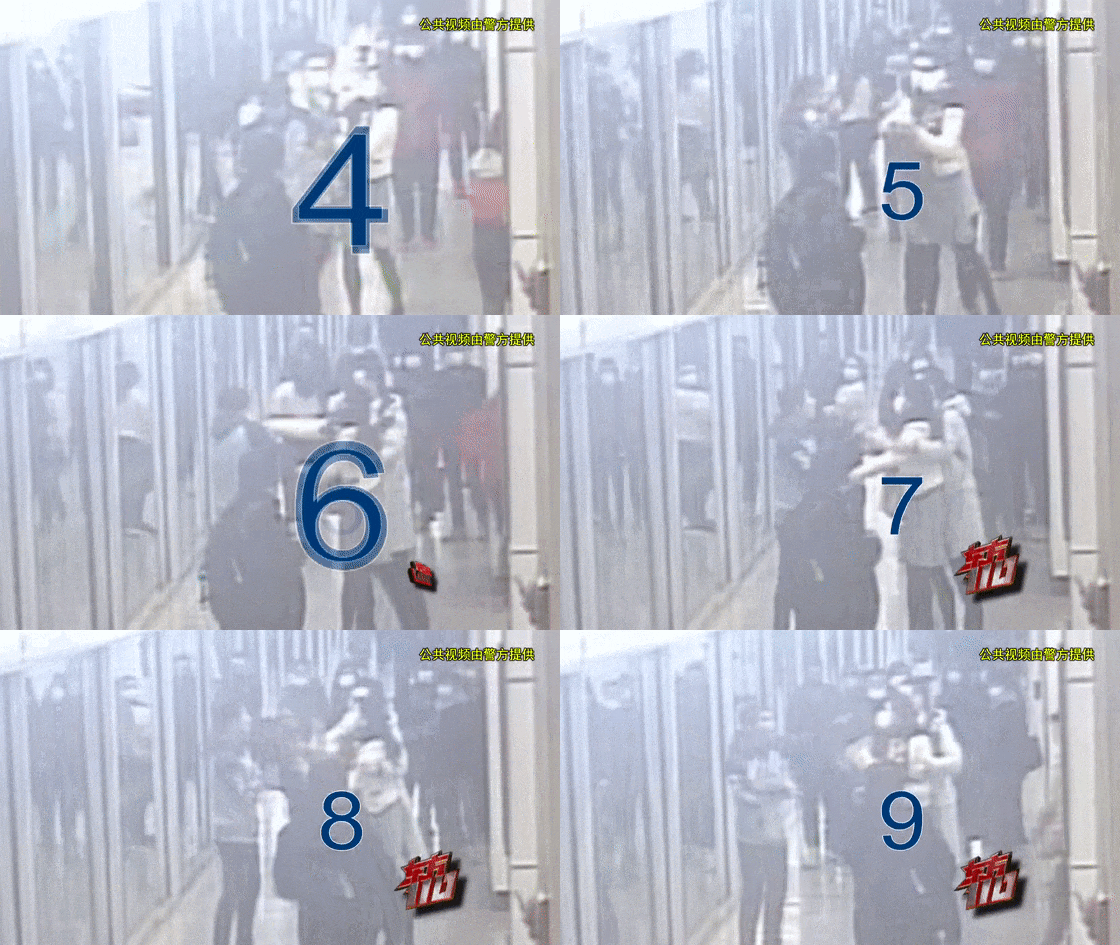
Legitimate self-defense
In one Shanghai Metro incident, a man who was slapped 10 times by another passenger did not retaliate, and only the aggressor was detained. In another case, a man who struck back after being attacked was detained alongside the assailant. Shanghai police later disclosed details of a 2021 case at Lujiabang Road Station on Metro Line 9, where a female passenger repeatedly slapped a man on the platform, reportedly because he had looked at her in a crowded space.
Legal experts say the new provision represents a clear break from such "muddling-through" enforcement. Lawyer Cao Zhuping and Du Yifang, vice dean of the law school at Fudan University, told Jiefang Daily that the revised law explicitly states that actions taken to stop an ongoing unlawful infringement do not constitute illegal behavior under public security penalties. This clarification, they said, gives citizens a clear legal basis to defend themselves without fear of automatic punishment.
They argued that the earlier approach conflicted with basic notions of justice, as a victim's attempt to stop an unlawful act should not be penalized. The change, they noted, reflects both legislative progress and a more mature understanding of citizens' rights under the rule of law.
Exemption no longer applies
Another closely watched revision concerns the execution of administrative detention for certain age groups. Under the previous law, individuals aged 14 to 16 and those over 70 could be detained in principle, but were often exempted from actually serving detention. In practice, some offenders repeatedly exploited this provision.
The revised law adds a new clause specifying that when violations involve serious circumstances, cause particularly negative social impact, or occur more than twice within a year, the exemption no longer applies.
He Jun, an official with the Legal Affairs Division of the Shanghai Municipal Public Security Bureau, told Knews that the adjustment is intended to prevent protective provisions from being abused.
He cited examples such as minors who assault multiple people, causing serious injuries or significant social impact, and elderly individuals who repeatedly violate public security regulations within a year, including assault or illegal cultivation of opium poppies. In such cases, administrative detention would now be enforced.
He added that provinces, including Heilongjiang and Shaanxi, have previously reported cases where detention could not be carried out solely due to age restrictions. With the revised law taking effect, authorities expect these loopholes to be closed, providing clearer and fairer enforcement standards.
Editor: Wang Qingchu

![[First in SH] Neo Young 6, K-Pop Debuts, and the Mall Wars](https://obj.shine.cn/files/2026/05/12/5396b5c2-9d47-4c33-9358-bd01e9afcca3_0.jpg)

