Chinese Humanoid Robot Performs Live Pig Surgery in World-First Trial
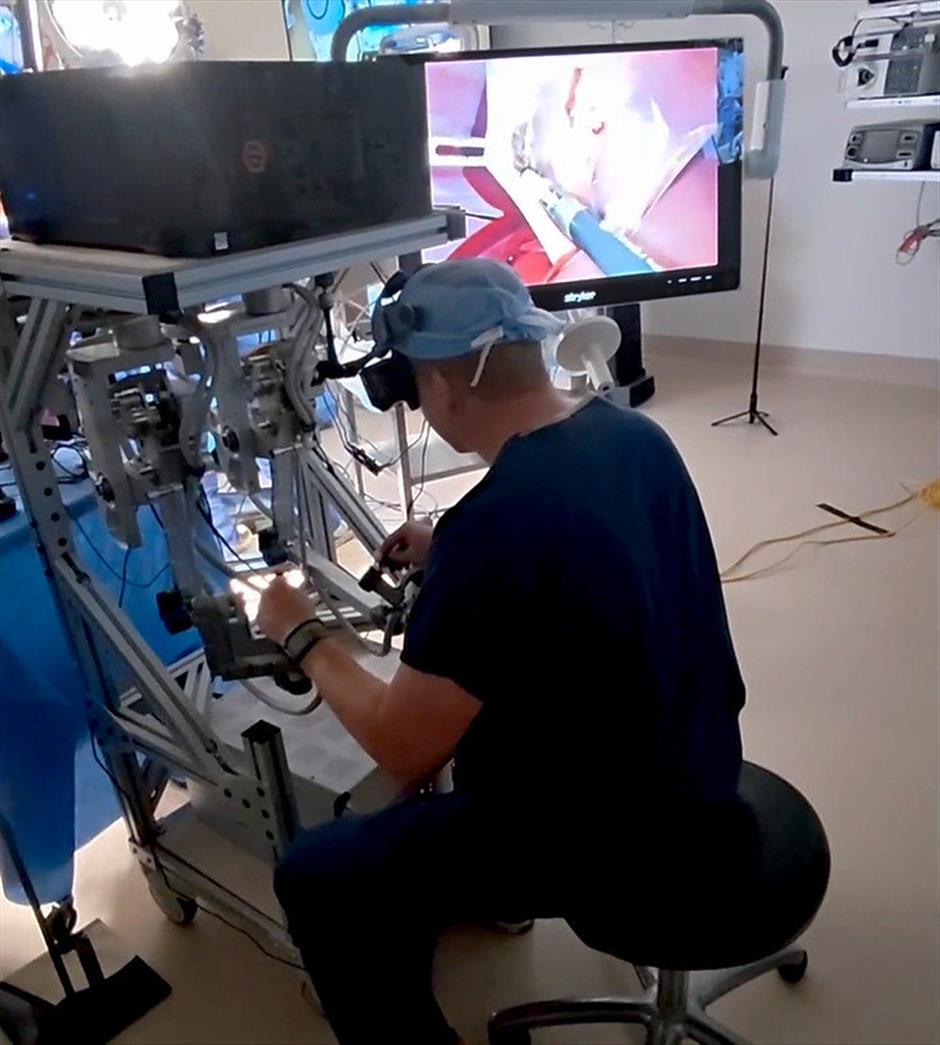
A humanoid robot has completed laparoscopic gallbladder surgery on two live pigs in what researchers described as an early test of whether general-purpose robots can work inside an operating room.
The work, recently published online in Nature, was led by a University of California San Diego team using Unitree Robotics' G1 humanoid robot. The first author and corresponding author was Liang Zekai, a Chinese doctoral student at UC San Diego.
The robot, named Surgie, did not operate on its own. A surgeon sat at a remote console, watched through a stereoscopic high-definition headset and endoscopic video feed, and controlled the robot with master hand controllers.
The team designed custom grippers for the robot's arms so it could hold commercial wristed laparoscopic instruments normally used by human surgeons. The procedures followed a standard laparoscopic cholecystectomy workflow on two live female pigs, about 11 weeks and 16 weeks old.
Researchers said the two operations showed preliminary feasibility for using humanoid robots in live surgical settings. No major complication occurred during the first surgery. The second involved minor bile spillage and bleeding from the liver bed, both of which were handled with suction and electrocautery.
Most support work was still done by people. A human assistant controlled the camera, retracted tissue and adjusted instruments. During a short period in the first operation, a second humanoid robot was used for camera holding and retraction, according to the paper.
The study also compared the humanoid platform with manual operation and a dedicated surgical robot. Participants reported that the humanoid robot improved performance over manual operation in ring-transfer and object-transfer tasks, but it still lagged behind the more mature da Vinci system.
Surgeons also pointed to a wide gap between technical feasibility and clinical readiness. The paper cited limits in the robot's range of motion and force output, the need for frequent recalibration, intermittent overheating and the added difficulty of integrating a humanoid robot into a sterile operating room.
A leading Chinese neurosurgeon told Chinese business news outlet Yicai that even mature commercial surgical robots, including the da Vinci system, remain remotely controlled robotic arms. Moving from teleoperation to real surgical autonomy is still a distant goal, the doctor said.
Liang received his bachelor's degree from Huazhong University of Science and Technology in 2023 and a master's degree from UC San Diego in 2025. He is now pursuing a doctorate in the lab of Professor Michael C. Yip, and led the design and construction of the teleoperation framework.
Editor: Wang Qingchu
In Case You Missed It...
 Jul 13, 2026


![[Quick News] Heat and Wind Alerts Replace Typhoon Bavi](https://obj.shine.cn/files/2026/07/13/e4ed9e9b-915d-4778-8b18-e0d54e699de7_0.jpg)
![[Quick News] Typhoon Bavi Makes Landfall Twice, Weakens as It Moves Inland](https://obj.shine.cn/files/2026/07/12/45097d9a-145e-4244-b7dc-75c5025b1ecb_0.jpg)
![[Quick News] Shanghai Shuts Parks, Ferries and Attractions as Typhoon Bavi Closes in](https://obj.shine.cn/files/2026/07/11/5c43c44e-fdb3-4be0-9c05-147e9d58afc0_0.jpg)