The Pudong New Area has been China's "Leading Zone for Socialist Modernization Construction" for five years, with a focus on strong corporate services and rapid breakthroughs in cutting-edge technology.
This year, a service center was established specifically to assist Chinese enterprises relocating overseas. The center, dubbed "Going Global," has created a service ecosystem by using a council of 11 institutions and attracting over 90 partners to integrate government direction, market mechanisms, and professional experience across legal, financial and consulting fields.
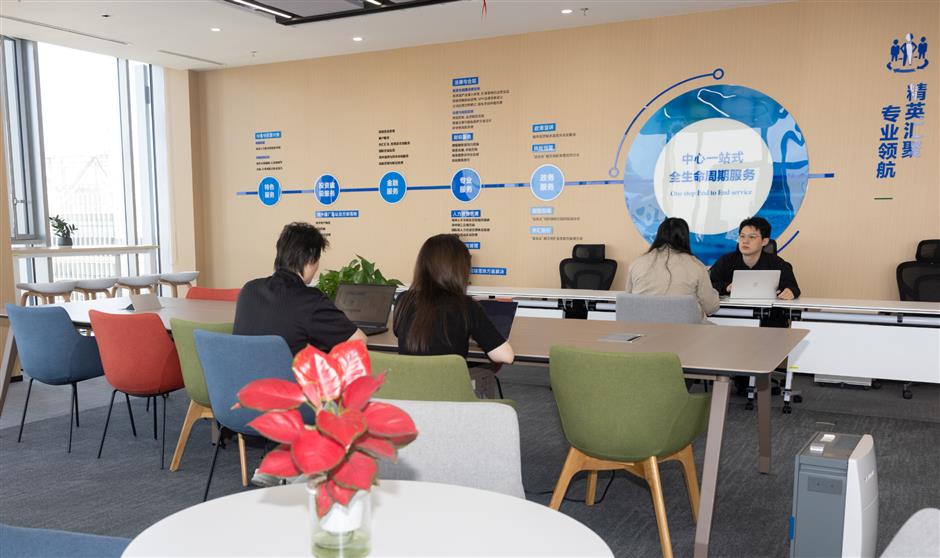
"Since our launch in March, we have provided one-on-one services to over 170 companies, closing more than 30 cases. Most of our clients are private firms with urgent international ambitions," said Wang Yue, general manager of the center. "We have built a network that can provide information on Europe, North and South America, Asia Pacific and the Middle East."
The advantages are already transforming corporate trajectories. The Shanghai YKC Corporation, a printed circuit board manufacturer with over 30 years of experience, stated that the center provided significant support for its investment in Thailand.
"It solved very complicated overseas direct investment paperwork with very rapid response, professional resolution, and in-time tracking," said Wu Jingqi, who oversees YKC's financial department.
Pudong has achieved significant advancements in frontier scientific research over the past five years.
One of the fine examples is Fudan University's Zhangjiang Campus, which focuses on frontier research in biomedicine, AI and brain technologies, including the first domestic institute dedicated to brain science and brain-inspired artificial intelligence.
Recently, Professor Feng Jianfeng and his team released the Digital Twin Brain platform, a full-brain-scale simulation platform capable of modeling 86 billion neurons and hundreds of trillions of synapses.
"The Digital Twin Brain platform can assist brain scientists in conducting digital experiments to explore and validate theories of neuroscience and the mechanisms underlying brain intelligence," said Feng.
"Our research is expected to solve many medical problems in the future, including understanding the mechanism of mental health issues and cognitive disorders and developing artificial intelligence based on how a real human brain works."

Editor: Liu Qi
In Case You Missed It...
![[China Maxxing] The Many Faces of the Moon: Mid-Autumn Festival for the World](https://obj.shine.cn/files/2026/09/17/2386eab0-ff31-4d0a-9a35-22c755948f93_0.jpg)
 Sep 18, 2026