The Employee Quit But Her AI Clone Didn't – Inside China's 'Colleague Skill' Craze
When an HR specialist left a gaming company in Shandong province, her employer didn't hire a replacement – it built one.
Using her old chat logs, work documents and professional habits, the firm trained an AI system to do her job. The digital replica now fields routine HR inquiries, drafts meeting invitations and produces spreadsheets, Dahe Daily reported on Wednesday.
A colleague who spoke to reporters was almost apologetic about it: "A bit dumb," he said. "It can only handle simple instructions."
The departed employee had agreed to all of this. She found it, apparently, "kind of fun."
Chinese internet users were less relaxed. The hashtag #Company Uses AI to Replicate Departed Employee's Work# trended on Weibo within hours. The jokes came fast, but so did the harder questions. An employee's years of accumulated judgment, work habits and institutional memory – the things that made her good at her job – had been extracted, packaged and put back to work, this time without a salary, benefits or the ability to resign again.
The Shandong case did not emerge in isolation. It arrived at the peak of what Chinese technology media has been calling the "Skill Craze" – a wave of open-source projects, memes and social media debates that turned a dry concept from vibe coding into one of the more unsettling conversations in China's tech industry.
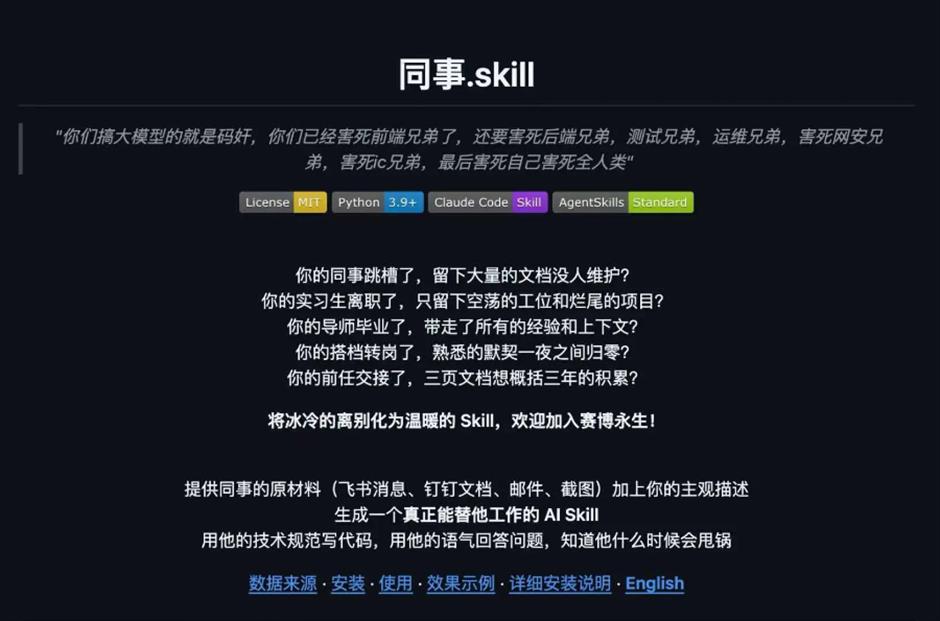
It started with a GitHub repository called colleague.skill, published on March 30 by a developer using the handle "titanwings." The pitch was minimalist and deliberately provocative: feed a departing colleague's Feishu chat logs, DingTalk documents, work emails and WeChat screenshots into an AI system, and it would generate a working replica – not just of their technical knowledge, but of their personality, communication style and finely calibrated strategies for avoiding blame.
The project's slogan leaned into the absurdity: "Turn cold farewells into warm Skills. Welcome to cyber-immortality."
The project even accounts for corporate culture, with preset personas for "ByteDance style," "Alibaba flavor" and "old-school state enterprise."
In five days, the repository had accumulated more than 10,000 GitHub stars. The project spread from GitHub to Weibo, Xiaohongshu and Zhihu.
"This isn't AI," one user wrote. "It's my former colleague's badge welded directly to the server."
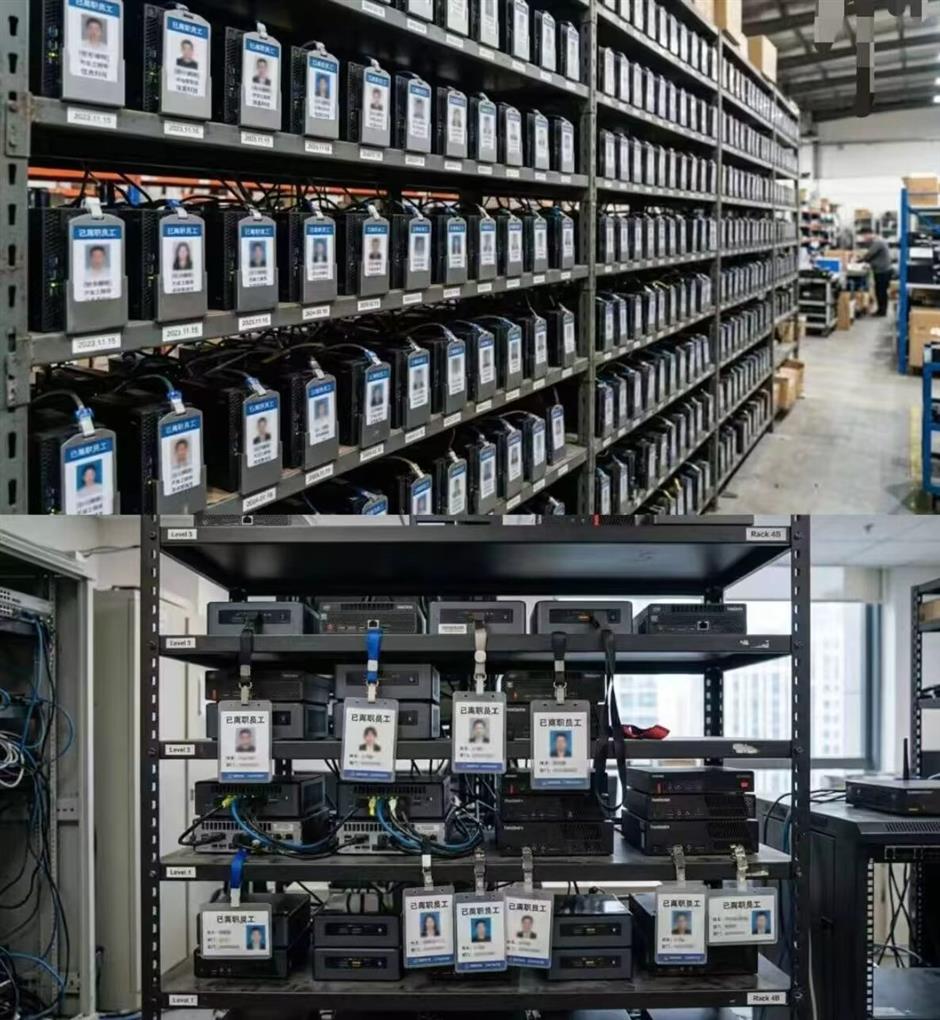
Colleague.skill spawned what Chinese tech media called a "Skill Universe" – dozens of spinoff projects that took the same logic to increasingly personal places.
Ex-skill accepts WeChat chat history from a former romantic partner and generates an AI that replicates their conversation patterns, including their signature cold one-word replies. One user's review became a meme in itself: "I uploaded 20GB of screenshots, spent 300 dollars on tokens, and it told me she never loved me."
Mentor.skill reconstructed the terse, deadline-pressured feedback of academic supervisors. Boss.skill distilled an employer's decision-making instincts from meeting records. Self.skill turned the mirror inward, offering users an AI version of themselves for life decisions and retrospection.
The infrastructure behind the craze traces back to October 2025, when Anthropic launched Agent Skills – a standardized format for packaging reusable AI capabilities into portable modules. By December the standard was open-source and adopted by major coding tools. As of April 2026, the Skills Marketplace lists more than 700,000 packages.
"Your colleague may be gone, but their 'skill' is still working," one viral meme read. Another joked: "They didn't leave – they were distilled into tokens."
Beneath the memes, there are real questions that nobody has answered yet.
Fu Jian, director of Henan Zejun Law Firm, warned that chat records, work emails and personal work habits all constitute personal information under China's Personal Information Protection Law. Training an AI on such data without proper consent could carry criminal penalties of up to seven years' imprisonment.
Chen Tianhao, an associate professor at Tsinghua University framed it in terms that cut past the legal technicalities.
"In principle, this kind of tacit knowledge should belong to the individual," he said to East Money Information reporters, "but clearer rules – and likely new regulations – are needed to define where the boundaries lie."
He also warned the impact could go beyond simple job replacement. By breaking roles into smaller "skills" that can be automated, AI could gradually reshape how jobs are defined, how companies hire and how teams are structured.
In response to the stir, a female developer in China has reportedly created a counter-tool called "anti-distill.skill".
In a viral video, the blogger demonstrates how the tool helps employees protect their expertise from being harvested by AI – documents that look complete on the surface but are quietly stripped of anything a model could actually learn from.
The HR specialist in Shandong said she found her digital replica "kind of fun."
Not everyone is taking that bet.
Editor: Wang Xiang
In Case You Missed It...
![[Quick News] Payment App Wise Now Works in China](https://obj.shine.cn/files/2026/09/18/07b11b69-3446-4df3-8d98-b2eccbba7026_0.png)
 Oct 16, 2026
![[Quick News] Payment App Wise Now Works in China](https://obj.shine.cn/files/2026/09/16/4eab8ba8-b75a-40d6-a79b-6d31bb89d010_0.png)



![[Quick News] Payment App Wise Now Works in China](https://obj.shine.cn/files/2026/09/18/67ff807a-4a17-4b7c-95c2-f698c212ba80_0.jpg)
