Digital Technology Drives Development of Oral Orthodontics in China
Cutting-edge artificial intelligence, 3D facial reconstruction, computer-aided design and other advanced digital technologies are making breakthroughs in the field of oral orthodontics in China.
These technical means are breaking the limitations of traditional experience-based diagnosis and treatment, empowering orthodontists to formulate more precise, personalized and predictable diagnosis and treatment plans, and bringing a revolutionary transformation to the prevention and standardized treatment of malocclusion, a major global oral disease.
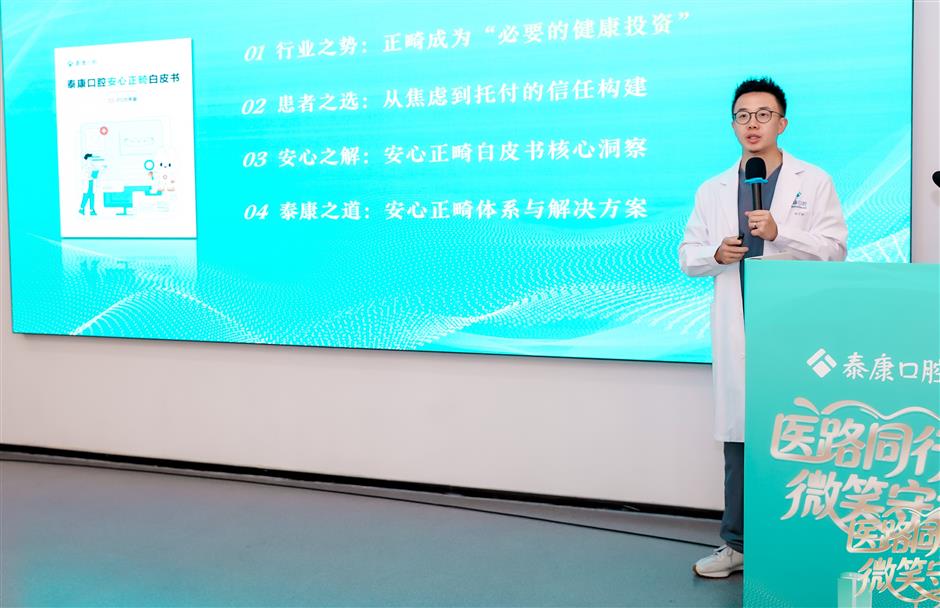
Against the backdrop of the high prevalence of malocclusion in China and the huge gap between treatment demand and penetration rate, the deep integration of AI and digital orthodontic technology is not only solving industry dilemmas such as the shortage of professional medical resources and unbalanced regional supply, but also opening up a new path for accurate orthodontic diagnosis and treatment, early intervention for children and adolescents, and standardized development of the industry, injecting strong technical impetus into the high-quality development of China's orthodontic industry, according to an industry white paper released by Taikang Bybo Dental in Shanghai.
Malocclusion is recognized by the World Health Organization as a major oral disease. According to the WHO, around half of the global population suffers from malocclusion requiring orthodontic intervention. The issue is particularly prominent in China.
Data from the 4th National Oral Health Epidemiology Survey shows that the prevalence of malocclusion in China reaches as high as 72 percent, translating to over 1 billion people with varying degrees of dental misalignment, occlusal disorders or jaw relationship abnormalities.
The prevalence of malocclusion varies across age groups. It is 30 to 50 percent for children in primary dentition, over 71 percent for children in mixed dentition, 60 to 70 percent for adolescents and 50 to 60 percent among adults.
Data also indicates that the mixed dentition stage (around 6-12 years old) is a critical period for the development of malocclusion and the optimal window for early orthodontic intervention.
"Despite the enormous demand base, the penetration rate of orthodontic treatment in China remains relatively low," said Dr Xu Ziqing of Taikang Bybo Dental.
Data showed about 3.7 million orthodontic cases were completed in China in 2022, representing a penetration rate of merely 0.36 percent by total population – far below the United States rate of about 2 percent in the same period.
Penetration in early orthodontic treatment for children is even more inadequate. The 2025 China Children Early Orthodontics Trend Report shows that the early intervention rate for childhood malocclusion in China is only 0.95 percent.
"China's orthodontics market is defined by three core features: high prevalence, low treatment penetration and strong growth potential. The gap between the massive patient pool and low treatment coverage reflects immense opportunities, while also highlighting challenges in professional medical resource supply and public health education," Xu said.
Statistics from the Orthodontics Committee of the Chinese Stomatological Association show that fewer than 10,000 dentists in China have received standardized professional orthodontic training. Nationwide, there are fewer than 0.7 qualified orthodontists per 100,000 population.
In comparison, data from the American Dental Association in 2018 recorded 10,658 orthodontists in the US, equivalent to 3.27 specialists per 100,000 people – 4.67 times the figure in China.
Compound specialists with dual expertise in pediatric dentistry and orthodontics are particularly scarce. Given the childhood and adolescent malocclusion prevalence of 67.82 percent, the shortage of early intervention professionals directly hinders the healthy development of this sector.
Orthodontic specialists are highly concentrated geographically. Most practitioners are based in first-tier cities such as Beijing, Shanghai, Guangzhou and Shenzhen, as well as developed eastern coastal regions. High-quality orthodontic resources are severely lacking in central and western areas and grassroots county-level regions. This regional imbalance makes standardized orthodontic care inaccessible to a large number of patients, especially residents in grassroots areas.
Deep integration of AI and digital technology is reshaping orthodontics and offering solutions.
In treatment planning, big data-powered AI systems assist doctors in delivering more precise therapeutic design. The combination of 3D imaging, 3D printing and AI is driving orthodontic diagnosis and treatment from experience-based practice toward data-driven precision care. Software design and mass 3D printing have become the standard manufacturing workflow for clear aligners, forming a closed digital loop that underpins efficient, high-precision industry development.
Experts said orthodontics will further improve accuracy and predictability through AI-driven treatment plans, expand indications covering complex clinical cases and all age groups, and offer higher diagnostic and treatment efficiency enabled by accelerated digital integration.
Editor: Liu Qi