From Dragon Boats to Dragons: Navigating the Translation of Chinese Cultural Icons
As the Duanwu (端午 Dragon Boat Festival) holiday approaches, dragon boats will once again slice across rivers from Shanghai to Boston, and from Guangzhou to Vancouver. What began as an ancient Chinese folk ritual has evolved into a global sporting phenomenon, featuring as a demonstration event in recent Olympic Games and set to become an official competition at the 2025 World Games, which will be held in Chengdu, Sichuan Province, from August 7 to 17.
Yet, even as dragon boat racing conquers the globe, a quieter debate continues to ripple beneath the surface: How should China translate its most culturally distinctive terms into English? This question is far more than a linguistic puzzle; it touches upon national identity, cultural confidence, and the delicate balance between being universally understood and remaining authentically Chinese.
Consider the festival itself, which falls on June 19 this year.
In May 2026, The Denver Post described dragon boat racing as a tradition "dating back thousands of years to China's Duanwu Festival." Notably, the American publication opted for Duanwu Festival over the far more familiar Dragon Boat Festival – a translation long accepted as standard English and enshrined in major dictionaries.
This was no isolated choice. Britain's Daily Express, reporting on a Qing Dynasty (1644-1911) bridge collapse tied to the holiday, similarly used Duanwu Festival. Meanwhile, in 2025, The Atlantic, an American political magazine, employed both forms side by side: "Dragon Boat Festival, also known as Duanwu Festival."

While corpus data still shows Dragon Boat Festival as overwhelmingly dominant, the rise of Duanwu Festival is hardly accidental. It reflects a broader trend in translating culturally specific Chinese terms: a growing preference for transliteration – preserving the original phonetics rather than replacing them with culturally adapted equivalents.
This debate has grown even more intense around another iconic symbol: 龙 (long).
For generations, "dragon" seemed the obvious, unquestioned translation. Chinese-English dictionaries treated the pairing as automatic, and the language of global culture followed suit: dragon boat, Dragon Boat Festival, dragon dance, dragon fruit. All are firmly entrenched in mainstream English.
Yet critics have long argued that this translation carries significant cultural baggage.
In Western mythology, dragons are often monstrous creatures associated with chaos, greed and evil. Heroes slay them; saints conquer them. They are symbols to be feared, not revered. China's 龙, by contrast, embodies auspicious power, vitality, imperial authority and harmony with nature.
To many scholars and cultural commentators, translating 龙 as "dragon" amounts to importing centuries of Western negative imagery onto a fundamentally different Chinese symbol. Their proposed solution is transliteration: long – or, in some variants, loong – a distinct linguistic marker for a distinctly Chinese creature.
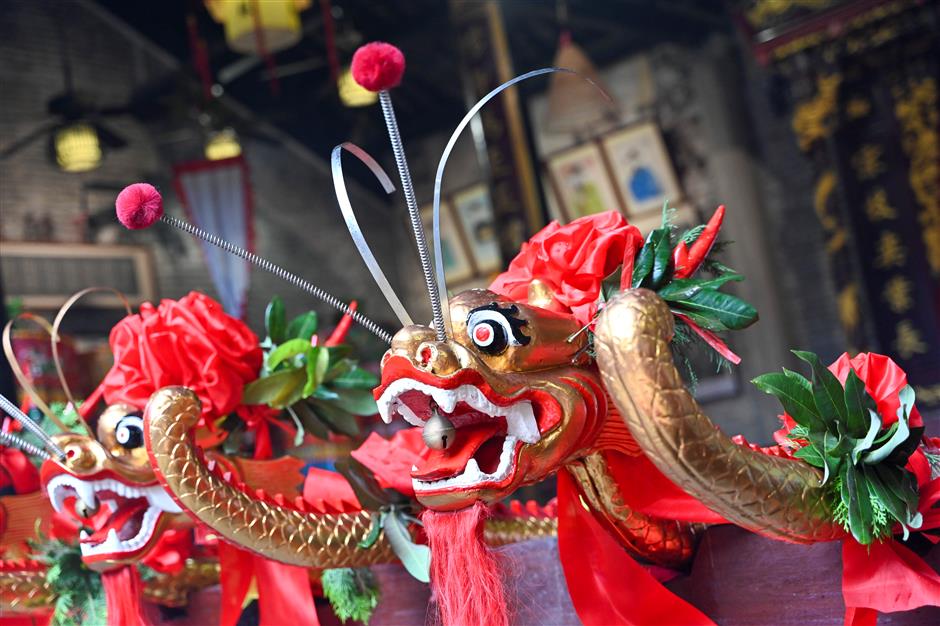
The argument carries considerable weight. After all, transliteration is hardly unusual in global English. Sushi remains sushi; kung fu remains kung fu; tai chi was never converted into "supreme ultimate boxing." Why, advocates ask, should the Chinese dragon alone be forced into a Western conceptual mold?
Yet language evolves less through academic decree than through organic cultural usage. And while intellectuals debate, the English word "dragon" itself has been quietly shifting.
Major dictionaries have already begun to reflect this evolution. The Merriam-Webster Unabridged Dictionary, for instance, now includes a distinct sense for dragon, defining its Eastern counterpart as a "beneficent supernatural creature in Chinese mythology connected with rain and floods." It also preserves the older Wade-Giles transliteration lung (now long in Pinyin), cross-referencing it to this specific Chinese context.
The New Oxford Dictionary of English similarly draws a distinction: in European tradition, the dragon is typically a fire-breathing symbol of chaos or evil, whereas its East Asian counterpart is usually a beneficent symbol associated with water, fertility and the heavens.
Even more revealing is the Oxford English Dictionary, which notes that by the 1980s, dragon had acquired a new metaphorical meaning: the "little dragons" of East Asia. The dictionary explicitly traces the term to Chinese cultural symbolism, where the dragon represents imperial prestige and vitality.
Meanwhile, encyclopedias such as Britannica and Wikipedia now devote extensive entries to the "Chinese dragon" or long, treating it not as a variant of a Western monster, but as a cultural symbol in its own right.
All of this points to a larger truth: Language is alive. Meanings shift. Cultural boundaries blur. Words once burdened with negative associations can acquire new dimensions through contact, context and repetition.
So, where does that leave China's translation dilemma?
A balanced approach may be the wisest path forward.
First, there is little reason to abandon "dragon" entirely. In English-speaking contexts, the term has already accumulated decades of association with Chinese culture. Through sustained exposure, many readers now instinctively recognize that a Chinese dragon is fundamentally different from its European counterpart.
Second, context is key. When clarity or cultural distinction is paramount, "Chinese dragon" provides a useful middle ground – familiar enough to be immediately understood, yet specific enough to avoid conflation.
Third, transliteration deserves serious consideration. Terms such as long or loong carry cultural autonomy and symbolic confidence. They signal that certain concepts should not be fully absorbed into preexisting Western categories. Over time, with consistent usage and careful contextualization, such terms may establish themselves naturally in the English lexicon.
The deeper issue is not simply what China should call its dragon, but how a civilization chooses to present itself to the world. That evolution may ultimately matter more than any single word choice. Because in the end, languages do not belong to dictionaries or scholars alone. They belong to the people who speak them, reshape them, and carry them across borders.
(The author, who earned a PhD in linguistics at the University of Illinois Urbana-Champaign, is a professor of English and college dean at Sanda University, Shanghai.)
Editor: Liu Qi
![[Big News] Have Korean Friends? CNS Korea Launches TODAY!](https://obj.shine.cn/files/2026/06/16/8019f88c-a0ea-4f3c-9886-e9f83264e535_0.jpg)