[Hai Streets] Did You Know You Can Shop Duty Free on Nanjing Road?
Hai Streets is our semi-regular column on Shanghai's great commercial arteries. From Nanjing Rd East's blend of heritage storefronts and pop-culture malls to Huaihai's luxe lanes and Hongqiao's international cultural diversity hubs, we explore how Shanghai's commercial hubs drive billions in sales and shape the city's identity – where commerce, culture and history collide in neon, nostalgia and nonstop foot traffic.
Walk Nanjing Road W. on any afternoon and you'll see what you expect: glass, controlled light, logos that cost more than the buildings they're mounted on. Louis Vuitton, Cartier, Gucci, Chanel. The storefronts gleam. The foot traffic moves with purpose. It could be Paris. It could be Milan. It could be anywhere money pools in the same careful configurations.
To know why Nanjing Road W. matters, you have to know what it was before the glass arrived, before the neon hum, before the brands claimed every corner. You have to know the street by its first name.
![[Hai Streets] Did You Know You Can Shop Duty Free on Nanjing Road?](https://obj.shine.cn/files/2025/12/01/4e03cafc-b617-4b21-b211-177da645e6cc_0.jpg)
A Street Born from the Racecourse
Bubbling Well Road. That was the name, borrowed from a spring that ran near Jing'an Temple long before anyone thought to build anything taller than a tree here.
The British came in the mid-19th century and threw up a racecourse. A wide carriage road materialized to serve it, one of Shanghai's first proper Western-style boulevards, and what started as a route to horses and gambling became something larger: a rehearsal space where the city learned to speak modernity.
Rebellion elsewhere meant refuge here. Refugees poured into the foreign concessions, land prices climbed like steam, and villas went up behind iron gates. English gardens took root. Deep verandas opened to the light. Bubbling Well Road became a garden suburb.
![[Hai Streets] Did You Know You Can Shop Duty Free on Nanjing Road?](https://obj.shine.cn/files/2025/12/01/3649bae4-12a6-48fe-bcef-3c246845e2f0_0.jpg)
![[Hai Streets] Did You Know You Can Shop Duty Free on Nanjing Road?](https://obj.shine.cn/files/2025/12/01/eea3b559-09cf-4cab-98e6-f3dbefa37542_0.jpg)
![[Hai Streets] Did You Know You Can Shop Duty Free on Nanjing Road?](https://obj.shine.cn/files/2025/12/01/86f5d484-5107-4e2e-bd44-fb5345f159ab_0.jpg)
![[Hai Streets] Did You Know You Can Shop Duty Free on Nanjing Road?](https://obj.shine.cn/files/2025/12/01/e02821f9-ad99-4d54-86d1-f55f8e4c0097_0.jpg)
Then the street changed its mind.
By the 1920s, horses gave way to automobiles. Neon began its hum. Mansions receded; apartment blocks and commercial faces crowded in closer, pressing the street into density. In 1934, the Park Hotel rose at the eastern end, tallest building in Asia at the time, and it announced something definitive: Shanghai had arrived as a modern city. The buildings around it spoke two languages at once, Chinese modernist restraint married to European geometry. Gardens disappeared. Verandas became balconies. Carriage drives became traffic. What came alive after dark was different. Dance halls. Cinemas. Cafés that held conversations into the evening. This western stretch, compared to the boisterous churn of Nanjing Road E., had learned a quieter ambition. It aspired upward, not outward. It wanted to be refined.
![[Hai Streets] Did You Know You Can Shop Duty Free on Nanjing Road?](https://obj.shine.cn/files/2025/12/01/11c808ed-7b2d-4b5c-996a-0705385e3b18_0.jpg)
Blueprint for a New Boulevard
What Nanjing Road W. became was not accident. It was decided.
October 1992. Shanghai was clawing its way back into the global economy, and city officials called in the planners, the economists, the foreign money, the architects. They gathered to argue not just about design but about destiny: What does this boulevard need to become in a China that's finally open? The answer came back decisive and clear. Not a relic. Not a conventional retail strip. A high-density, internationally oriented commercial and business corridor, capable of pulling in landmark projects and global corporations. The kind of place that makes other cities jealous.
Block-wide redevelopment replaced incremental patching. Entire parcels could be torn down and reconfigured. A second forum in 1995 sharpened the vision further. Commercial and business functions would coexist, reinforce each other. Luxury retail, Grade-A office space, high-end hotels. An ecosystem that fed itself.
And then there was the philosophy underneath it all. The government would set the rules and get out of the way. Create clarity. Let capital and enterprise move freely. It worked. In the early wave of redevelopment, foreign investment dominated. It was the money that built the boulevard, not municipal ambition alone.
The street was no longer making it up as it went. It was designing itself into being.
![[Hai Streets] Did You Know You Can Shop Duty Free on Nanjing Road?](https://obj.shine.cn/files/2026/02/13/d57eead6-4629-4597-a703-bbe4781906da_0.jpg)
The 'First-Store Economy' Revolution
Plaza 66. CITIC Plaza. Westgate Mall. By the late 1990s and early 2000s, these projects reshaped the skyline, and international luxury brands discovered something useful: Density creates gravity. In luxury retail, proximity doesn't dilute prestige. It amplifies it. Suddenly everyone wanted to be here, which made everyone else want to be here more.
The competition shifted. It wasn't about who could open a store anymore. It was about who could open first.
Shanghai started calling it the "first-store economy," and what that meant in practice was this: global launches, Asian premieres, flagship experiences that turned retail into cultural event. Brands competed not on inventory but on arrival. The street became a stage for debuts, and debuts became reasons to show up.
Within 1.8 square kilometers, more than 2,000 brands now operate, over 70 percent international. Jing'an welcomed more than 200 new first stores in a single recent year, multiple global and regional premieres among them. The numbers were almost beside the point. What mattered was the principle: If you wanted to announce yourself to the world, you announced yourself here.
![[Hai Streets] Did You Know You Can Shop Duty Free on Nanjing Road?](https://obj.shine.cn/files/2025/11/28/bf78c910-c0b5-4532-8283-6daf58b88526_0.jpg)
LVMH, Kering, Richemont. The luxury conglomerates come here to unveil what they want the world to see: concept stores, cultural installations, the kind of experiences that turn a boutique into a statement.
In 2025 alone, 238 new first stores opened in Jing'an. The district ranked first citywide. Global debuts landed here. Asian and Chinese market premieres launched here. The numbers accumulate, but they're less interesting than the pattern they describe.
Since 2021, the district has absorbed 991 first stores total. Some have become nationally recognized consumption hotspots. Some are globally recognized now. The street rewrites itself constantly, and each rewrite erases the previous one.
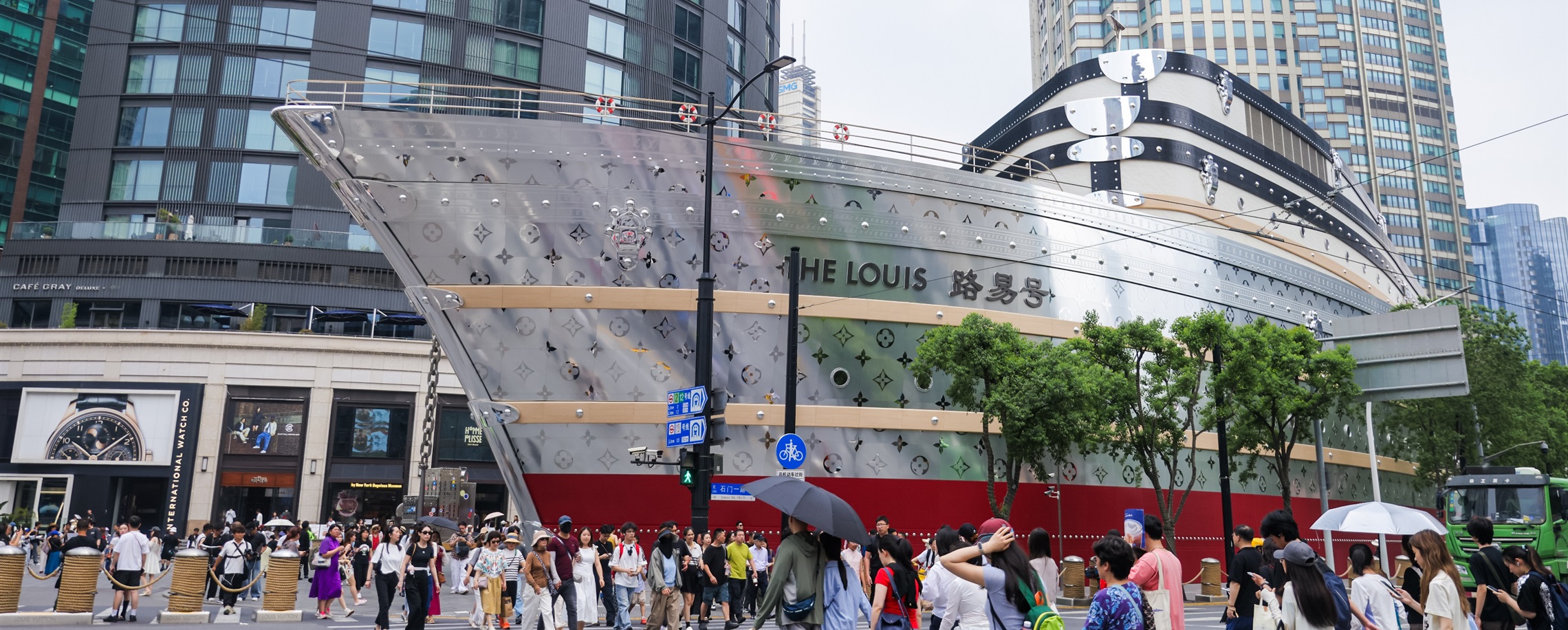
But certain projects linger in memory. Prada opened its first stand-alone restaurant in Asia at Rong Zhai, that century-old building, and the gesture mattered: a century-old house receiving a contemporary occupation. Gucci took its bamboo mythology and turned it into a global exhibition. And then there's the Louis Vuitton Voyager, 114 meters of vessel-like architecture anchored in the middle of the street, which became what it was designed to become: a pilgrimage site for anyone who needed to be seen standing in front of it.
![[Hai Streets] Did You Know You Can Shop Duty Free on Nanjing Road?](https://obj.shine.cn/files/2026/01/15/ef52cfc8-5cbb-47a7-9469-ee998b96ccf4_0.jpg)
Each launch event now doubles as spectacle. Moncler's Genius fashion show turned the street into a runway and moved nearby store sales up nearly 40 percent. Celine's five-week global debut pulled in 15,000 visitors. Overseas shoppers showed up in unexpected numbers. The surge in sales came from somewhere, and that somewhere had a name: instant tax refunds.
Yes, You Can Shop 'Duty Free' Outside the Airports
Just off the main boulevard, in the freshly restored Zhangyuan, history and commerce have worked out their arrangement again. The shikumen (stone-gated) alleys that once held families and small factories have been reborn as Shanghai's first downtown tax-free demonstration zone.
![[Hai Streets] Did You Know You Can Shop Duty Free on Nanjing Road?](https://obj.shine.cn/files/2026/01/15/e085cab5-a828-48e1-83a3-8d01a098220a_0.jpg)
![[Hai Streets] Did You Know You Can Shop Duty Free on Nanjing Road?](https://obj.shine.cn/files/2026/01/15/055012e5-3d87-4a34-b6cf-556c91912982_0.jpg)
"Instant refund" is not marketing hyperbole here. It is a promise the system actually keeps. A jet-lagged shopper, latte in hand, buys a designer handbag, shows a passport, and within 10 minutes walks out with the tax rebate in cash. Then moves to the next boutique. The efficiency has reached the point where the district's working slogan is, "a tax-free shop every 2 meters."
![[Hai Streets] Did You Know You Can Shop Duty Free on Nanjing Road?](https://obj.shine.cn/files/2026/02/24/66e39571-d858-419f-b548-53aad6adc7e1_0.png)
More than 800 retailers across Jing'an now offer duty-free services. The network expands. The goal is a five-minute tax-refund circle throughout the district. Over 100 stores provide instant refunds already. Plans exist to grow to 1,000 participating outlets and 500 instant-refund points. The infrastructure is being built to make refunds frictionless.
The numbers tell the story. In 2025, Jing'an's tax-refund sales increased 60 percent year on year. Instant-refund sales rose more than thirteenfold. Overseas shoppers arrived from 87 countries and regions. The Louis Vuitton Voyager installation pulled them in; they spent money; the system captured it. Cross-border consumption surged because the bureaucracy got out of the way.
At Zhangyuan's Sisley boutique, an Italian tourist bought 5,000 yuan (US$727.6) worth of skincare. She walked out with the products and 450 yuan in cash. She spent it immediately at a nearby artisan gift shop. That's the system working. That's the circle closing.
![[Hai Streets] Did You Know You Can Shop Duty Free on Nanjing Road?](https://obj.shine.cn/files/2026/02/13/4204a0fa-0cc7-468e-9817-92d383ba71d2_0.jpg)
Plaza 66 and Réel have added multilingual concierge services, luggage storage, on-site repair studios. The infrastructure expanded to serve the international shopper completely, removing every reason to leave.
The result is a model that works. "Shop global, refund local." Shanghai has turned it into soft power, proof that the city's ambition to become a global consumption capital is not rhetorical. It is executable. It is real.
![[Hai Streets] Did You Know You Can Shop Duty Free on Nanjing Road?](https://obj.shine.cn/files/2026/02/13/18573671-e62d-4a62-ad00-f8fd2dd11666_0.jpg)
The Soul of Modern Shanghai
And yet the past does not leave. Step off the main boulevard, away from the LED and the launches, and incense drifts from Jing'an Temple, the same temple that gave Bubbling Well Road its name more than a century ago. Old sycamores still shade the sidewalks where chauffeurs once waited beside Bentley doors. The city rewrote itself, but it did not erase.
What makes Nanjing Road W. extraordinary is not the scale or the spending. It is the continuity. The street has always been Shanghai: worldly, adaptable, always reaching for what comes next, yet somehow still rooted in what came before. It reinvents itself constantly. It never forgets itself. That is the real luxury.
![[Hai Streets] Did You Know You Can Shop Duty Free on Nanjing Road?](https://obj.shine.cn/files/2026/02/13/67badd4b-f720-4bc7-9f36-9b40183b79e2_0.jpg)
Night falls. The shop windows glow. A tourist gets her tax refund receipt and walks out satisfied. A local designer opens his first concept store. The city moves forward, impatient as always, certain of what comes next.
From horse races to luxury runways. From Bubbling Well to the world stage. Nanjing Road W. is Shanghai performing modernity, endlessly, without apology. It is what the street does.
Editor: Shi Jingyun
![[Health Byte] Shanghai's First Bad Breath Clinic Opens in Huadong Hospital](https://obj.shine.cn/files/2026/05/25/0cc5059c-33fe-41d9-9efd-e5e8339dec54_0.jpg)
![[Explainer] China Visa-Free Entry Explained: FAQs on Eligibility, Rules and Stay Duration](https://obj.shine.cn/files/2026/05/25/ab25b6fd-8014-4709-b3e1-07fc9acadcfb_0.jpg)