A Big Leap in Chinese Autonomous Driving Has Arrived, With Caveats
At last week's annual session of Shanghai lawmakers and political advisers, Sun Yin, chairman of the Eastern Hongqiao Group, called for an area in Changning District to become a standardized pilot zone for a "closed-loop" model of autonomous driving.
"There should be clear operational guidelines, a set of detailed rules for commercial self-driving vehicles and one-stop services for approvals and oversight so that companies don't have to jump through multiple hoops," he said.
"We need to build a smart tracking platform for these vehicles that would monitor cars in real-time, assign IDs and flag potential safety risks," he went on. "That would allow both the district and city governments to work together to keep the streets safe."
Sun's proposal is timely. It comes two months after China fundamentally rewrote the rules of the road pertaining to autonomous driving.
For years, the global autonomous driving industry has been stuck in a loop of technological "almost," but things changed in December when China began granting Level-3 licenses to carmakers. That designation refers to vehicles with sensors that can detect the driving environment and can make informed decisions such as passing a slow vehicle. But they still require human override, where drivers must be alert and ready to take control if the automated system fails to execute a task.
L3 autonomous driving trials are currently underway in cities such as Shanghai, Beijing, Chongqing and Wuhan.
In Shanghai, for example, trials are permitted throughout Pudong, covering busy areas such as Zhangjiang High-Tech Park and the World Expo site. This sprawling network now spans more than 580 roads, covering more than 750 kilometers.
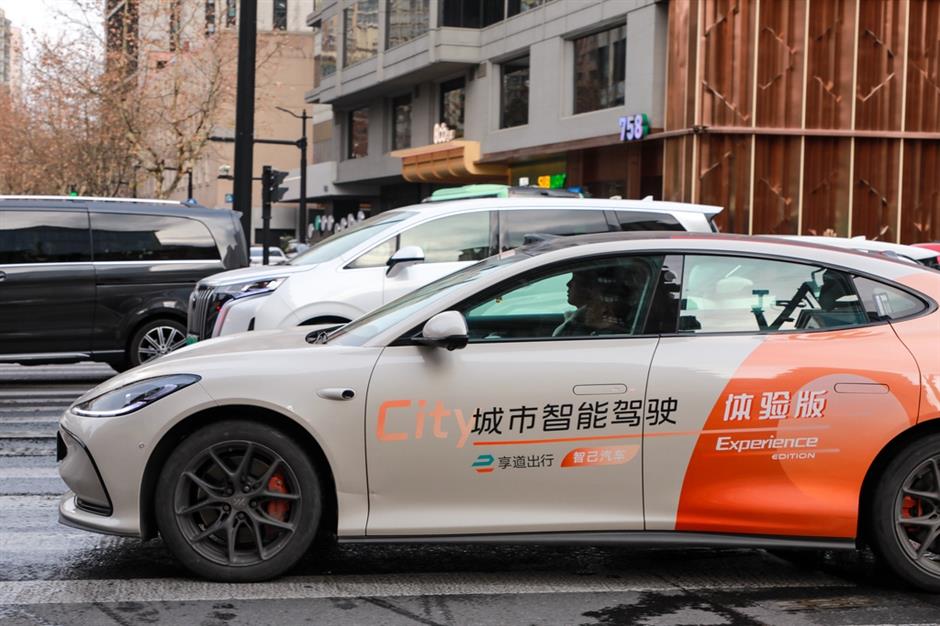
But a closer look reveals the many limitations. Within these designated zones, only vehicles from licensed brands, such as BMW and IM Motors, are permitted to navigate high-speed roads and urban expressways in the L3 mode. And they are only allowed to operate at speeds of 80 kilometers an hour or less on clear days. The trials are also open only on arterial roads without any unexpected conditions like road works.
But hurdles still face deployment of Level 3 driving. Technology is certainly not the problem. Many Chinese carmakers have either received L3 licenses or announced the mass production of L3 vehicles: Voyah, a brand under Dongfeng Motor Group, is set to lead the pack in March with the launch of the Taishan Dark Knight, a specialized SUV featuring Huawei's advanced four-laser sensor suite. Industry heavyweights like XPeng, Zeekr, BYD and Nio are all racing to fine-tune their own automotive software to meet strict safety regulations.
The true challenge lies with regulation, especially determination of accident liability.
In June 2025, new regulations were adopted codifying what happens if an accident occurs while an L3 system is at the controls. The rules stipulate that if the automated system is active, the carmaker bears prime responsibility. Drivers are liable only if they fail to respond when the system requires them to take over the controls.
However, this regulation is still a framework, with further details yet to be fleshed out. If an accident occurs, can objectivity be assured when automakers store and analyze vehicle logs? How can a driver prove that the L3 system failed? And if the accident involves criminal liability, who would be fined or sentenced: the driver, the automaker or automaker employees?
Gong Min, head of China Autos Research at UBS, said that once L3 autonomy is introduced, determining whether the driver or the automaker is liable depends entirely on whether the specific operating conditions were met at the moment of the accident.
"This inevitably opens the door to heated disputes between users and manufacturers," Gong said. "In a complex environment, automakers may worry about bad-faith actors or competitors intentionally 'trapping' the system to create trouble. These gray areas are incredibly difficult to clarify. For companies, these disputes represent a massive burden – not just in legal terms but also in potential damage to brand reputation."
Even if the laws are clarified, a challenge still exists bridging the gap between "legal to drive" and "profitable to operate," and that can prove expensive. To support true L3 autonomy, cities need "smart" roads capable of communicating directly with vehicles – the so-called vehicle-road-cloud integration.
Constructing this digital infrastructure is costly. Take Beijing as an example. Data from the capital's project for infrastructure integration show costs as high as 4 billion yuan (US$564 million). The project aims to cover 6,050 intersections across 12 districts.
Currently, the bill is being almost exclusively footed by governments. But as they build the "hardware" of the infrastructure, automakers have been slow to integrate their proprietary data into these public platforms, creating information silos. Without a clear return on investment, the commercial loop remains broken.
In the near term, Level 3 autonomous driving will primarily focus on sectors such as robotaxis and public transit rather than individual motorists because commercial operators possess better legal and insurance systems to manage the complex liability risks. Commercial testing in approved corridors also gives more time for infrastructure analysis and improvement.
Once all the kinks are ironed out and risk assessment clarified, the self-driving realm will move to private motorists. Ahead lie Level 4, which shifts more driving responsibility from man to machine, allowing vehicles to automatically intervene if there is a system failure; and then the top Level 5, where full-driving automation doesn't require any human attention.
In Case You Missed It...
![[Hai Streets] A Photo-Worthy Walk Through Nanjing Rd W's Most Iconic Design & Lifestyle Spots](https://obj.shine.cn/files/2026/03/23/e1f1afed-2b55-4320-8e55-7d235f6ee511_0.jpg)
 Apr 7, 2026
![[Hai Streets] A Walk Through Shanghai's Most Glamorous Fashion Avenue](https://obj.shine.cn/files/2026/03/19/1bbbbd3d-2084-4027-af7c-b58b8db79026_0.jpg)

Popular Reads
![[Expats & Ailments] Quick Response Saves A Spanish Traveler's Vision in Shanghai](https://obj.shine.cn/files/2026/04/03/22563955-4c87-47fc-98dc-7974e2f66bb9_0.jpg)
[Expats & Ailments] Quick Response Saves A Spanish Traveler's Vision in Shanghai

Training Center Files Police Report Over Cyberbullying Targeting Diving Champion Quan Hongchan

How to Stay Bite-Free as Mosquito Season Arrives Early in China
![[China Tech] Shanghai Chest Hospital Shares Its Expertise in Treating Esophageal Cancer](https://obj.shine.cn/files/2026/04/03/80213380-d491-426c-94a5-a2e4a5e3986c_0.jpg)
